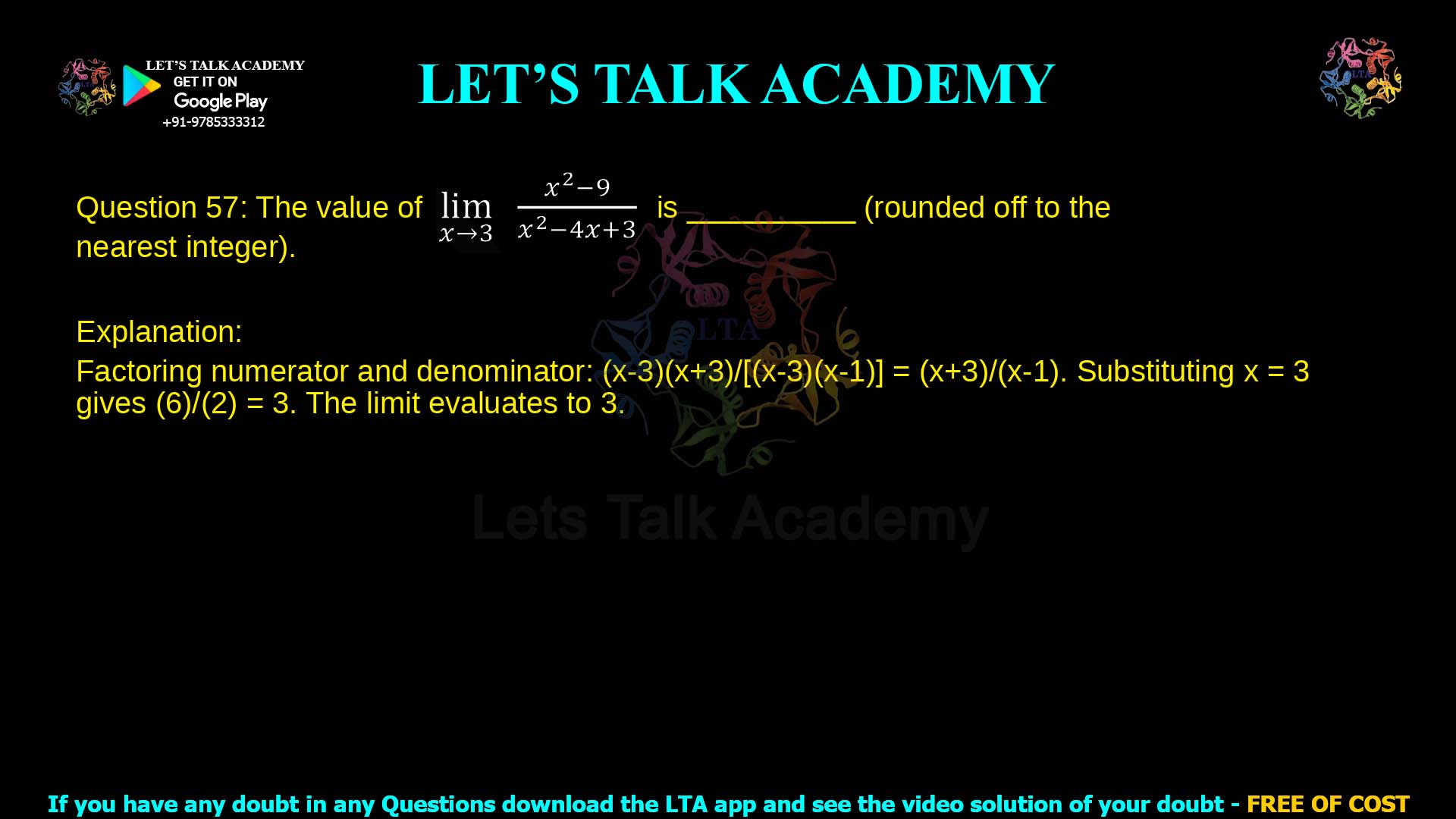
Q.57 The value of lim 𝑥2−9/𝑥2−4𝑥+3 is __________(rounded off to the nearest integer).
x–>3
The limit as x approaches 3 of (x² − 9)/(x² − 4x + 3) is a classic calculus problem that tests understanding of factoring, cancellation of common factors, and evaluating limits of rational functions. Solving this limit carefully avoids the 0/0 indeterminate form and shows how algebra simplifies limit evaluation .
Step-by-Step Solution
Consider \(\lim_{x \to 3} \frac{x^2 – 9}{x^2 – 4x + 3}\).
Direct Substitution
Denominator: \(x^2 – 4x + 3 = 3^2 – 4 \cdot 3 + 3 = 9 – 12 + 3 = 0\)
The expression becomes \(\frac{0}{0}\), an indeterminate form, so algebraic simplification is required .
Factor Numerator and Denominator
Numerator \(x^2 – 9\) is a difference of squares: \(\frac{x^2 – 9}{(x^2 – 4x + 3)} = \frac{(x-3)(x+3)}{(x^2 – 4x + 3)}\).
Denominator \(x^2 – 4x + 3\) factors as: \(x^2 – 4x + 3 = (x-3)(x-1)\).
Cancel Common Factor
For \(x \neq 3\), cancel the common factor \((x-3)\): \(\frac{(x-3)(x+3)}{(x-3)(x-1)} = \frac{x+3}{x-1}\).
The limit of the original function as \(x \to 3\) equals the limit of the simplified function \(\frac{x+3}{x-1}\) as \(x \to 3\) .
Evaluate Simplified Limit
Therefore, \(\lim_{x \to 3} \frac{x^2 – 9}{x^2 – 4x + 3} = 3\).
Conceptual Explanation
- Why factoring? Factoring exposes common factors causing the 0/0 form at x=3; cancelling removes the removable discontinuity.
- Why cancellation allowed? In limits, only behavior near the point matters, not the function value at x=3.
- Simplified function continuity: \(\frac{x+3}{x-1}\) is continuous at x=3 where denominator ≠ 0 .
Multiple-Choice Analysis
Common options: (A) 0 (B) 1 (C) 2 (D) 3
- 0 or 1: From direct substitution ignoring 0/0 form.
- 2: Algebraic error in factoring or substitution.
- 3 (Correct): Proper factoring, cancellation, substitution .
Key Takeaways
- Always test direct substitution first to detect 0/0 forms.
- For rational functions, factor and cancel common factors before L’Hôpital’s Rule.
- Simplified continuous functions allow direct substitution .


