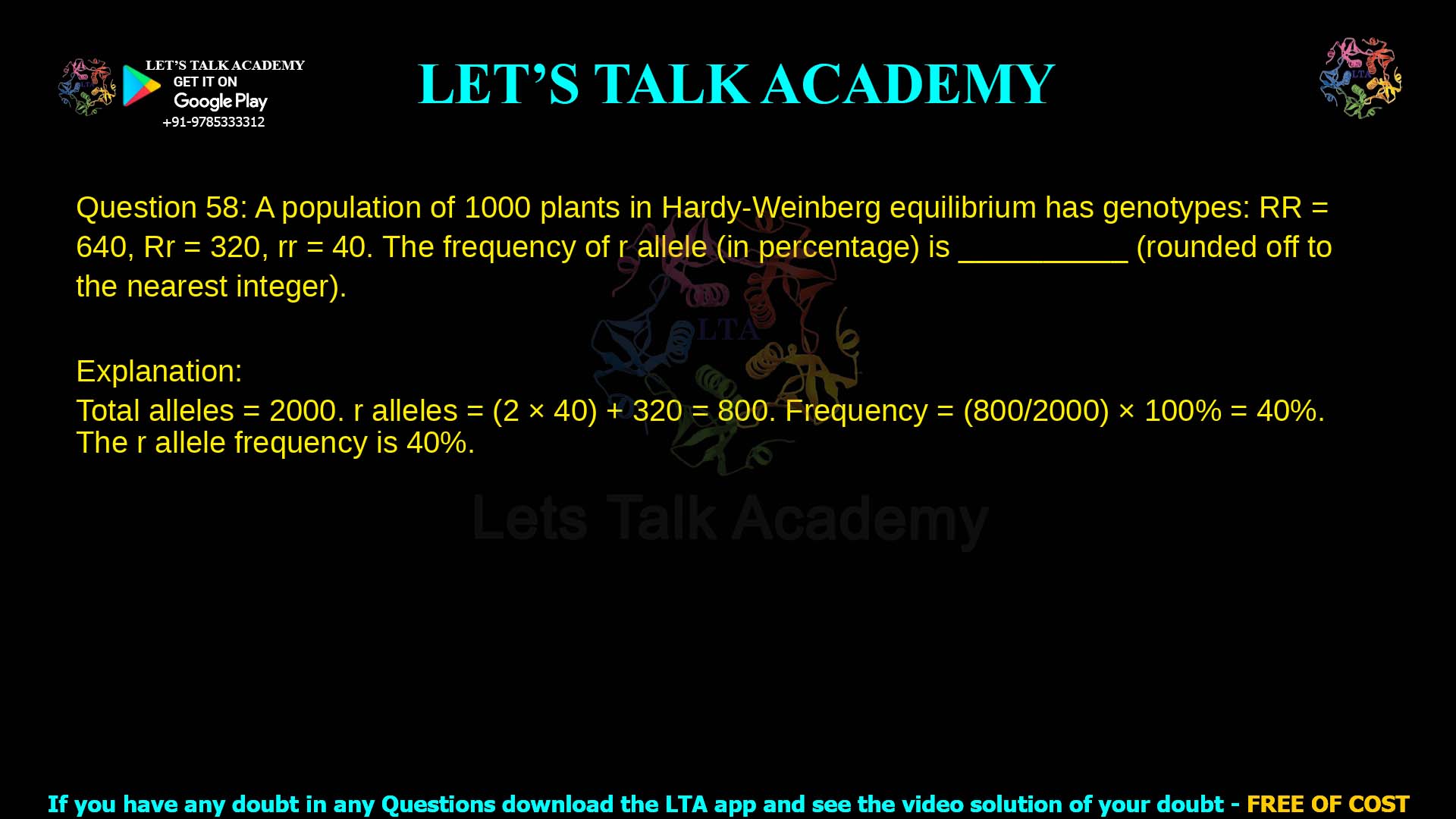
Q.58 A population of 1000 plants are in Hardy–Weinberg equilibrium. Two alleles R
and r determine a particular trait in this population. If the number of plants with
RR genotype is 640, Rr genotype is 320 and rr genotype is 40, the frequency
of r allele (in percentage) in this population is __________ (rounded off to the
nearest integer).
The frequency of the r allele in this Hardy-Weinberg equilibrium population is 20%. This CSIR NET Life Sciences question tests direct application of the Hardy-Weinberg principle to calculate recessive allele frequency from genotype counts.
Problem Verification
Total plants sum to 1000 (640 RR + 320 Rr + 40 rr), confirming the population size. Genotype frequencies match HWE expectations: p² = 0.64 (RR), 2pq = 0.32 (Rr), q² = 0.04 (rr), where p + q = 1.
Step-by-Step Calculation
Calculate q from homozygous recessive genotype: q² = rr frequency = 40/1000 = 0.04. Thus, q = √0.04 = 0.2 (or 20%).
Verify via total alleles: 2000 alleles total (2 per plant). r alleles = (2 × 40 rr) + (1 × 320 Rr) = 80 + 320 = 400. Frequency q = 400/2000 = 0.2.
Hardy-Weinberg Context
HWE assumes random mating, no selection/mutation/migration, large population. Here, observed genotypes fit p = 0.8, q = 0.2 perfectly (p² + 2pq + q² = 0.64 + 0.32 + 0.04 = 1).
Introduction to Hardy Weinberg Equilibrium r Allele Frequency
In population genetics, the Hardy Weinberg equilibrium r allele frequency calculation determines allele proportions from genotype counts in stable populations. This CSIR NET Life Sciences problem—with 1000 plants (RR 640, Rr 320, rr 40)—perfectly demonstrates the method for exam preparation.
Direct q² Method (Fastest for Exams)
For recessive rr, q² = 40/1000 = 0.04, so q = √0.04 = 0.2 or 20% (nearest integer). This leverages HWE’s key property: homozygous recessive frequency equals recessive allele squared.
Allele Counting Verification
-
RR contributes 1280 R alleles (640 × 2)
-
Rr contributes 320 R + 320 r alleles
-
rr contributes 80 r alleles (40 × 2)
Total r = 400/2000 = 0.2 (20%). Matches perfectly, confirming equilibrium.
Why This Matters for CSIR NET
Such questions test HWE assumptions and formulas (p + q = 1, p² + 2pq + q² = 1). Common pitfalls: forgetting square root or total alleles (2000).


