
Biological Energy Transducers
1. Definition of Biological Energy Transduction
1.1 Meaning of Biological Energy Transduction
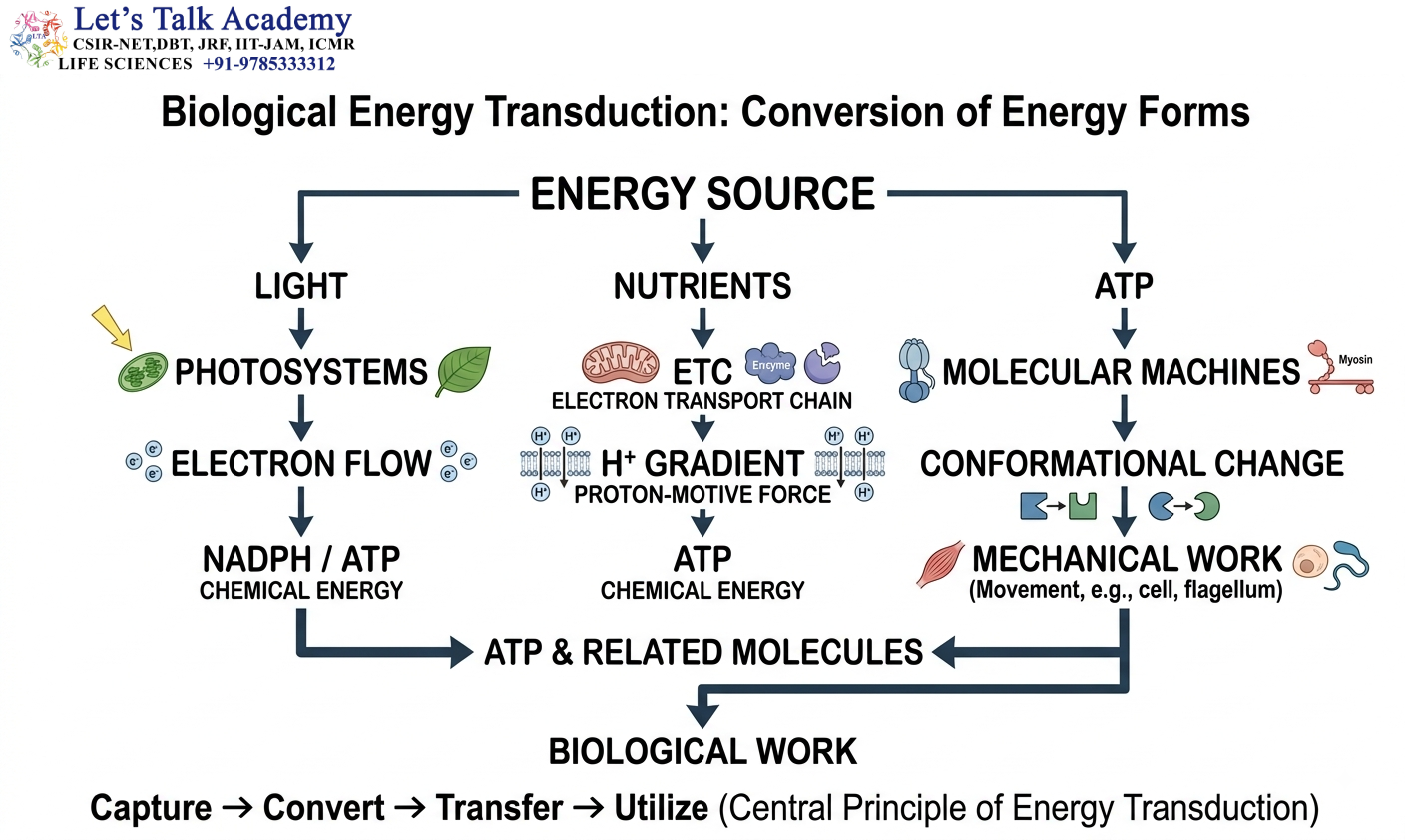
Biological energy transduction refers to the conversion of energy from one form into another form within living organisms.
Living cells continuously require energy to perform essential functions such as:
- Biosynthesis
- Active transport
- Muscle contraction
- Cell movement
- DNA replication
- Protein synthesis
- Maintenance of ion gradients
- Signal transduction
- Cellular growth and division
Cells cannot use all forms of energy directly. Therefore, specialized biological systems convert energy into forms that can be efficiently stored, transported, and utilized.
For example, mitochondria convert the energy of reduced electron carriers into a proton-motive force, which is then converted into the chemical energy of ATP.
Similarly, chloroplasts convert light energy into chemical energy during photosynthesis.
Therefore, biological energy transduction can be summarized as:
One form of energy → Biological energy transducer → Another usable form of energy
1.2 Examples of Biological Energy Transduction
Several important examples occur in living systems:
Chemical energy → Electrochemical energy
Occurs during mitochondrial electron transport when energy from electron transfer is used to generate a proton gradient.
Electrochemical energy → Chemical energy
Occurs when ATP synthase uses the proton-motive force to synthesize ATP.
Light energy → Chemical energy
Occurs during photosynthetic energy transduction.
Chemical energy → Mechanical energy
Occurs during muscle contraction and movement of molecular motors.
Chemical energy → Electrochemical gradient
Occurs when ATP-dependent ion pumps transport ions across membranes.
1.3 Biological Energy Transducers
A biological energy transducer is a molecular or membrane-associated system that converts energy from one form into another.
Major examples include:
- ATP synthase
- Electron transport complexes
- Na⁺/K⁺-ATPase
- Ca²⁺ pumps
- H⁺ pumps
- Myosin
- Kinesin
- Dynein
- Photosynthetic reaction centers
- Uncoupling proteins
1.4 Central Principle
A biological energy transducer does not simply “create” energy.
Instead, it:
Captures → Converts → Transfers → Utilizes energy
The energy is transformed according to the needs of the cell.
Biological energy transduction is the controlled conversion of energy between different forms through specialized molecular machines and biochemical pathways.
2. Energy Forms in Living Organisms
2.1 Major Forms of Biological Energy
Energy in living organisms can exist in several forms, including:
- Chemical energy
- Electrochemical energy
- Light energy
- Mechanical energy
- Thermal energy
These forms are interconnected.
2.2 Energy Conversion in Cells
A simplified representation is:
Light energy
↓
Chemical energy
↓
Electrochemical energy
↓
Chemical energy of ATP
↓
Mechanical work / Transport / Biosynthesis
This demonstrates that cellular metabolism is essentially a network of energy-conversion processes.
3. Chemical Energy
3.1 Definition
Chemical energy is energy stored in chemical bonds and molecular structures.
Important biological molecules that store or transfer chemical energy include:
- ATP
- NADH
- FADH₂
- NADPH
- Acetyl-CoA
- Glucose
- Fatty acids
3.2 ATP as an Energy Currency
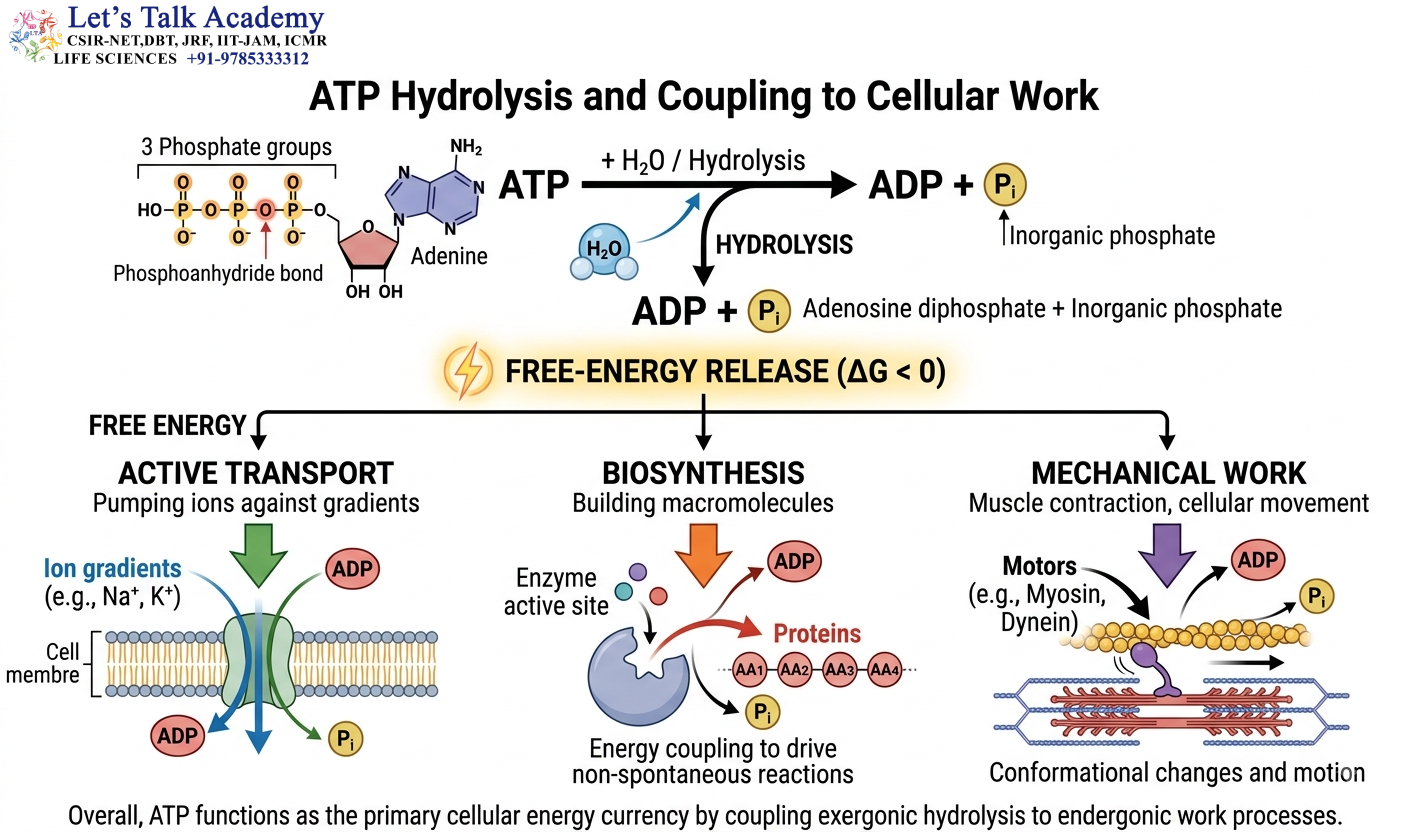
ATP is often called the energy currency of the cell.
ATP contains phosphoanhydride bonds between its phosphate groups.
Hydrolysis of ATP is represented as:
ATP + H₂O → ADP + Pi
The hydrolysis reaction is thermodynamically favorable under cellular conditions and can be coupled to energy-requiring processes.
3.3 Why ATP Is Useful
ATP is useful because its hydrolysis can be coupled to:
- Active transport
- Biosynthesis
- Mechanical movement
- Protein conformational changes
- Signal transduction
Therefore:
ATP hydrolysis → Energy-requiring cellular work
3.4 ATP Is Not a Long-Term Energy Store
ATP is primarily an immediate energy-transfer molecule, not the principal long-term energy-storage molecule.
Long-term energy is mainly stored in:
- Lipids
- Carbohydrates
ATP functions as an intermediate energy currency between energy-releasing and energy-consuming processes.
3.5 Reduced Electron Carriers
NADH and FADH₂ store transferable reducing power.
Their electrons can be transferred through electron transport systems.
Thus:
NADH/FADH₂ → Electron transport → Proton gradient → ATP
3.6 NADPH
NADPH is particularly important in:
- Reductive biosynthesis
- Photosynthesis
- Antioxidant defense
- Cellular redox reactions
Therefore, NADPH and NADH have related but distinct metabolic roles.
4. Electrochemical Energy
4.1 Definition
Electrochemical energy results from differences in both:
- Chemical concentration
- Electrical potential
across a membrane.
For ions, especially H⁺, Na⁺ and Ca²⁺, these two components combine to determine the direction of ion movement.
4.2 Electrochemical Gradient
An electrochemical gradient consists of:
Chemical gradient + Electrical gradient
An ion tends to move according to the combined influence of both forces.
4.3 Example: Proton Gradient
During mitochondrial respiration, protons are pumped from:
Matrix → Intermembrane space
This generates:
- Higher H⁺ concentration outside the matrix
- Electrical charge difference
- Proton-motive force
4.4 Example: Na⁺ Gradient
The plasma membrane of animal cells maintains: High Na⁺ outside and Low Na⁺ inside
This Na⁺ gradient can be used to drive:
- Secondary active transport
- Nutrient uptake
- Ion exchange
- Electrical signaling
4.5 Importance
Electrochemical gradients function as stored energy.
They can be used to drive:
- ATP synthesis
- Secondary transport
- Electrical signaling
- Molecular movement
An electrochemical gradient represents stored potential energy that can be converted into cellular work.
5. Light Energy
5.1 Definition
Light is electromagnetic radiation that can be captured by specialized biological pigments.
In photosynthetic organisms, pigments absorb photons and convert their energy into excited electronic states.
5.2 Photosynthetic Pigments
Important pigments include:
- Chlorophyll a
- Chlorophyll b
- Carotenoids
- Other accessory pigments
5.3 Light Absorption
When a pigment absorbs a photon:
Ground-state pigment + photon → Excited-state pigment
The excited state contains higher energy than the ground state.
This energy can be transferred through the photosynthetic apparatus.
5.4 Conversion of Light Energy
Photosynthetic organisms convert:
Light energy → Excited electrons → Electron transport → Proton gradient → ATP/NADPH
5.5 Biological Importance
Light energy ultimately supports:
- Carbon fixation
- Carbohydrate synthesis
- Biomass production
- Ecosystem productivity
The light reactions of photosynthesis convert light energy into:
- ATP
- NADPH
These molecules are then used during carbon fixation.
6. Mechanical Energy
6.1 Definition
Mechanical energy is associated with physical movement or force generation.
Cells use mechanical energy for:
- Muscle contraction
- Vesicle transport
- Chromosome movement
- Ciliary movement
- Flagellar movement
- Cell migration
6.2 Molecular Motors
Molecular motors are proteins that convert chemical energy, usually from ATP hydrolysis, into mechanical work.
Major molecular motors include:
- Myosin
- Kinesin
- Dynein
6.3 General Mechanism
A simplified molecular motor mechanism is:
ATP binding/hydrolysis
↓
Conformational change
↓
Interaction with cytoskeletal track
↓
Mechanical movement
Molecular motors convert chemical energy into mechanical work through ATP-dependent conformational changes.
7. Biological Energy Conversion
7.1 General Concept
Biological systems rarely use energy in the exact form in which it is initially obtained.
Instead, energy is repeatedly transformed.
For example:
Nutrients
↓
NADH/FADH₂
↓
Electron transport
↓
Proton-motive force
↓
ATP
↓
Cellular work
7.2 Coupling
Energy conversion is usually achieved by coupling an energy-releasing process to an energy-requiring process.
For example: ATP hydrolysis can be coupled to Active transport
Similarly:
Electron transfer can be coupled to Proton pumping
7.3 Free-Energy Principle
An energetically unfavorable reaction can proceed when it is appropriately coupled to a sufficiently favorable reaction.
For two coupled processes:
ΔG_total = ΔG₁ + ΔG₂
If the total ΔG is negative, the overall coupled process can proceed spontaneously.
7.4 Importance of Coupling
Coupling prevents energy from being lost as uncontrolled heat and allows cells to conserve energy in useful forms.
7.5 Biological Examples
- ETC + proton pumping
- Proton gradient + ATP synthesis
- ATP hydrolysis + ion transport
- ATP hydrolysis + molecular motor movement
- Light absorption + electron transfer
8. Mitochondrial Respiratory Chain
8.1 Definition
The mitochondrial respiratory chain is a series of electron carriers located primarily in the inner mitochondrial membrane.
It transfers electrons from:
NADH/FADH₂ → O₂
8.2 Major Components
The classical mitochondrial respiratory chain contains:
- Complex I
- Complex II
- Complex III
- Complex IV
- Coenzyme Q
- Cytochrome c
8.3 Electron Flow
For NADH:
NADH → Complex I → CoQ → Complex III → Cytochrome c → Complex IV → O₂
For FADH₂-linked electrons:
Complex II → CoQ → Complex III → Cytochrome c → Complex IV → O₂
8.4 Proton Pumping
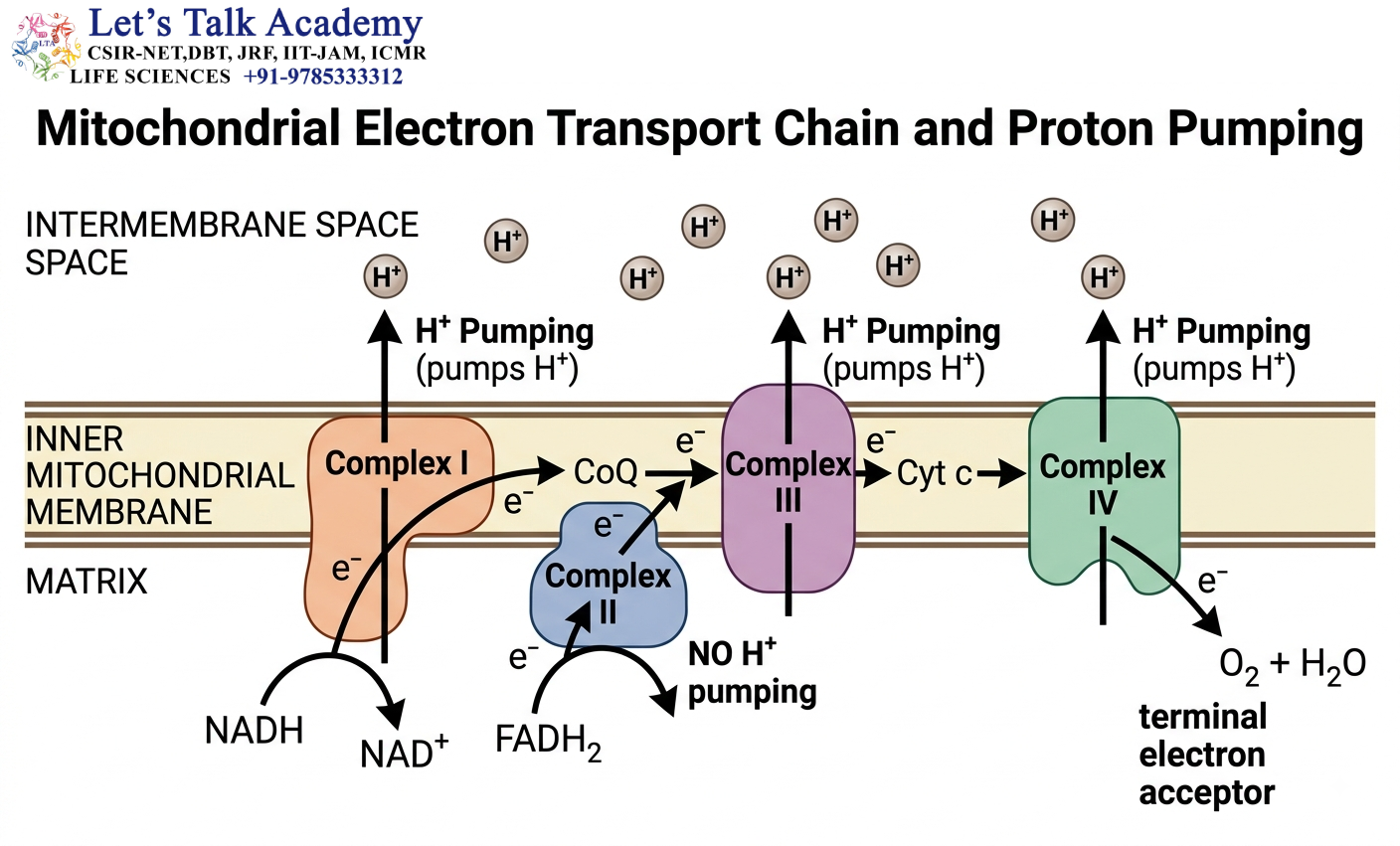
Complexes:
I, III and IV
pump protons.
Complex II does not.
8.5 Energy Conversion
The respiratory chain converts:
Redox energy → Electrochemical energy
The proton gradient is then used by ATP synthase to produce ATP.
The mitochondrial respiratory chain is an energy-converting system that transforms the free energy of electron transfer into a proton-motive force.
9. ATP Synthase
9.1 Definition
ATP synthase is a molecular machine that synthesizes ATP using the proton-motive force.
It is commonly called:
F₀F₁-ATP synthase
9.2 Location
In mitochondria, ATP synthase is located in the:
Inner mitochondrial membrane
9.3 Basic Reaction
ADP + Pi → ATP
9.4 Energy Source
The energy comes from:
Proton movement down the electrochemical gradient
Thus:
Proton-motive force → ATP synthase → ATP
9.5 F₀ Component
F₀ is the membrane-associated component.
It provides the proton-conducting and rotary machinery.
9.6 F₁ Component
F₁ contains the catalytic sites involved in ATP synthesis.
The major catalytic arrangement includes:
α₃β₃
The β subunits contain the principal catalytic sites.
9.7 Rotary Mechanism
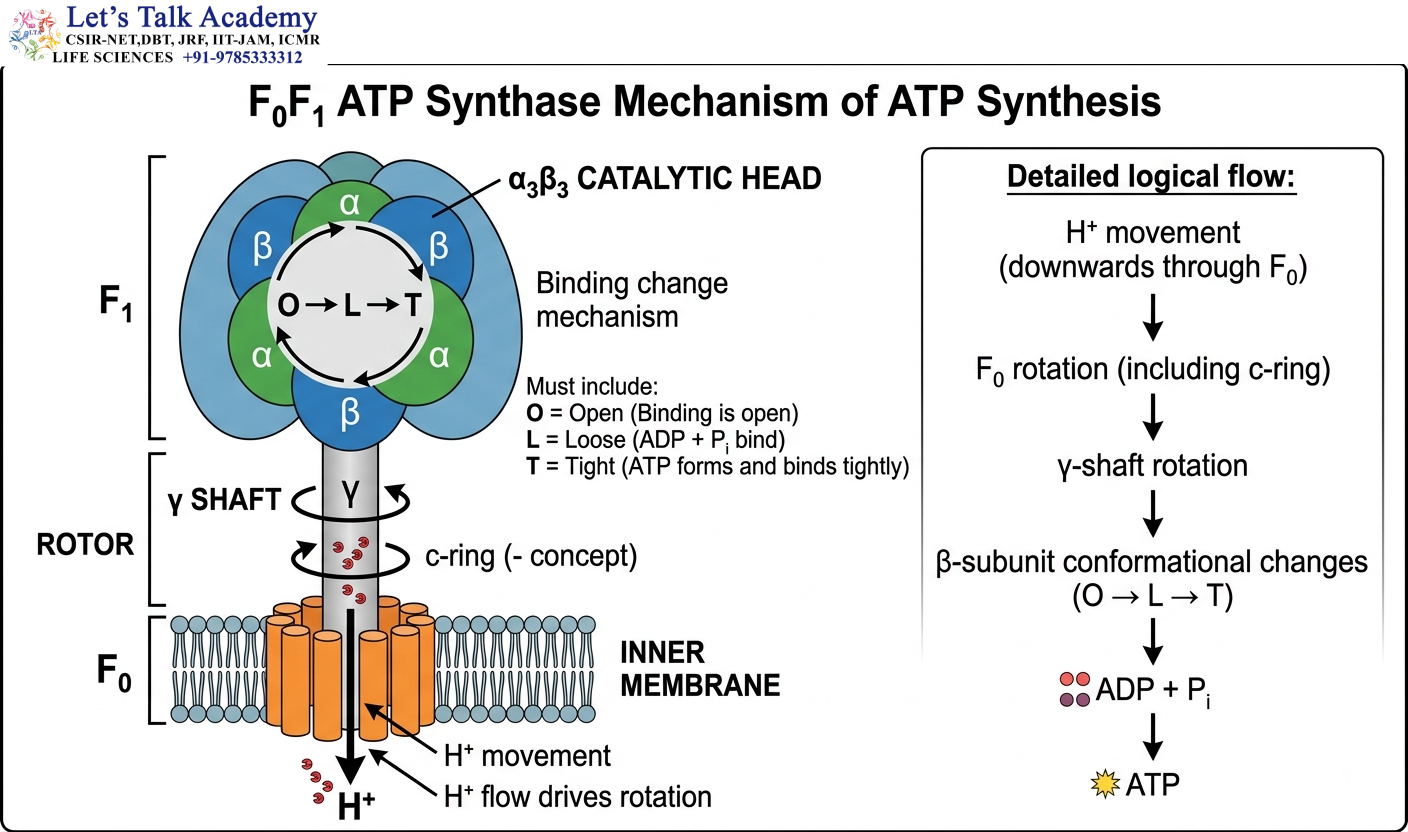
Proton movement through F₀ drives rotation.
Rotation causes conformational changes in F₁ catalytic subunits.
This facilitates:
- ADP binding
- ATP formation
- ATP release
9.8 Binding-Change Mechanism
The catalytic β subunits cycle through:
- Open
- Loose
- Tight
This mechanism is associated with:
Paul Boyer
ATP synthase converts electrochemical energy stored in the proton gradient into chemical energy stored in ATP.
10. Proton-Motive Force
10.1 Definition
The proton-motive force (PMF) is the electrochemical driving force that causes protons to move across a membrane.
In mitochondria, it is generated by proton pumping through the respiratory chain.
10.2 Components
PMF has two major components:
- Electrical potential difference (Δψ)
- Chemical proton gradient (ΔpH)
10.3 Electrical Component
When protons are pumped out of the mitochondrial matrix:
Matrix becomes relatively negative
and:
Intermembrane space becomes relatively positive
10.4 Chemical Component
The intermembrane space contains a higher concentration of H⁺ than the matrix.
Therefore:
Intermembrane space → acidic
Matrix → relatively alkaline
10.5 Direction of Proton Flow
Protons tend to flow:
Intermembrane space → Matrix
through ATP synthase.
10.6 PMF as Stored Energy
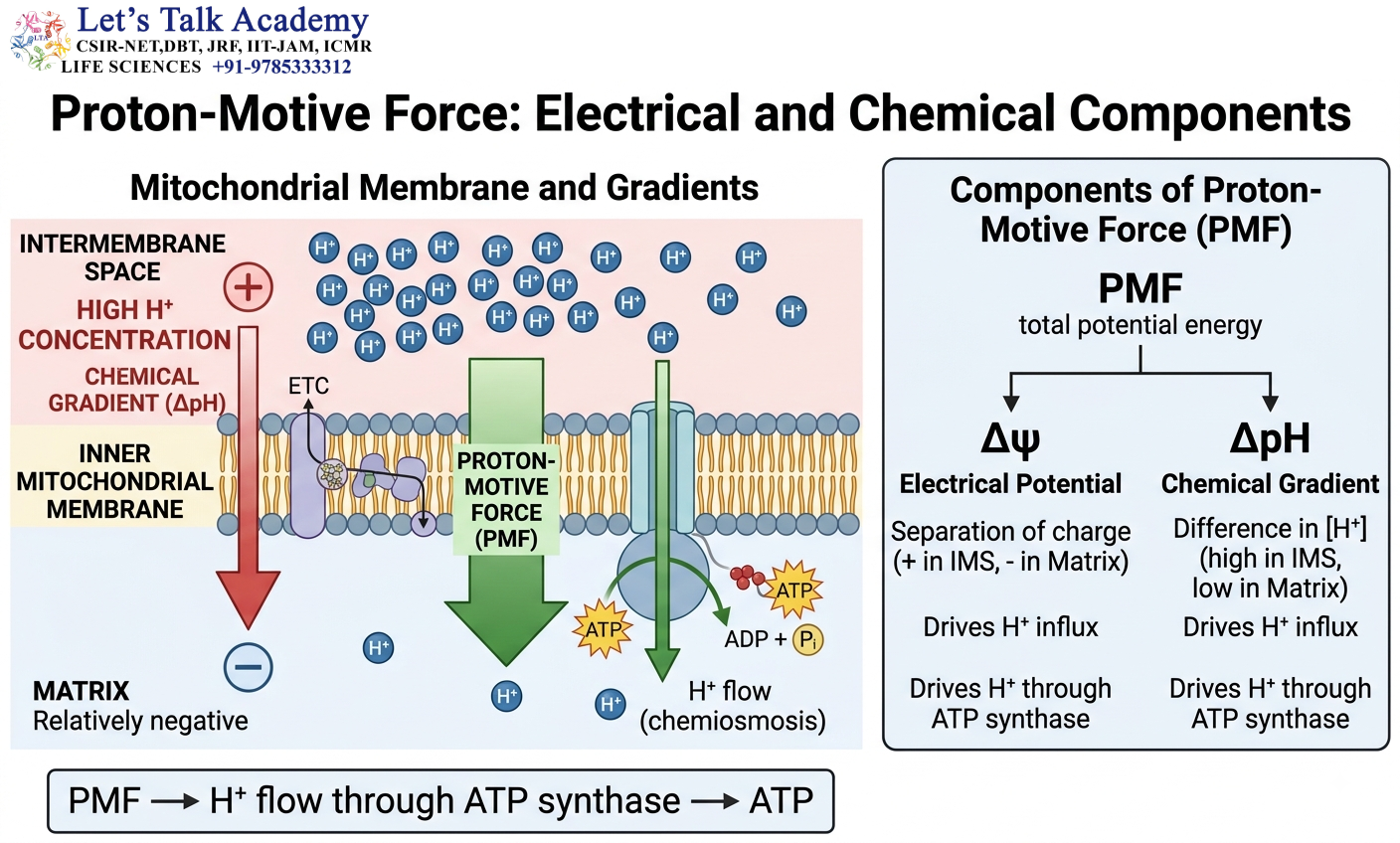
The proton gradient acts as an energy reservoir.
It can be used for:
- ATP synthesis
- Transport
- Cellular work
10.7 Generalization
A proton-motive force is not unique to mitochondria.
Similar principles occur in:
- Chloroplasts
- Bacteria
- Archaea
The proton-motive force is an electrochemical form of stored energy generated by separating charge and proton concentration across a biological membrane.
11. Photosynthetic Energy Transduction
11.1 Definition
Photosynthetic energy transduction is the process by which photosynthetic organisms convert light energy into chemical energy.
In plants, this occurs in the: Chloroplast
11.2 Major Stages
The light-dependent reactions involve:
Photon absorption
↓
Excitation of chlorophyll
↓
Electron transfer
↓
Proton gradient formation
↓
ATP synthesis
and
Electron transfer → NADPH formation
11.3 Photosystems
Two major photosystems operate in oxygenic photosynthesis:
- Photosystem II
- Photosystem I
11.4 Photosystem II
Photosystem II contains the reaction-center chlorophyll:
P680
It is associated with water oxidation.
The simplified reaction is:
2H₂O → O₂ + 4H⁺ + 4e⁻
11.5 Photosystem I
Photosystem I contains the reaction-center chlorophyll: P700
It contributes to the production of reducing power, ultimately leading to: NADPH
11.6 Overall Light-Reaction Concept
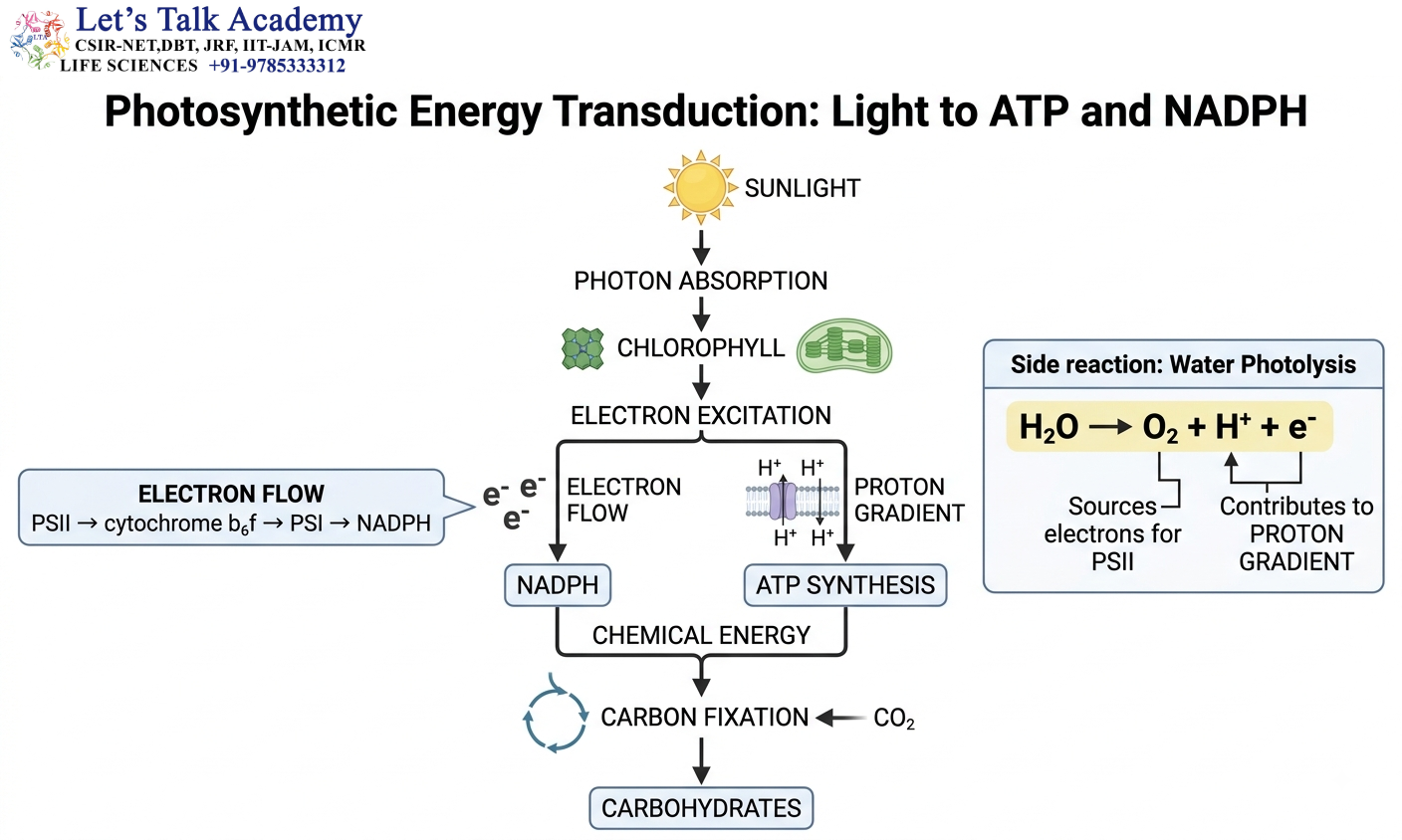
Light energy
↓
Electron excitation
↓
Electron transport
↓
Proton gradient
↓
ATP synthesis
and
High-energy electrons → NADPH
Photosynthetic energy transduction converts photon energy into electrochemical and chemical forms of energy.
12. Photophosphorylation
12.1 Definition
Photophosphorylation is the synthesis of ATP using energy derived from light-driven electron transport.
It is analogous in principle to oxidative phosphorylation.
12.2 Basic Sequence
Light
↓
Electron excitation
↓
Electron transport
↓
Proton gradient
↓
ATP synthase
↓
ATP
12.3 Types of Photophosphorylation
Two major forms are:
- Non-cyclic photophosphorylation
- Cyclic photophosphorylation
12.4 Non-Cyclic Photophosphorylation
Non-cyclic electron flow involves:
Photosystem II + Photosystem I
It results in production of:
- ATP
- NADPH
- O₂
Water acts as the source of electrons.
12.5 Cyclic Photophosphorylation
Cyclic electron flow primarily involves: Photosystem I
Electrons cycle back through components of the electron transport chain.
It produces: ATP
but does not directly produce:
- NADPH
- O₂
12.6 Comparison
Feature |
Non-Cyclic |
Cyclic |
|---|---|---|
| PSI | Yes | Yes |
| PSII | Yes | No |
| ATP | Yes | Yes |
| NADPH | Yes | No |
| O₂ evolution | Yes | No |
| Electron return | No | Yes |
13. Chloroplast Electron Transport
13.1 Location
The photosynthetic electron transport chain is located in the Thylakoid membrane of chloroplasts.
13.2 Major Components
Important components include:
- Photosystem II
- Plastoquinone
- Cytochrome b₆f complex
- Plastocyanin
- Photosystem I
- Ferredoxin
- Ferredoxin-NADP⁺ reductase
13.3 Simplified Electron Flow
H₂O
↓
Photosystem II
↓
Plastoquinone
↓
Cytochrome b₆f
↓
Plastocyanin
↓
Photosystem I
↓
Ferredoxin
↓
NADP⁺
↓
NADPH
13.4 Proton Gradient
Electron transport contributes to proton accumulation in the: Thylakoid lumen
The lumen therefore becomes relatively enriched in H⁺.
13.5 ATP Synthesis
Protons flow from: Thylakoid lumen → Stroma through Chloroplast ATP synthase
This proton flow drives ATP synthesis.
13.6 Important Comparison
Mitochondria H⁺ accumulates in intermembrane space
Chloroplasts H⁺ accumulates in thylakoid lumen
In both systems H⁺ flows back through ATP synthase
14. Proton Gradients
14.1 Proton Gradient in Mitochondria
During mitochondrial respiration:
Matrix → H⁺ pumped → Intermembrane space
Therefore:
Intermembrane space = high H⁺
Matrix = low H⁺
14.2 Proton Gradient in Chloroplasts
During photosynthesis:
Stroma → H⁺ transported/accumulated → Thylakoid lumen
Therefore:
Lumen = high H⁺
Stroma = lower H⁺
14.3 Common Principle
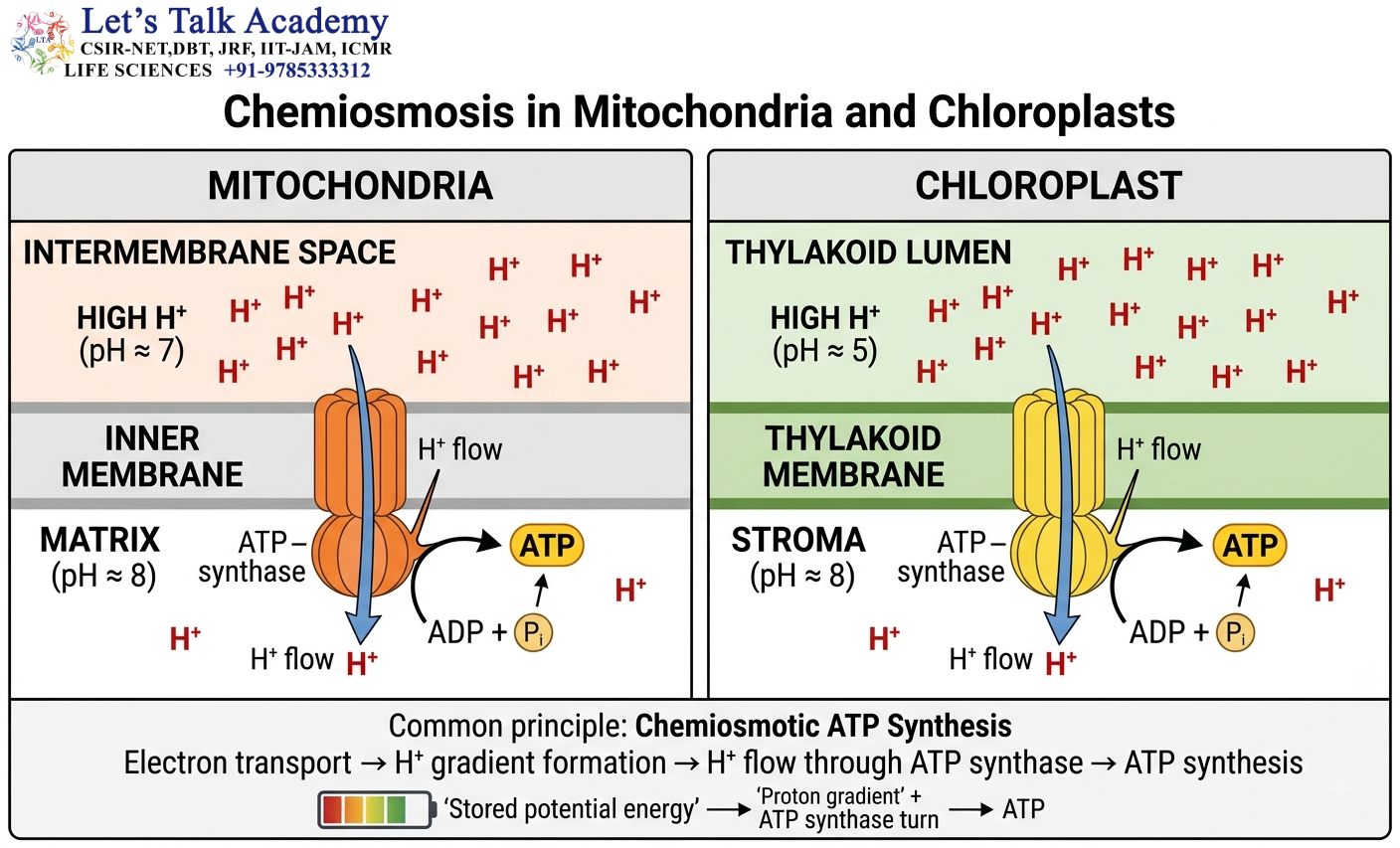
Despite differences in location, both systems use:
Electron transport → Proton gradient → ATP synthase → ATP
14.4 Importance
A proton gradient is a form of:
Electrochemical energy
It can be converted into chemical energy by ATP synthase.
The direction of proton accumulation differs between mitochondria and chloroplasts, but the principle of chemiosmotic ATP synthesis is fundamentally similar.
15. Molecular Motors
15.1 Definition
Molecular motors are specialized proteins that convert chemical energy into mechanical movement.
Most molecular motors use:
ATP hydrolysis
as their immediate energy source.
15.2 Major Molecular Motors
Important molecular motors include:
- Myosin
- Kinesin
- Dynein
15.3 General Mechanism

The general process involves:
ATP binding
↓
ATP hydrolysis
↓
Conformational change
↓
Interaction with cytoskeletal track
↓
Mechanical movement
15.4 Cytoskeletal Tracks
Different motors interact with different cytoskeletal polymers:
Myosin → Actin
Kinesin → Microtubules
Dynein → Microtubules
15.5 Importance
Molecular motors are involved in:
- Vesicle transport
- Organelle movement
- Muscle contraction
- Chromosome movement
- Ciliary beating
- Cellular organization
16. Myosin
16.1 Definition
Myosin is a molecular motor that generally moves along: Actin filaments
16.2 Energy Source
Myosin uses: ATP hydrolysis to produce mechanical movement.
16.3 Muscle Contraction
In muscle cells, myosin interacts with actin.
The interaction produces: Sliding of actin relative to myosin
This produces muscle contraction.
16.4 Cross-Bridge Cycle
The simplified cycle includes:
- ATP binding
- ATP hydrolysis
- Actin binding
- Power stroke
- ATP/ADP-Pi transitions
- Detachment and reattachment
16.5 Important Statement
ATP binding promotes detachment of myosin from actin, whereas ATP hydrolysis helps prepare the myosin head for the next cycle.
The energy of ATP hydrolysis is converted into:
Conformational change → Mechanical movement
17. Kinesin
17.1 Definition
Kinesins are molecular motors that generally move along: Microtubules
17.2 Direction
Many conventional kinesins move toward the: Plus end of microtubules
17.3 Function
Kinesins are involved in:
- Vesicle transport
- Organelle movement
- Intracellular cargo transport
- Mitotic chromosome movement
17.4 Mechanism
Kinesin uses ATP hydrolysis to generate coordinated conformational changes in its motor domains.
This produces stepwise movement along the microtubule.
17.5 Important Statement
Kinesin generally transports cargo toward the plus end of microtubules, whereas cytoplasmic dynein generally moves toward the minus end.
18. Dynein
18.1 Definition
Dyneins are microtubule-associated molecular motors.
They use ATP hydrolysis to generate movement.
18.2 Direction
Cytoplasmic dynein generally moves toward the Minus end of microtubules
18.3 Functions
Dyneins participate in:
- Retrograde vesicle transport
- Organelle movement
- Mitotic processes
- Ciliary movement
- Flagellar movement
18.4 Axonemal Dynein
Axonemal dynein is found in cilia and flagella.
Its ATP-dependent activity causes sliding between microtubules.
Because the microtubules are structurally constrained, sliding is converted into Bending.
18.5 Comparison
Motor |
Track |
Typical Direction |
|---|---|---|
| Myosin | Actin | Actin-directed movement |
| Kinesin | Microtubule | Usually toward plus end |
| Dynein | Microtubule | Usually toward minus end |
19. Ion Pumps
19.1 Definition
Ion pumps are membrane proteins that use energy to move ions against their electrochemical gradients.
This is a form of: Primary active transport
19.2 Energy Source
Many ion pumps use ATP hydrolysis directly.
19.3 Major Ion Pumps
Important examples include:
- Na⁺/K⁺-ATPase
- Ca²⁺ pumps
- H⁺ pumps
19.4 Energy Conversion
Ion pumps convert Chemical energy of ATP into Electrochemical energy stored in ion gradients
This is an important form of biological energy transduction.
20. Na⁺/K⁺-ATPase
20.1 Definition
Na⁺/K⁺-ATPase is a primary active transporter found in the plasma membrane of animal cells.
It uses ATP to maintain: High Na⁺ outside and High K⁺ inside
20.2 Transport Stoichiometry
For each ATP hydrolyzed, the classical pump transports: 3 Na⁺ out and 2 K⁺ in
20.3 Electrogenic Nature
Because three positive charges leave while only two positive charges enter:
Net positive charge moves outward
Therefore, Na⁺/K⁺-ATPase is:
Electrogenic
20.4 Functions
The Na⁺/K⁺ pump contributes to:
- Resting membrane potential
- Cell volume regulation
- Na⁺-dependent secondary transport
- Nerve function
- Muscle function
- Ion homeostasis
20.5 Reaction Cycle
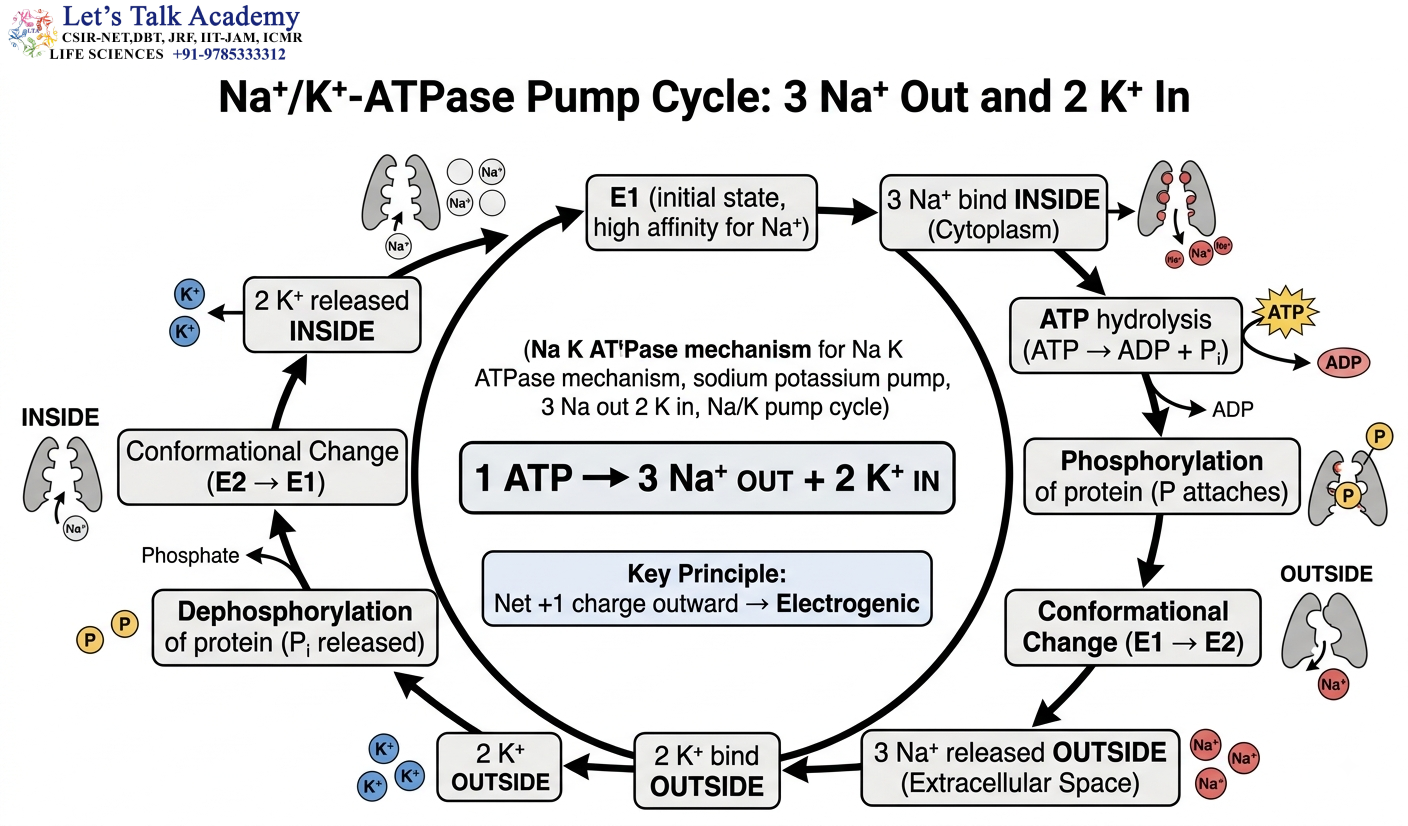
The pump operates through alternating conformations: E1 and E2
ATP phosphorylation drives conformational changes.
20.6 Simplified Cycle
3 Na⁺ bind inside
↓
ATP phosphorylates pump
↓
Conformational change
↓
3 Na⁺ released outside
↓
2 K⁺ bind outside
↓
Dephosphorylation
↓
Conformational change
↓
2 K⁺ released inside
Na⁺/K⁺-ATPase transports 3 Na⁺ out and 2 K⁺ in per ATP, making it electrogenic.
21. Ca²⁺ Pumps
21.1 Importance of Calcium
Ca²⁺ is an important:
- Signaling molecule
- Second messenger
- Regulator of muscle contraction
- Regulator of secretion
- Regulator of enzymes
Because cytosolic Ca²⁺ must be kept low under resting conditions, cells require Ca²⁺ pumps.
21.2 Major Ca²⁺ Pumps
Important examples include SERCA and PMCA
21.3 SERCA
SERCA stands for:
Sarcoplasmic/Endoplasmic Reticulum Ca²⁺-ATPase
It pumps Ca²⁺ from:
Cytosol → ER/Sarcoplasmic reticulum
21.4 Function in Muscle
During muscle relaxation:
Cytosolic Ca²⁺ decreases
because SERCA pumps Ca²⁺ back into the sarcoplasmic reticulum.
21.5 PMCA
Plasma membrane Ca²⁺-ATPase pumps Ca²⁺ from:
Cytosol → Extracellular space
21.6 Energy Transduction
These pumps convert:
ATP energy → Ca²⁺ electrochemical gradient
22. H⁺ Pumps
22.1 Definition
H⁺ pumps actively transport protons across membranes.
They are important in:
- Mitochondria
- Chloroplasts
- Lysosomes
- Plasma membranes
- Plant vacuoles
- Bacteria
22.2 Types
Important H⁺-transporting systems include:
- Respiratory-chain proton pumps
- V-type H⁺-ATPases
- P-type H⁺ pumps
- Photosynthetic electron-transfer systems
22.3 V-Type H⁺-ATPase
V-type ATPases use ATP hydrolysis to pump H⁺ into intracellular compartments such as lysosomes.
This produces an acidic lumen.
22.4 Importance
H⁺ gradients generated by pumps can regulate:
- Organelle pH
- Protein degradation
- Vesicle function
- Secondary transport
- Membrane energetics
22.5 Energy Conversion
ATP hydrolysis → H⁺ gradient
This is the reverse direction of ATP synthase:
H⁺ gradient → ATP synthesis
23. Membrane Potential
23.1 Definition
Membrane potential is the electrical potential difference across a biological membrane.
It results primarily from:
- Unequal ion distribution
- Selective membrane permeability
- Active ion transport
23.2 Mitochondria
In mitochondria, proton pumping produces a membrane potential in which the matrix becomes relatively negative.
This contributes significantly to the proton-motive force.
23.3 Plasma Membrane
Animal cells typically maintain a negative membrane potential inside the cell.
This is generated by:
- Na⁺/K⁺-ATPase
- K⁺ permeability
- Other ion channels and transporters
23.4 Importance
Membrane potential is important for:
- Nerve impulses
- Muscle contraction
- Transport
- Cellular signaling
- ATP synthesis
- Ion homeostasis
Membrane potential is an electrical form of stored energy that can contribute to electrochemical driving forces.
24. Electrochemical Gradients
24.1 Definition
An electrochemical gradient combines:
Chemical concentration gradient + Electrical potential gradient
24.2 Ion Movement
The direction of ion movement depends on both components.
For example, a positively charged ion may be driven by:
- Higher concentration on one side
- More negative electrical potential on the other side
24.3 Importance in Biology
Electrochemical gradients drive:
- ATP synthesis
- Secondary active transport
- Membrane excitability
- Ion exchange
- Nutrient uptake
24.4 Examples
H⁺ gradient → ATP synthase
Na⁺ gradient → Secondary transport
Ca²⁺ gradient → Signaling and transport
24.5 Important Statement
Electrochemical gradients are not merely concentration differences; they also include the electrical potential difference experienced by charged ions.
25. Chemiosmosis
25.1 Definition
Chemiosmosis is the process in which the movement of ions, especially protons, down an electrochemical gradient across a membrane is coupled to useful cellular work.
The most important example is:
Proton gradient → ATP synthesis
25.2 Mitochondrial Chemiosmosis
In mitochondria:
ETC
↓
H⁺ pumping
↓
PMF
↓
H⁺ flow through ATP synthase
↓
ATP
25.3 Chloroplast Chemiosmosis
In chloroplasts:
Photosynthetic electron transport
↓
H⁺ accumulation in thylakoid lumen
↓
PMF
↓
H⁺ flow through ATP synthase
↓
ATP
25.4 Bacterial Chemiosmosis
Bacteria can generate proton gradients across their plasma membranes.
The same general principle can be used for:
- ATP synthesis
- Transport
- Motility
25.5 Importance
Chemiosmosis provides a common mechanism for energy conservation across very different organisms.
Chemiosmosis is a general biological energy-transduction principle rather than a process restricted to mitochondria.
26. Coupling Mechanisms
26.1 Definition
Coupling means linking an energy-releasing reaction to an energy-requiring reaction.
26.2 Thermodynamic Basis
For coupled reactions: ΔG_total = ΔG₁ + ΔG₂
If the combined ΔG is negative, the overall process can proceed spontaneously.
26.3 ATP-Dependent Coupling
Example: ATP hydrolysis
coupled to: Active transport
26.4 Redox Coupling
Example: Electron transfer
coupled to: Proton pumping
26.5 Proton-Gradient Coupling
Example: Proton movement
coupled to: ATP synthesis
26.6 Mechanical Coupling
Example: ATP hydrolysis
coupled to: Molecular motor movement
26.7 Light-Driven Coupling
Example: Photon absorption
coupled to: Electron transfer and proton-gradient generation
26.8 Importance
Coupling allows cells to capture energy rather than allowing it to dissipate uncontrollably.
27. Uncoupling
27.1 Definition
Uncoupling occurs when an energy-releasing process becomes separated from the energy-conserving process it normally drives.
In oxidative phosphorylation: Electron transport becomes uncoupled from: ATP synthesis
27.2 Normal Coupling
Electron transport
↓
Proton gradient
↓
ATP synthase
↓
ATP
27.3 Uncoupled Condition
Electron transport
↓
Proton gradient
↓
Proton leak
↓
Heat
27.4 Effects
Uncoupling generally results in:
- ATP production ↓
- Proton gradient ↓
- Heat production ↑
- Oxygen consumption often ↑
- Substrate oxidation ↑
27.5 Chemical Uncouplers
Examples include classical protonophores such as:
- 2,4-Dinitrophenol
- FCCP
These compounds dissipate proton gradients by providing an alternative route for proton movement.
27.6 Physiological Uncoupling
Physiological uncoupling occurs through proteins such as: UCP1
27.7 Important Statement
Uncoupling decreases the efficiency of energy conservation as ATP while allowing electron transport to continue.
28. Thermogenesis
28.1 Definition
Thermogenesis is the biological production of heat.
It is important for:
- Body-temperature regulation
- Adaptation to cold
- Energy expenditure
28.2 Shivering Thermogenesis
Shivering generates heat through repeated muscle contraction.
This involves:
ATP hydrolysis → Mechanical work + Heat
28.3 Non-Shivering Thermogenesis
Non-shivering thermogenesis is strongly associated with:
Brown adipose tissue and UCP1
28.4 Mechanism
Fatty acid oxidation
↓
Electron transport
↓
Proton gradient
↓
UCP1-mediated proton leak
↓
Energy dissipated as heat
28.5 Importance in Newborns
Brown adipose tissue is particularly important in newborn mammals because they have limited capacity for effective shivering.
28.6 Important Statement
Thermogenesis demonstrates that biological energy transduction can intentionally convert chemical energy into heat rather than conserving it primarily as ATP.
29. UCP Proteins
29.1 Definition
UCPs, or uncoupling proteins, are mitochondrial inner-membrane proteins associated with proton leak and regulation of mitochondrial energy metabolism.
29.2 UCP1
UCP1 is the best-characterized physiological thermogenic uncoupler.
It is abundant in:
Brown adipose tissue
29.3 Function of UCP1

UCP1 allows proton re-entry into the mitochondrial matrix without productive ATP synthesis through ATP synthase.
Therefore:
PMF → Heat
rather than primarily:
PMF → ATP
29.4 Other UCPs
Other UCP family members exist and have been associated with:
- Regulation of mitochondrial metabolism
- Redox balance
- Proton conductance
- Cellular stress responses
Their physiological functions are more diverse and should not simply be assumed to be identical to UCP1.
29.5 UCP1 versus ATP Synthase
Feature |
ATP Synthase |
UCP1 |
|---|---|---|
| Proton movement | Yes | Yes |
| ATP synthesis | Yes | No direct ATP synthesis |
| PMF utilization | Productive | Dissipative |
| Major consequence | ATP production | Heat production |
| Major location | Inner mitochondrial membrane | Brown adipose mitochondria |
30. Biological Energy Transducers as Molecular Machines
30.1 Definition
Many biological energy transducers can be considered molecular machines because they perform controlled mechanical or chemical work through coordinated molecular movements.
Examples include:
- ATP synthase
- Myosin
- Kinesin
- Dynein
- Na⁺/K⁺-ATPase
- Ca²⁺ pumps
- H⁺ pumps
30.2 ATP Synthase as a Molecular Machine
ATP synthase converts:
Proton-motive force → Rotation → ATP
30.3 Myosin as a Molecular Machine
Myosin converts:
ATP hydrolysis → Conformational changes → Mechanical movement
30.4 Kinesin as a Molecular Machine
Kinesin converts:
ATP hydrolysis → Stepping movement → Cargo transport
30.5 Dynein as a Molecular Machine
Dynein converts:
ATP hydrolysis → Conformational movement → Microtubule sliding/transport
30.6 Ion Pumps as Molecular Machines
Ion pumps convert:
ATP hydrolysis → Conformational change → Ion transport
30.7 Common Principle
Although these molecular machines perform different functions, they share a common principle:
Energy input → Conformational change → Directed biological work
31. Comparison of Mitochondrial and Photosynthetic Transduction
31.1 Similarities
Both mitochondria and chloroplasts use:
- Electron transport
- Membrane-associated protein complexes
- Proton gradients
- Electrochemical potential
- ATP synthase
- Chemiosmosis
Therefore, both systems use:
Electron transport → Proton gradient → ATP synthesis
31.2 Differences in Energy Source
Mitochondria primarily use: Chemical/redox energy
Chloroplasts use: Light energy
31.3 Location of Proton Accumulation
Mitochondria: Intermembrane space
Chloroplasts: Thylakoid lumen
31.4 ATP Production
Mitochondria:vOxidative phosphorylation
Chloroplasts: Photophosphorylation
31.5 Terminal Electron Acceptor
Mitochondrial aerobic respiration: O₂
Photosynthetic linear electron flow: NADP⁺ is reduced to NADPH
31.6 Electron Source
Mitochondria: NADH/FADH₂
Photosynthetic oxygenic electron flow: H₂O
31.7 Oxygen
Mitochondria consume oxygen during aerobic respiration.
Photosystem II produces oxygen by splitting water.
31.8 Comparison Table
Feature |
Mitochondria |
Chloroplast |
|---|---|---|
| Major process | Oxidative phosphorylation | Photophosphorylation |
| Initial energy source | Chemical/redox energy | Light |
| Main membrane | Inner mitochondrial membrane | Thylakoid membrane |
| H⁺ accumulates in | Intermembrane space | Thylakoid lumen |
| ATP synthase location | Inner membrane | Thylakoid membrane |
| Electron source | NADH/FADH₂ | H₂O in linear flow |
| Terminal acceptor | O₂ | NADP⁺ in linear flow |
| Major product | ATP | ATP + NADPH |
| Oxygen | Consumed | Produced in linear flow |
32. Integrated Energy-Transduction Model
32.1 General Model
The major biological energy-transduction systems can be integrated into a single model:
Energy source
↓
Energy capture
↓
Energy conversion
↓
Electrochemical/chemical intermediate
↓
Molecular machine
↓
Biological work
32.2 Mitochondrial Model
Nutrient oxidation
↓
NADH/FADH₂
↓
ETC
↓
Proton gradient
↓
ATP synthase
↓
ATP
↓
Cellular work
32.3 Photosynthetic Model
Light
↓
Photosystems
↓
Electron transport
↓
Proton gradient
↓
ATP synthase
↓
ATP
and:
Electron transfer → NADPH
↓
Carbon fixation
32.4 Molecular Motor Model
ATP
↓
ATP hydrolysis
↓
Conformational change
↓
Motor movement
↓
Mechanical work
32.5 Ion Pump Model
ATP
↓
ATP hydrolysis
↓
Pump conformational change
↓
Ion movement against gradient
↓
Electrochemical energy stored
32.6 Thermogenic Model
Chemical energy
↓
Electron transport
↓
Proton gradient
↓
UCP1
↓
Heat
33. Biological Energy Transduction and Coupling
33.1 Redox-to-Proton Coupling
In respiratory chains:
Electron transfer
is coupled to:
Proton pumping
33.2 Proton-to-ATP Coupling
The proton gradient is coupled to:
ATP synthesis
33.3 ATP-to-Mechanical Coupling
ATP hydrolysis is coupled to:
Molecular movement
33.4 ATP-to-Ion Transport Coupling
ATP hydrolysis is coupled to:
Active ion transport
33.5 Light-to-Redox Coupling
Photon absorption is coupled to:
Electron excitation and electron transfer
33.6 Central Principle
Biological systems conserve energy by coupling energy-releasing reactions to energy-consuming processes through molecular machines and electrochemical gradients.
34. Membrane Potential and Energy Transduction
34.1 Electrical Energy Across Membranes
A membrane potential represents stored electrical energy.
This energy can influence the movement of ions across the membrane.
34.2 Mitochondrial Membrane Potential
The mitochondrial membrane potential is generated primarily through proton pumping by the respiratory chain.
The matrix becomes relatively negative.
This electrical component contributes significantly to the PMF.
34.3 Plasma Membrane Potential
The plasma membrane potential is influenced by:
- Na⁺/K⁺-ATPase
- K⁺ channels
- Na⁺ channels
- Cl⁻ channels
- Other transport systems
34.4 Functional Importance
Membrane potential can drive:
- Ion movement
- Secondary transport
- Electrical signaling
- ATP production in energy-transducing membranes
35. Electrochemical Energy in Secondary Transport
35.1 Primary Active Transport
Primary active transport directly uses energy, usually ATP, to move ions against their electrochemical gradients.
Example:
Na⁺/K⁺-ATPase
35.2 Secondary Active Transport
Secondary transport uses an existing ion gradient to drive movement of another molecule.
For example:
Na⁺ gradient → Glucose transport
The Na⁺ gradient itself was established using ATP by Na⁺/K⁺-ATPase.
Therefore:
ATP → Na⁺ gradient → Nutrient transport
This represents an indirect form of energy coupling.
35.3 Important Statement
Secondary active transport does not directly hydrolyze ATP at the transporter; it uses the energy stored in an ion gradient established by primary active transport.
36. Energy Transduction in Muscle
36.1 ATP as Energy Source
Muscle contraction requires ATP.
Myosin hydrolyzes ATP and uses the released free energy to undergo conformational changes.
36.2 ATP Hydrolysis
ATP + H₂O → ADP + Pi
The energy released is coupled to the mechanical cycle.
36.3 Cross-Bridge Cycling
ATP binding
↓
Myosin detachment
↓
ATP hydrolysis
↓
Myosin head repositioning
↓
Actin binding
↓
Pi release
↓
Power stroke
↓
ADP release
This cycle produces repeated movement of myosin relative to actin.
36.4 Energy Transduction
Thus:
Chemical energy of ATP → Mechanical energy of contraction
37. Energy Transduction in Cilia and Flagella
37.1 Axonemal Structure
Cilia and many eukaryotic flagella contain microtubules arranged in a characteristic: 9 + 2 organization.
37.2 Dynein
Axonemal dynein uses ATP hydrolysis to generate sliding between adjacent microtubules.
37.3 Conversion of Sliding to Bending
Microtubules are mechanically constrained.
Therefore, sliding is converted into:
Bending movement
37.4 Energy Conversion
ATP chemical energy
↓
Dynein conformational changes
↓
Microtubule sliding
↓
Ciliary/flagellar bending
This is another example of a biological molecular machine.
38. Biological Energy Transducers Comparison
Energy Transducer |
Energy Input |
Energy Output |
Major Function |
|---|---|---|---|
| ATP synthase | Proton-motive force | ATP | ATP synthesis |
| Respiratory chain | Redox energy | Proton gradient | Energy conservation |
| Photosynthetic ETC | Light-derived electron energy | Proton gradient + NADPH | Photosynthesis |
| Myosin | ATP | Mechanical movement | Muscle/cell movement |
| Kinesin | ATP | Mechanical movement | Cargo transport |
| Dynein | ATP | Mechanical movement | Transport/ciliary movement |
| Na⁺/K⁺-ATPase | ATP | Na⁺/K⁺ gradients | Ion homeostasis |
| Ca²⁺ pumps | ATP | Ca²⁺ gradient | Ca²⁺ regulation |
| H⁺ pumps | ATP/redox energy | H⁺ gradient | pH/energy transduction |
| UCP1 | Proton-motive force | Heat | Thermogenesis |
39. Mitochondria and Chloroplasts Comparison
Feature |
Mitochondria |
Chloroplasts |
|---|---|---|
| Energy source | Chemical oxidation | Light |
| Main membrane | Inner mitochondrial membrane | Thylakoid membrane |
| Proton-rich compartment | Intermembrane space | Thylakoid lumen |
| ATP production | Oxidative phosphorylation | Photophosphorylation |
| Main electron source | NADH/FADH₂ | H₂O in linear flow |
| Terminal acceptor | O₂ | NADP⁺ in linear flow |
| ATP synthase | Yes | Yes |
| Chemiosmosis | Yes | Yes |
| O₂ | Consumed | Produced in linear flow |
| NADPH | Not the major product | Major light-reaction product |
40. Primary and Secondary Active Transport Comparison
40.1 Primary Active Transport
Directly uses energy, commonly ATP.
Examples:
- Na⁺/K⁺-ATPase
- SERCA
- PMCA
- H⁺-ATPases
40.2 Secondary Active Transport
Uses energy stored in an ion gradient.
Examples:
- Na⁺-glucose cotransport
- Na⁺/Ca²⁺ exchange
- H⁺-sucrose transport in plants
40.3 Energy Relationship
Primary active transport:
ATP → Ion gradient
Secondary active transport:
Ion gradient → Transport work
This demonstrates how energy can be transferred through multiple intermediate forms.
41. ATP Synthase and Ion Pumps Comparison
Feature |
ATP Synthase |
Ion Pump |
|---|---|---|
| Main energy direction | Gradient → ATP | ATP/redox → Gradient |
| Proton movement | Usually down gradient | Often against gradient |
| ATP synthesis | Yes | No |
| ATP hydrolysis | Can occur in some systems | Usually central |
| Example | F₀F₁ ATP synthase | Na⁺/K⁺-ATPase |
ATP synthase and ion pumps can therefore be viewed as functionally opposite types of energy converters:
ATP synthase:
Electrochemical energy → Chemical energy
Ion pump:
Chemical energy → Electrochemical energy
42. Integrated Energy-Transduction Network
42.1 Nutrient-Based Energy Transduction
Nutrients
↓
Oxidation
↓
NADH/FADH₂
↓
Respiratory chain
↓
Proton gradient
↓
ATP synthase
↓
ATP
↓
Cellular work
42.2 Light-Based Energy Transduction
Light
↓
Photosystems
↓
Electron transport
↓
Proton gradient
↓
ATP synthase
↓
ATP
and:
NADPH
↓
Carbon fixation
42.3 Mechanical Energy Transduction
ATP
↓
Molecular motor
↓
Mechanical work
44.4 Transport Energy Transduction
ATP
↓
Ion pump
↓
Electrochemical gradient
↓
Secondary transport
42.4 Thermogenic Energy Transduction
Nutrient oxidation
↓
ETC
↓
Proton gradient
↓
UCP1
↓
Heat
43. Final Integrated Energy-Transduction Model
43.1 Central Model
The complete biological energy-transduction network can be represented as:
Chemical Energy
↕
Redox Energy
↕
Electrochemical Energy
↕
Mechanical Energy
↕
Chemical Energy of ATP
↕
Biological Work
43.2 Major Directional Examples
NADH → Electron transport → Proton gradient
Proton gradient → ATP
ATP → Molecular movement
ATP → Ion gradient
Light → Electron excitation → Proton gradient
Proton gradient → ATP
Proton gradient → Heat through UCP1
43.3 Universal Principle
Although mitochondria, chloroplasts, molecular motors, and ion pumps perform very different functions, they all follow the same fundamental principle:
Energy is captured in one form, temporarily stored or transferred through an intermediate, and then converted into a form that can perform biological work.


