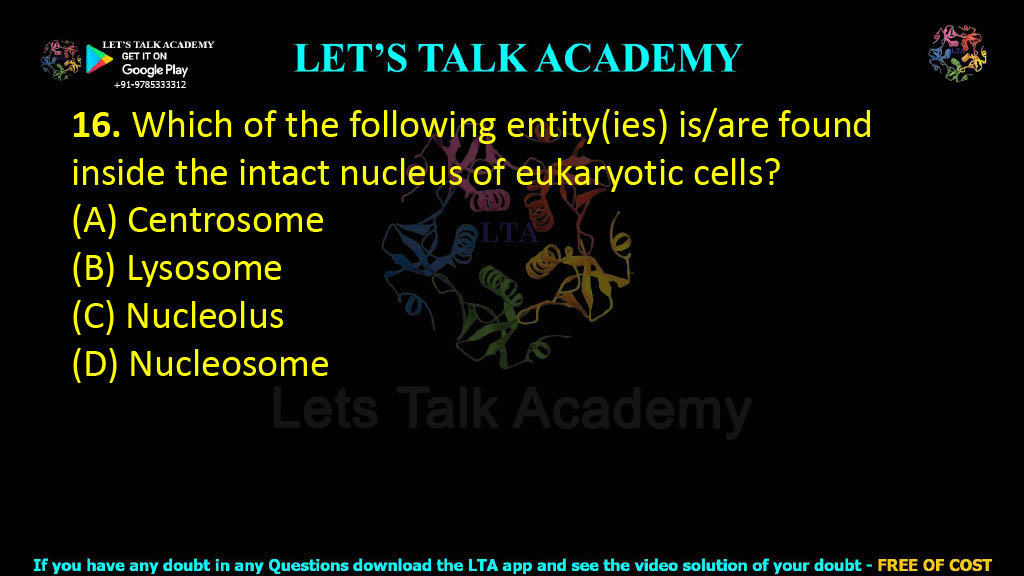
16. Which of the following entity(ies) is/are found inside the intact nucleus of eukaryotic cells?
(A) Centrosome
(B) Lysosome
(C) Nucleolus
(D) Nucleosome
Structures Found Inside the Intact Nucleus of Eukaryotic Cells: Nucleolus and Nucleosome
Introduction
The nucleus is the defining organelle of eukaryotic cells and serves as the control center that stores, protects, and regulates the expression of genetic information. It is enclosed by a double-membrane nuclear envelope containing nuclear pores that regulate the movement of molecules between the nucleus and cytoplasm. Within the nucleus are several specialized structures responsible for DNA organization, RNA synthesis, ribosome production, and gene regulation. Understanding which cellular components are located inside the nucleus and which remain in the cytoplasm is one of the most fundamental concepts in cell biology.
Correct Answer
Correct Option: (C) and (D)
Detailed Explanation
The intact nucleus of a eukaryotic cell contains several highly organized structures that are directly involved in maintaining genetic information and regulating gene expression. Two important nuclear components are the nucleolus, which functions as the site of ribosomal RNA synthesis and ribosome assembly, and the nucleosome, which represents the fundamental repeating unit of chromatin responsible for packaging DNA around histone proteins.
In contrast, centrosomes and lysosomes are cytoplasmic organelles. Centrosomes organize microtubules and form the mitotic spindle during cell division, whereas lysosomes function as intracellular digestive organelles responsible for degradation and recycling of cellular materials. Since neither of these structures is located inside an intact nucleus, they are incorrect options.
Explanation of Each Option
Option (A): Centrosome
This statement is incorrect. The centrosome is located in the cytoplasm, usually close to the nucleus, but it is not enclosed within the nuclear envelope. It consists of two centrioles surrounded by pericentriolar material and serves as the major microtubule-organizing center (MTOC) of animal cells. During mitosis, centrosomes migrate to opposite poles of the cell and organize the mitotic spindle required for chromosome segregation. Because centrosomes remain outside the intact nucleus, this option is incorrect.
Option (B): Lysosome
This statement is incorrect. Lysosomes are membrane-bound cytoplasmic organelles containing numerous hydrolytic enzymes that digest damaged organelles, pathogens, and macromolecules. They participate in intracellular digestion, autophagy, and recycling of cellular components. Since lysosomes are located exclusively in the cytoplasm and are never found inside an intact nucleus, this option is also incorrect.
Option (C): Nucleolus
This statement is correct. The nucleolus is a dense, non-membrane-bound structure located within the nucleus. It is the primary site of ribosomal RNA (rRNA) transcription, processing, and ribosome subunit assembly. Ribosomal proteins synthesized in the cytoplasm enter the nucleus and combine with newly synthesized rRNA in the nucleolus to form the large and small ribosomal subunits. These subunits are then exported through nuclear pores to the cytoplasm, where they participate in protein synthesis. The nucleolus is therefore one of the most prominent structures within the intact nucleus.
Option (D): Nucleosome
This statement is correct. The nucleosome is the fundamental structural unit of chromatin found throughout the nucleus. It consists of approximately 147 base pairs of DNA wrapped around an octamer of histone proteins composed of two molecules each of histones H2A, H2B, H3, and H4. Histone H1 associates with linker DNA to promote higher-order chromatin folding. Nucleosomes compact DNA efficiently while simultaneously regulating DNA replication, transcription, recombination, and repair. Since nucleosomes are integral components of nuclear chromatin, they are present inside every intact eukaryotic nucleus.
Why the Correct Answer is (C) and (D)
The nucleolus and nucleosomes are both essential nuclear structures. The nucleolus carries out ribosome biogenesis, whereas nucleosomes package genomic DNA into chromatin. Both are located entirely within the intact nucleus. Conversely, centrosomes and lysosomes are cytoplasmic organelles that remain outside the nuclear envelope. Therefore, the correct answer is Options (C) and (D).
Why the Other Options are Incorrect
Why Option (A) is Incorrect
Centrosomes function as microtubule-organizing centers in the cytoplasm and participate in spindle formation during mitosis. They are positioned outside the nuclear envelope and are not nuclear components.
Why Option (B) is Incorrect
Lysosomes are membrane-bound digestive organelles located in the cytoplasm. They degrade macromolecules and damaged organelles but are never found within an intact nucleus.
Comparison of All Options
| Option | Structure | Located Inside Intact Nucleus? | Main Function |
|---|---|---|---|
| A | Centrosome | No | Microtubule organization and spindle formation |
| B | Lysosome | No | Intracellular digestion and recycling |
| C | Nucleolus | Yes | rRNA synthesis and ribosome assembly |
| D | Nucleosome | Yes | DNA packaging and chromatin organization |
Major Structures Found Inside the Eukaryotic Nucleus
| Structure | Primary Function |
|---|---|
| Nucleolus | Ribosomal RNA synthesis and ribosome assembly |
| Chromatin | Storage and regulation of genetic information |
| Nucleosomes | Packaging DNA around histone proteins |
| Nuclear Lamina | Provides structural support to the nucleus |
| Nuclear Pores | Regulate transport between nucleus and cytoplasm |
Comparison Between Nuclear and Cytoplasmic Structures
| Nuclear Structures | Cytoplasmic Structures |
|---|---|
| Nucleolus | Centrosome |
| Nucleosome | Lysosome |
| Chromatin | Mitochondrion |
| Nuclear Lamina | Golgi Apparatus |
| Nuclear Pores | Endoplasmic Reticulum |
Biological Significance of the Nucleolus and Nucleosome
The nucleolus is essential for ribosome production, making it indispensable for protein synthesis and cellular growth. Rapidly dividing cells often possess large and prominent nucleoli because of their increased demand for ribosome biogenesis. Nucleosomes, on the other hand, compact nearly two meters of DNA into the microscopic nucleus while simultaneously regulating access to genetic information. Through histone modifications and chromatin remodeling, nucleosomes play central roles in transcription, DNA replication, DNA repair, epigenetic regulation, and chromosome organization.
Final Answer
Correct Option: (C) and (D)
The nucleolus and nucleosome are both located inside the intact nucleus of eukaryotic cells. The nucleolus is responsible for ribosomal RNA synthesis and ribosome assembly, while nucleosomes package DNA into chromatin. In contrast, centrosomes and lysosomes are cytoplasmic organelles and are not found within the intact nucleus.


