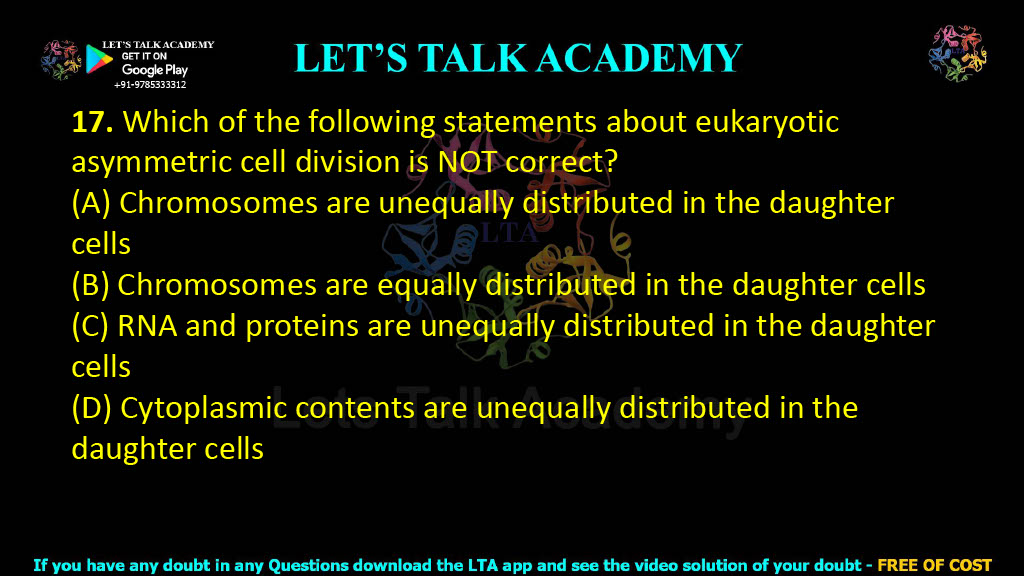
17. Which of the following statements about eukaryotic asymmetric cell division is NOT correct?
(A) Chromosomes are unequally distributed in the daughter cells
(B) Chromosomes are equally distributed in the daughter cells
(C) RNA and proteins are unequally distributed in the daughter cells
(D) Cytoplasmic contents are unequally distributed in the daughter cells
Eukaryotic Asymmetric Cell Division
Introduction
Cell division is one of the most fundamental biological processes responsible for growth, development, tissue maintenance, and reproduction. In multicellular eukaryotes, cell division occurs in two principal forms: symmetric cell division and asymmetric cell division. Symmetric division generates two daughter cells that are nearly identical in size, genetic content, and developmental potential. In contrast, asymmetric cell division produces daughter cells that differ in their molecular composition, developmental fate, or function, allowing organisms to generate cellular diversity during embryonic development and tissue regeneration.
Although asymmetric cell division produces daughter cells with different biological identities, the process normally preserves equal distribution of genetic material. The asymmetry arises from unequal inheritance of cytoplasmic determinants such as messenger RNAs, proteins, organelles, signaling molecules, and other cellular components rather than unequal chromosome segregation.
Correct Answer
Correct Option: (A) Chromosomes are unequally distributed in the daughter cells
Detailed Explanation
Asymmetric cell division is a specialized type of mitotic division in which two genetically identical daughter cells inherit different amounts of cytoplasmic determinants and consequently adopt distinct developmental fates. During this process, chromosomes are segregated equally so that each daughter cell receives one complete copy of the genome. However, messenger RNAs, proteins, signaling molecules, transcription factors, cell fate determinants, and various cytoplasmic organelles are distributed unequally. These molecular differences activate distinct gene expression programs, allowing the daughter cells to acquire different structures and functions.
The unequal distribution of cytoplasmic components is achieved through the establishment of cell polarity before mitosis. Polarity proteins orient the mitotic spindle and localize specific RNAs and proteins to one side of the cell. During cytokinesis, these determinants are inherited preferentially by one daughter cell, while the other receives a different molecular composition. Because chromosome segregation remains accurate and equal, asymmetric cell division maintains genomic stability while generating functional diversity.
Explanation of Each Option
Option (A): Chromosomes are Unequally Distributed in the Daughter Cells
This statement is incorrect and is therefore the correct answer. In normal eukaryotic asymmetric cell division, chromosomes are distributed equally between the two daughter cells through the mitotic spindle. Equal chromosome segregation ensures that both daughter cells inherit the same genetic information and maintain genomic stability. Unequal chromosome segregation would produce aneuploidy and is generally associated with chromosomal abnormalities, developmental disorders, or cancer rather than normal asymmetric cell division.
Option (B): Chromosomes are Equally Distributed in the Daughter Cells
This statement is correct. Despite differences in cell fate and cytoplasmic composition, the mitotic machinery ensures precise segregation of sister chromatids so that each daughter cell receives an identical chromosome complement. Equal chromosome distribution distinguishes normal asymmetric division from abnormal mitotic events that result in chromosome imbalance.
Option (C): RNA and Proteins are Unequally Distributed in the Daughter Cells
This statement is correct. One of the defining features of asymmetric cell division is the unequal inheritance of messenger RNAs, regulatory proteins, transcription factors, signaling molecules, and other cell fate determinants. These molecules influence gene expression after cell division, causing the daughter cells to differentiate into distinct cell types despite possessing identical genomes.
Option (D): Cytoplasmic Contents are Unequally Distributed in the Daughter Cells
This statement is correct. During asymmetric division, cytoplasmic organelles, signaling molecules, metabolites, and developmental determinants are partitioned unequally. This unequal cytoplasmic inheritance contributes directly to differences in cellular behavior, differentiation, self-renewal capacity, and developmental potential. Stem cell divisions commonly utilize this mechanism to generate one stem cell and one differentiated daughter cell.
Why Option (A) is Correct
The question asks for the statement that is NOT correct. Normal asymmetric cell division preserves equal chromosome segregation while creating asymmetry through unequal distribution of cytoplasmic determinants. Since chromosomes are not distributed unequally under normal conditions, Option (A) is the incorrect statement and therefore the correct answer.
Why the Other Options are Correct
Why Option (B) is Correct
The mitotic spindle ensures accurate chromosome segregation, allowing both daughter cells to inherit identical genetic information regardless of differences in developmental fate.
Why Option (C) is Correct
Localized RNAs and proteins serve as cell fate determinants that become unequally partitioned during cytokinesis, driving differential gene expression in the daughter cells.
Why Option (D) is Correct
Unequal inheritance of cytoplasmic contents is a hallmark of asymmetric cell division and is responsible for generating daughter cells with distinct identities and biological functions.
Comparison of All Options
| Option | Statement | Correct for Asymmetric Cell Division? | Explanation |
|---|---|---|---|
| A | Chromosomes are unequally distributed | No | Chromosomes are normally segregated equally. |
| B | Chromosomes are equally distributed | Yes | Maintains genomic stability in both daughter cells. |
| C | RNA and proteins are unequally distributed | Yes | Produces different cell fates. |
| D | Cytoplasmic contents are unequally distributed | Yes | Generates functional and developmental asymmetry. |
Comparison Between Symmetric and Asymmetric Cell Division
| Feature | Symmetric Cell Division | Asymmetric Cell Division |
|---|---|---|
| Chromosome Distribution | Equal | Equal |
| RNA Distribution | Nearly Equal | Unequal |
| Protein Distribution | Nearly Equal | Unequal |
| Cytoplasmic Contents | Nearly Equal | Unequal |
| Daughter Cell Fate | Identical | Different |
| Major Function | Growth and Tissue Maintenance | Development and Cell Differentiation |
Mechanism of Asymmetric Cell Division
Asymmetric cell division begins with the establishment of cell polarity through polarity proteins such as the PAR complex. Cell fate determinants become localized to specific regions of the cytoplasm before mitosis. The mitotic spindle aligns according to this polarity axis, ensuring that these determinants are inherited preferentially by one daughter cell during cytokinesis. Although both daughter cells receive identical chromosomes, differences in inherited RNAs, proteins, signaling molecules, and organelles activate distinct transcriptional programs, ultimately producing different cellular phenotypes.
Biological Significance of Asymmetric Cell Division
Asymmetric cell division is essential for embryonic development, tissue patterning, stem cell maintenance, organ formation, and regeneration. Neural stem cells, epithelial stem cells, hematopoietic stem cells, and many developmental precursor cells rely on asymmetric division to simultaneously maintain a stem cell population while generating differentiated progeny. Failure of this process can lead to developmental abnormalities, depletion of stem cells, or uncontrolled cell proliferation associated with cancer.
Final Answer
Correct Option: (A) Chromosomes are unequally distributed in the daughter cells
During normal eukaryotic asymmetric cell division, chromosomes are distributed equally to maintain identical genetic information in both daughter cells. The asymmetry arises from the unequal inheritance of RNAs, proteins, cytoplasmic determinants, and other cellular components, which ultimately produce daughter cells with different developmental fates and functions.


