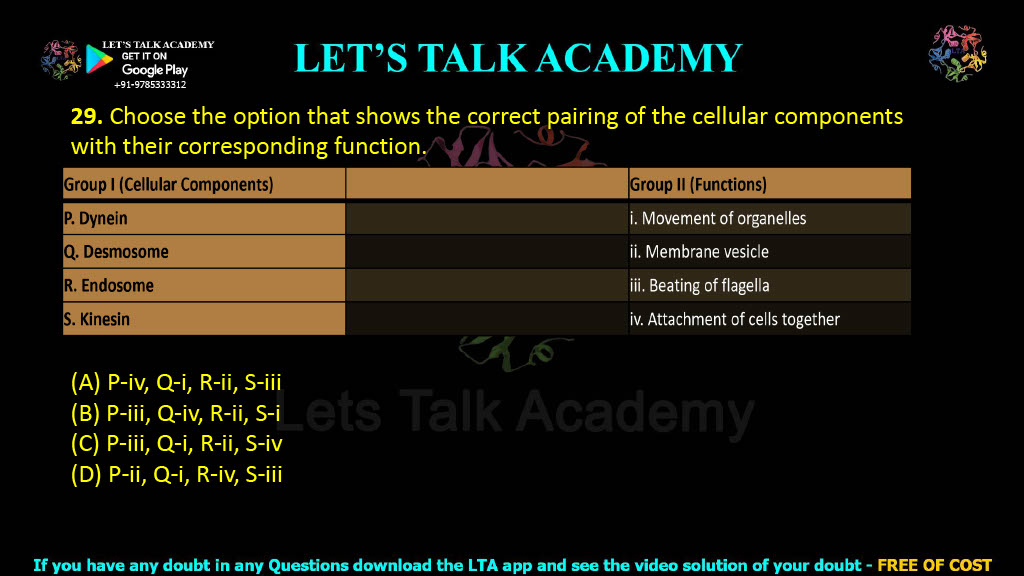
29. Choose the option that shows the correct pairing of the cellular components with their corresponding function.
P. Dynein i. Movement of organelles
Q. Desmosome ii. Membrane vesicle
R. Endosome iii. Beating of flagella
S. Kinesin iv. Attachment of cells together
(A) P-iv, Q-i, R-ii, S-iii
(B) P-iii, Q-iv, R-ii, S-i
(C) P-iii, Q-i, R-ii, S-iv
(D) P-ii, Q-i, R-iv, S-iii
Dynein, Desmosome, Endosome and Kinesin Functions
Introduction
Eukaryotic cells contain highly specialized proteins and organelles that coordinate intracellular transport, cell adhesion, membrane trafficking, and cellular movement. Motor proteins such as dynein and kinesin transport cargo along microtubules, while specialized junctions such as desmosomes provide strong mechanical attachment between neighboring cells. Membrane-bound compartments such as endosomes regulate intracellular trafficking by sorting molecules that enter the cell through endocytosis.
Understanding the functions of these cellular components is fundamental in Cell Biology because they are essential for tissue organization, intracellular communication, vesicle transport, organelle movement, and cell motility.
Correct Answer
Correct Option: (B) P-iii, Q-iv, R-ii, S-i
Detailed Explanation
Each cellular component listed in this question performs a highly specialized biological function. Dynein is a microtubule-associated motor protein responsible for the beating of cilia and flagella and for retrograde intracellular transport. Desmosomes are specialized cell junctions that firmly attach neighboring cells by linking intermediate filaments, thereby providing mechanical strength to tissues. Endosomes are membrane-bound vesicular compartments involved in sorting, recycling, and transporting materials internalized by endocytosis. Kinesin is another motor protein that transports vesicles, organelles, and protein complexes toward the plus end of microtubules.
Therefore, the correct pairing is:
P → iii (Beating of flagella)
Q → iv (Attachment of cells together)
R → ii (Membrane vesicle)
S → i (Movement of organelles)
This combination corresponds to Option (B).
Explanation of Each Cellular Component
P. Dynein → Beating of Flagella (iii)
This pairing is correct. Dynein is a microtubule motor protein that moves toward the minus end of microtubules using energy derived from ATP hydrolysis. Axonemal dynein generates the sliding movement between adjacent microtubule doublets inside cilia and flagella, producing their characteristic beating motion. Cytoplasmic dynein also participates in retrograde transport of vesicles and organelles toward the centrosome.
Q. Desmosome → Attachment of Cells Together (iv)
This pairing is correct. Desmosomes are strong adhesive junctions found abundantly in epithelial tissues and cardiac muscle. They connect intermediate filaments of adjacent cells through cadherin family proteins such as desmoglein and desmocollin. Their primary function is to provide mechanical strength and resist physical stress.
R. Endosome → Membrane Vesicle (ii)
This pairing is correct. Endosomes are membrane-bound vesicular compartments formed during endocytosis. They receive internalized molecules from the plasma membrane and function as sorting stations that determine whether cargo is recycled back to the membrane, transported to lysosomes for degradation, or directed to other intracellular destinations.
S. Kinesin → Movement of Organelles (i)
This pairing is correct. Kinesin is a plus-end-directed microtubule motor protein responsible for anterograde transport of vesicles, mitochondria, lysosomes, secretory granules, chromosomes, and other organelles. It plays a particularly important role in neuronal axonal transport, where materials are moved efficiently over long intracellular distances.
Explanation of Each Option
Option (A): P-iv, Q-i, R-ii, S-iii
This option is incorrect. Dynein does not function in cell attachment, desmosomes do not transport organelles, and kinesin does not generate flagellar beating.
Option (B): P-iii, Q-iv, R-ii, S-i
This option is correct. Every cellular component is accurately matched with its primary biological function according to standard Cell Biology.
Option (C): P-iii, Q-i, R-ii, S-iv
This option is incorrect. Although dynein and endosome are correctly matched, desmosomes do not move organelles, and kinesin does not mediate cell-cell attachment.
Option (D): P-ii, Q-i, R-iv, S-iii
This option is incorrect. None of these pairings correctly represents the major biological functions of the listed cellular components.
Why Option (B) is Correct
Option (B) correctly associates dynein with flagellar movement, desmosomes with cell adhesion, endosomes with membrane vesicles involved in intracellular trafficking, and kinesin with movement of organelles. Each pairing reflects the well-established physiological role of these cellular structures.
Comparison of All Cellular Components
| Cellular Component | Main Function | Cellular Location |
|---|---|---|
| Dynein | Flagellar beating and retrograde transport | Microtubules, cilia and flagella |
| Desmosome | Strong cell-cell adhesion | Plasma membrane of adjacent cells |
| Endosome | Sorting and trafficking of endocytosed molecules | Cytoplasm |
| Kinesin | Anterograde movement of organelles | Microtubules |
Correct Matching Table
| Group I | Correct Match | Function |
|---|---|---|
| P. Dynein | iii | Beating of flagella |
| Q. Desmosome | iv | Attachment of cells together |
| R. Endosome | ii | Membrane vesicle |
| S. Kinesin | i | Movement of organelles |
Comparison Between Dynein and Kinesin
| Feature | Dynein | Kinesin |
|---|---|---|
| Direction of Movement | Toward minus end of microtubules | Toward plus end of microtubules |
| Main Transport | Retrograde transport | Anterograde transport |
| Additional Function | Beating of cilia and flagella | Movement of vesicles and organelles |
| Energy Source | ATP hydrolysis | ATP hydrolysis |
Biological Significance of These Cellular Components
Dynein and kinesin maintain efficient intracellular transport, which is essential for neuronal function, secretion, cell division, and organelle positioning. Desmosomes provide structural integrity to tissues subjected to mechanical stress, such as the skin and cardiac muscle. Endosomes regulate receptor recycling, nutrient uptake, antigen processing, and intracellular trafficking. Together, these structures ensure proper communication, transport, adhesion, and organization within eukaryotic cells.
Final Answer
Correct Option: (B) P-iii, Q-iv, R-ii, S-i
The correct pairing is Dynein → Beating of flagella, Desmosome → Attachment of cells together, Endosome → Membrane vesicle, and Kinesin → Movement of organelles. These cellular components play essential roles in intracellular transport, cell adhesion, membrane trafficking, and cellular motility.


