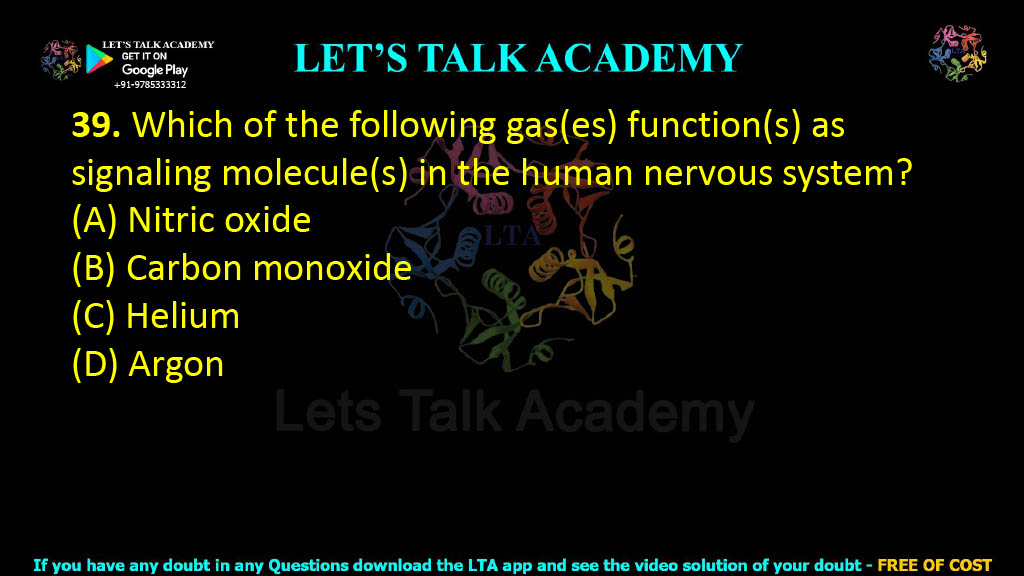
39. Which of the following gas(es) function(s) as signaling molecule(s) in the human nervous system?
(A) Nitric oxide
(B) Carbon monoxide
(C) Helium
(D) Argon
Gaseous Signaling Molecules in the Human Nervous System
Introduction
Cell-to-cell communication is essential for coordinating physiological activities in multicellular organisms. While many signaling molecules are proteins, peptides, hormones, or neurotransmitters, certain small gaseous molecules also function as important signaling mediators. These molecules are collectively known as gasotransmitters. Unlike conventional neurotransmitters that are stored in synaptic vesicles and released by exocytosis, gaseous signaling molecules are synthesized on demand and diffuse freely across plasma membranes without requiring membrane-bound receptors.
In the human nervous system, gaseous signaling molecules regulate neuronal communication, synaptic plasticity, smooth muscle relaxation, blood flow, immune responses, and memory formation. Among the recognized gasotransmitters, nitric oxide (NO) and carbon monoxide (CO) play important physiological roles. In contrast, inert noble gases such as helium and argon do not function as endogenous signaling molecules in humans.
Correct Answer
Correct Answer: (A) Nitric Oxide and (B) Carbon Monoxide
Detailed Explanation
The human nervous system utilizes several classes of signaling molecules, including neurotransmitters, neuropeptides, hormones, and gaseous mediators. Among gaseous molecules, nitric oxide (NO) and carbon monoxide (CO) are recognized physiological signaling molecules. Both gases are synthesized enzymatically within cells, diffuse rapidly through biological membranes, and activate intracellular signaling pathways without binding to conventional membrane receptors.
Nitric oxide is synthesized from the amino acid L-arginine by the enzyme nitric oxide synthase (NOS). Once produced, NO diffuses into neighboring cells and activates soluble guanylyl cyclase, leading to increased cyclic GMP (cGMP) production. This signaling pathway regulates vasodilation, neurotransmission, synaptic plasticity, learning, memory, and smooth muscle relaxation.
Carbon monoxide is produced endogenously by the enzyme heme oxygenase during the degradation of heme. Although carbon monoxide is toxic at high concentrations, small physiological amounts function as signaling molecules in the nervous system, regulating neuronal communication, vascular tone, anti-inflammatory responses, and cyclic GMP signaling.
Helium and argon are chemically inert noble gases. Although they have been investigated experimentally for neuroprotective and anesthetic properties, they are not synthesized by human cells and do not function as endogenous signaling molecules in the nervous system.
Explanation of Each Option
Option (A): Nitric Oxide
This statement is correct. Nitric oxide is one of the best-characterized gaseous signaling molecules in mammals. It is synthesized by nitric oxide synthase and functions as a neurotransmitter, paracrine messenger, and vasodilator. NO diffuses rapidly across cell membranes and activates soluble guanylyl cyclase, increasing intracellular cGMP levels and regulating numerous physiological processes.
Option (B): Carbon Monoxide
This statement is correct. Carbon monoxide is generated by heme oxygenase and functions as an endogenous gasotransmitter. It participates in neuronal signaling, vascular regulation, anti-inflammatory responses, and modulation of cyclic GMP signaling pathways.
Option (C): Helium
This statement is incorrect. Helium is an inert noble gas that does not function as an endogenous signaling molecule. Although it has been studied for potential therapeutic applications under experimental conditions, it is not involved in physiological signal transduction in humans.
Option (D): Argon
This statement is incorrect. Argon is another chemically inert noble gas. Similar to helium, it has been investigated for possible neuroprotective effects in research studies but is not produced naturally by human cells and does not function as a physiological signaling molecule.
Why Options (A) and (B) are Correct
Nitric oxide and carbon monoxide satisfy the defining characteristics of gasotransmitters. They are synthesized enzymatically within cells, diffuse freely through biological membranes, act locally without vesicular storage, regulate intracellular signaling pathways, and participate in normal physiological functions within the nervous system.
Why the Other Options are Incorrect
Why Option (C) is Incorrect
Helium is chemically inert and does not participate in endogenous cellular signaling pathways.
Why Option (D) is Incorrect
Argon is not synthesized by human cells and has no established physiological role as a signaling molecule.
Comparison of All Options
| Option | Gas | Functions as Signaling Molecule? | Reason |
|---|---|---|---|
| A | Nitric Oxide (NO) | Yes | Major endogenous gasotransmitter involved in cGMP signaling. |
| B | Carbon Monoxide (CO) | Yes | Produced by heme oxygenase and functions in neuronal signaling. |
| C | Helium (He) | No | Inert noble gas with no endogenous signaling role. |
| D | Argon (Ar) | No | Inert noble gas, not a physiological signaling molecule. |
Major Gasotransmitters in Humans
| Gasotransmitter | Enzyme Producing It | Major Biological Functions |
|---|---|---|
| Nitric Oxide (NO) | Nitric Oxide Synthase (NOS) | Neurotransmission, vasodilation, memory, smooth muscle relaxation |
| Carbon Monoxide (CO) | Heme Oxygenase (HO) | Neuronal signaling, vascular regulation, anti-inflammatory effects |
| Hydrogen Sulfide (H₂S) | Cystathionine β-Synthase and Cystathionine γ-Lyase | Neuromodulation, vascular regulation, cytoprotection |
Comparison Between Nitric Oxide and Carbon Monoxide
| Feature | Nitric Oxide | Carbon Monoxide |
|---|---|---|
| Source | Nitric Oxide Synthase | Heme Oxygenase |
| Diffuses Across Membranes | Yes | Yes |
| Activates Guanylyl Cyclase | Yes | Yes |
| Major Role | Neurotransmission and vasodilation | Neuromodulation and vascular regulation |
Biological Significance of Gaseous Signaling Molecules
Gasotransmitters provide rapid and localized communication between neighboring cells because they diffuse freely through biological membranes without requiring membrane transporters or vesicular release. Nitric oxide plays a central role in learning, memory, long-term potentiation, cerebral blood flow, immune defense, and cardiovascular physiology. Carbon monoxide contributes to neuronal survival, regulation of inflammation, and maintenance of vascular homeostasis. Together with hydrogen sulfide, these molecules form an important class of unconventional signaling mediators that complement classical neurotransmitters.
Final Answer
Correct Answer: (A) Nitric Oxide and (B) Carbon Monoxide
Nitric oxide (NO) and carbon monoxide (CO) are endogenous gaseous signaling molecules that regulate neuronal communication, vascular function, and intracellular signaling in the human nervous system. In contrast, helium and argon are inert noble gases and do not function as physiological signaling molecules.


