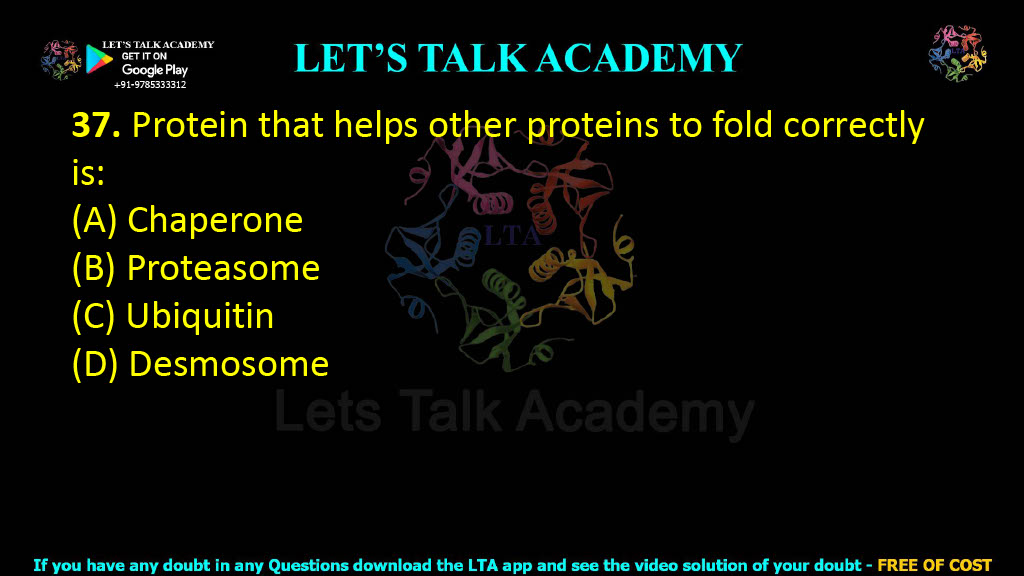
37. Protein that helps other proteins to fold correctly is:
(A) Chaperone
(B) Proteasome
(C) Ubiquitin
(D) Desmosome
Chaperone Proteins: Molecular Helpers of Protein Folding
Introduction
Proteins perform nearly every biological function within a cell, including catalysis, transport, signaling, structural support, and regulation of gene expression. However, newly synthesized polypeptide chains are not immediately functional. They must fold into a precise three-dimensional structure to acquire biological activity. Incorrect protein folding can produce inactive proteins, toxic protein aggregates, and numerous human diseases such as Alzheimer’s disease, Parkinson’s disease, Huntington’s disease, and prion disorders.
To prevent these problems, cells possess a specialized group of proteins called molecular chaperones. These proteins assist newly synthesized or partially unfolded proteins in achieving their correct three-dimensional conformation without becoming part of the final protein structure. Chaperones are therefore essential for maintaining protein homeostasis, particularly under conditions of heat shock, oxidative stress, and cellular damage.
Correct Answer
Correct Option: (A) Chaperone
Detailed Explanation
Molecular chaperones are proteins that facilitate the proper folding of newly synthesized polypeptides and assist in refolding proteins that have become partially unfolded due to environmental stress. Importantly, chaperones do not determine the final structure of proteins; instead, they prevent inappropriate interactions between exposed hydrophobic regions, thereby reducing protein aggregation and increasing the probability of correct folding.
Many molecular chaperones belong to the Heat Shock Protein (HSP) family because their expression increases dramatically in response to elevated temperatures and other cellular stresses. Well-known examples include Hsp70, which binds newly synthesized polypeptides emerging from ribosomes, and Hsp60 (chaperonins), which provides a protected environment where proteins can fold correctly. Other important chaperones include Hsp90 and small heat shock proteins.
Without molecular chaperones, cells would accumulate misfolded proteins that interfere with normal cellular function and contribute to numerous diseases.
Explanation of Each Option
Option (A): Chaperone
This statement is correct. Chaperones assist proteins in achieving their correct three-dimensional conformation without becoming part of the final protein structure. They prevent aggregation of unfolded proteins, stabilize folding intermediates, promote proper protein assembly, and help refold proteins damaged by cellular stress. Chaperones are essential for protein quality control in every living cell.
Option (B): Proteasome
This statement is incorrect. The proteasome is a large ATP-dependent protein complex responsible for degrading unwanted, damaged, or misfolded proteins. Proteins destined for degradation are first tagged with ubiquitin molecules and subsequently destroyed by the 26S proteasome. Therefore, proteasomes degrade proteins rather than assist in their folding.
Option (C): Ubiquitin
This statement is incorrect. Ubiquitin is a small regulatory protein that covalently attaches to proteins targeted for degradation. Polyubiquitinated proteins are recognized by the proteasome and degraded into peptides. Ubiquitin functions as a degradation signal rather than a protein-folding factor.
Option (D): Desmosome
This statement is incorrect. Desmosomes are specialized cell-cell junctions that provide strong mechanical attachment between neighboring cells, particularly in epithelial tissues and cardiac muscle. They have no role in protein folding or intracellular protein quality control.
Why Option (A) is Correct
Chaperones specifically recognize unfolded or partially folded proteins and facilitate their proper folding while preventing aggregation. This activity is essential for maintaining the functional proteome of the cell and ensuring that newly synthesized proteins become biologically active.
Why the Other Options are Incorrect
Why Option (B) is Incorrect
Proteasomes degrade damaged or misfolded proteins instead of assisting protein folding.
Why Option (C) is Incorrect
Ubiquitin labels proteins for degradation by the proteasome and does not participate in folding reactions.
Why Option (D) is Incorrect
Desmosomes function in cell adhesion and tissue integrity rather than intracellular protein processing.
Comparison of All Options
| Option | Cellular Component | Main Function | Correct or Incorrect |
|---|---|---|---|
| A | Chaperone | Assists proper protein folding | Correct |
| B | Proteasome | Degrades ubiquitinated proteins | Incorrect |
| C | Ubiquitin | Tags proteins for degradation | Incorrect |
| D | Desmosome | Cell-cell adhesion | Incorrect |
Major Molecular Chaperones
| Chaperone | Major Function |
|---|---|
| Hsp70 | Assists folding of newly synthesized proteins |
| Hsp60 (Chaperonin) | Provides isolated chamber for protein folding |
| Hsp90 | Maturation of signaling proteins and receptors |
| Small Heat Shock Proteins | Prevent protein aggregation during stress |
Difference Between Chaperone, Ubiquitin and Proteasome
| Feature | Chaperone | Ubiquitin | Proteasome |
|---|---|---|---|
| Main Function | Protein folding | Protein tagging | Protein degradation |
| Acts On | Newly synthesized or unfolded proteins | Damaged proteins | Ubiquitinated proteins |
| Requires ATP | Many chaperones require ATP | No | Yes |
| Final Outcome | Functional protein | Marks protein for destruction | Protein degradation |
Biological Significance of Chaperone Proteins
Molecular chaperones are indispensable for maintaining protein quality within cells. They ensure accurate protein folding during protein synthesis, assist in refolding proteins damaged by heat or oxidative stress, prevent formation of toxic protein aggregates, and contribute to the assembly of multisubunit protein complexes. Their activity is particularly important during cellular stress, where increased expression of heat shock proteins protects cells from protein denaturation. Defects in chaperone function are associated with neurodegenerative diseases, aging, cancer, and several inherited protein-folding disorders.
Final Answer
Correct Option: (A) Chaperone
Chaperones are specialized proteins that assist newly synthesized or unfolded proteins in achieving their correct three-dimensional structure while preventing aggregation. Unlike proteasomes, which degrade proteins, or ubiquitin, which labels proteins for degradation, molecular chaperones ensure proper protein folding and maintain cellular protein quality.


