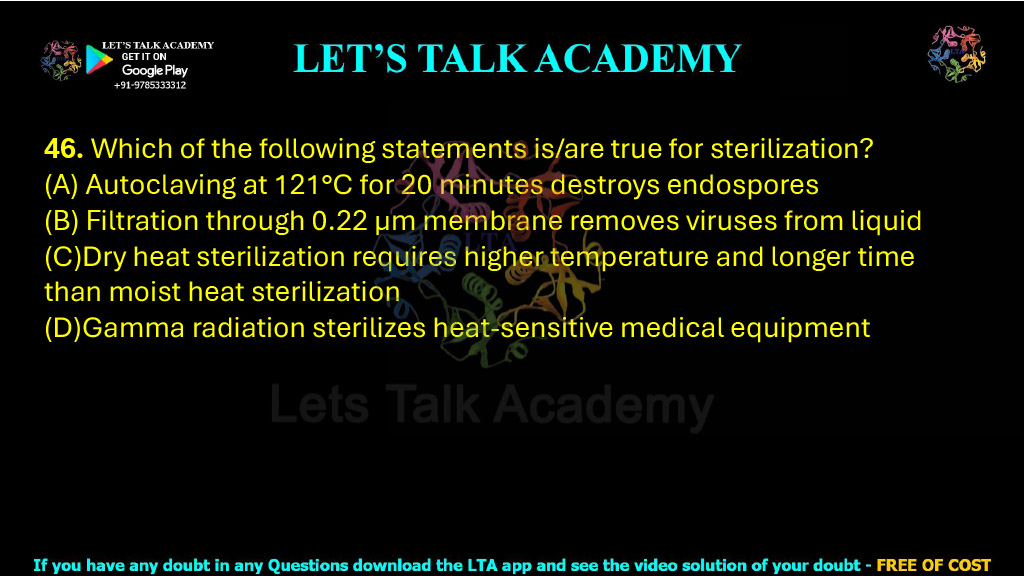
46. Which of the following statements is/are true for sterilization?
(A) Autoclaving at 121°C for 20 minutes destroys endospores
(B) Filtration through 0.22 μm membrane removes viruses from liquid
(C)Dry heat sterilization requires higher temperature and longer time than moist heat sterilization
(D)Gamma radiation sterilizes heat-sensitive medical equipment
Sterilization Methods Explained: Autoclaving, Filtration, Dry Heat, and Gamma Radiation
Introduction
Sterilization is the process of completely eliminating or destroying all forms of microbial life, including vegetative bacterial cells, bacterial endospores, fungi, fungal spores, protozoa, and viruses. It is one of the most fundamental procedures in microbiology, biotechnology, pharmaceutical industries, hospitals, food processing, tissue culture laboratories, and research institutions. Effective sterilization prevents contamination, ensures product safety, and protects human health.
Several sterilization methods are available, each designed for specific materials and applications. Moist heat sterilization using an autoclave is considered the most reliable method for sterilizing culture media, surgical instruments, and laboratory equipment because saturated steam under pressure efficiently destroys microorganisms, including highly resistant bacterial endospores. Dry heat sterilization is used for glassware, metal instruments, powders, and oils that cannot be sterilized by moist heat. Membrane filtration is suitable for heat-sensitive liquids such as antibiotics and vitamins, whereas gamma radiation is widely used for sterilizing disposable medical devices that cannot withstand heat.
Correct Answer
Correct Options: (A), (C), and (D)
Detailed Explanation
Sterilization methods differ in their mechanisms of microbial destruction. Moist heat kills microorganisms primarily by denaturing proteins and nucleic acids, whereas dry heat destroys cells through oxidative damage and dehydration. Radiation damages microbial DNA, while membrane filtration physically removes microorganisms from liquids without exposing them to heat.
An autoclave typically operates at 121°C under 15 psi pressure for 15–20 minutes. Under these conditions, saturated steam effectively destroys even highly resistant bacterial endospores, making moist heat sterilization the gold standard in microbiology laboratories.
Dry heat sterilization is comparatively less efficient because dry air transfers heat much more slowly than saturated steam. Consequently, higher temperatures and longer exposure times, such as 160–170°C for 2–3 hours, are required to achieve sterilization.
Gamma radiation possesses excellent penetrating ability and is therefore widely used to sterilize disposable syringes, surgical gloves, catheters, implants, sutures, and other heat-sensitive medical devices. Since no heat is involved, the physical properties of these materials remain largely unchanged.
Membrane filtration using a 0.22 μm filter efficiently removes bacteria and fungal spores from liquids. However, many viruses are considerably smaller than 0.22 μm and therefore can pass through the membrane. Consequently, standard membrane filtration does not reliably remove viruses.
Explanation of Each Option
Option (A): Autoclaving at 121°C for 20 Minutes Destroys Endospores
This statement is correct. Moist heat sterilization at 121°C under 15 psi pressure for approximately 15–20 minutes destroys vegetative cells, fungi, viruses, and highly resistant bacterial endospores. This is the standard sterilization protocol used worldwide.
Option (B): Filtration Through 0.22 μm Membrane Removes Viruses from Liquid
This statement is incorrect. Most viruses range from approximately 20–300 nm (0.02–0.30 μm). Many medically important viruses are much smaller than 0.22 μm and therefore pass through conventional membrane filters. Virus removal generally requires ultrafiltration, nanofiltration, or specialized viral filtration systems.
Option (C): Dry Heat Sterilization Requires Higher Temperature and Longer Time Than Moist Heat Sterilization
This statement is correct. Dry heat transfers thermal energy less efficiently than moist heat. As a result, sterilization requires temperatures of about 160–170°C for 2–3 hours, whereas moist heat achieves sterilization at only 121°C within 15–20 minutes.
Option (D): Gamma Radiation Sterilizes Heat-Sensitive Medical Equipment
This statement is correct. Gamma radiation penetrates packaging materials and effectively destroys microorganisms by causing DNA damage. It is widely used to sterilize disposable medical products that cannot tolerate heat or moisture.
Why Options (A), (C), and (D) are Correct
Autoclaving destroys bacterial endospores through moist heat, dry heat sterilization requires greater temperatures and exposure times than moist heat, and gamma radiation effectively sterilizes heat-sensitive medical equipment. Only the statement regarding virus removal by a 0.22 μm membrane filter is incorrect.
Comparison of All Options
| Option | Statement | Status |
|---|---|---|
| A | Autoclaving destroys endospores | Correct |
| B | 0.22 μm filter removes viruses | Incorrect |
| C | Dry heat requires higher temperature and longer time | Correct |
| D | Gamma radiation sterilizes heat-sensitive equipment | Correct |
Comparison of Sterilization Methods
| Method | Principle | Typical Conditions | Major Applications |
|---|---|---|---|
| Autoclaving | Moist heat | 121°C, 15 psi, 15–20 min | Culture media, instruments, laboratory materials |
| Dry Heat Oven | Oxidation and dehydration | 160–170°C for 2–3 h | Glassware, powders, oils |
| Membrane Filtration | Physical removal | 0.22 μm membrane | Heat-sensitive solutions |
| Gamma Radiation | DNA damage | Ionizing radiation | Disposable medical devices |
Autoclaving vs Dry Heat Sterilization
| Feature | Moist Heat | Dry Heat |
|---|---|---|
| Mechanism | Protein denaturation | Oxidation and dehydration |
| Temperature | 121°C | 160–170°C |
| Time | 15–20 minutes | 2–3 hours |
| Efficiency | Higher | Lower |
Biological Significance
Sterilization plays a crucial role in preventing microbial contamination in hospitals, pharmaceutical industries, biotechnology laboratories, and food production facilities. Proper selection of sterilization methods ensures patient safety, maintains product quality, prevents laboratory contamination, and minimizes healthcare-associated infections. Understanding the advantages and limitations of each method is essential for microbiologists, biotechnologists, clinicians, and quality control professionals.
Final Answer
The correct statements are:
- (A) Autoclaving at 121°C for 20 minutes destroys endospores.
- (C) Dry heat sterilization requires higher temperature and longer time than moist heat sterilization.
- (D) Gamma radiation is used to sterilize heat-sensitive medical equipment.
The statement that a 0.22 μm membrane filter removes viruses is incorrect because many viruses are smaller than the pore size.
Correct Answer: (A), (C), and (D)


