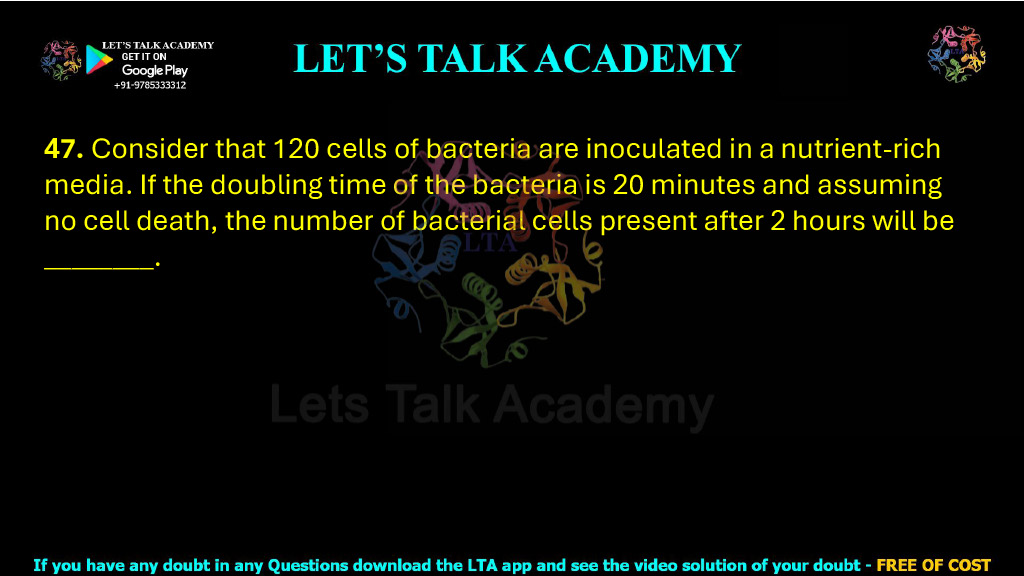
47. Consider that 120 cells of bacteria are inoculated in a nutrient-rich media. If the doubling time of the bacteria is 20 minutes and assuming no cell death, the number of bacterial cells present after 2 hours will be ________.
Bacterial Growth Calculation: Number of Bacterial Cells After 2 Hours Using Doubling Time Formula
Introduction
Bacteria reproduce through binary fission, one of the simplest and fastest modes of asexual reproduction. During binary fission, one bacterial cell divides into two genetically identical daughter cells. Under favorable environmental conditions such as sufficient nutrients, optimum temperature, appropriate pH, and adequate oxygen availability, bacterial populations increase exponentially. This exponential growth follows a predictable mathematical pattern that allows microbiologists to estimate the number of cells present after a given period.
The time required for a bacterial population to double is known as the doubling time or generation time. If the doubling time remains constant and there is no cell death, the bacterial population doubles after every generation. This principle forms the basis of microbial growth calculations and is widely applied in industrial fermentation, medical microbiology, food microbiology, biotechnology, and environmental microbiology.
Correct Answer
Correct Answer: 7,680 cells
Detailed Explanation
Since the bacteria are growing in a nutrient-rich medium and no cell death occurs, the population follows exponential growth. The standard equation used for bacterial growth is:
N = N0 × 2n
where:
- N = Final number of bacterial cells
- N0 = Initial number of bacterial cells
- n = Number of generations (doublings)
Step 1: Identify the Given Data
| Parameter | Value |
|---|---|
| Initial Population (N0) | 120 cells |
| Doubling Time | 20 minutes |
| Total Growth Time | 2 hours = 120 minutes |
| Cell Death | None |
Step 2: Calculate the Number of Generations
The number of generations is calculated using:
n = Total Time ÷ Doubling Time
n = 120 ÷ 20 = 6 generations
Step 3: Calculate the Final Population
Apply the exponential growth equation:
N = 120 × 26
Since:
26 = 64
Therefore:
N = 120 × 64
N = 7,680 cells
Step-by-Step Calculation Summary
| Calculation Step | Result |
|---|---|
| Initial Population | 120 cells |
| Total Time | 120 minutes |
| Doubling Time | 20 minutes |
| Number of Generations | 6 |
| Growth Factor | 26 = 64 |
| Final Population | 7,680 cells |
Formula Used in Bacterial Growth
| Formula | Purpose |
|---|---|
| N = N0 × 2n | Final bacterial population |
| n = t/g | Number of generations |
| g = t/n | Generation (doubling) time |
Growth Pattern During the 2-Hour Period
| Generation | Number of Cells |
|---|---|
| 0 | 120 |
| 1 | 240 |
| 2 | 480 |
| 3 | 960 |
| 4 | 1,920 |
| 5 | 3,840 |
| 6 | 7,680 |
Biological Significance
Bacterial growth calculations are fundamental in microbiology because they help estimate microbial populations during laboratory culture, industrial fermentation, clinical diagnostics, food preservation, and environmental monitoring. Knowledge of doubling time allows microbiologists to predict growth rates, optimize fermentation processes, evaluate antimicrobial treatments, and control microbial contamination. These calculations are also essential for designing experiments involving bacterial cultures.
Final Answer
Initial Population = 120 cells
Doubling Time = 20 minutes
Total Growth Time = 2 hours = 120 minutes
Number of Generations = 120 ÷ 20 = 6
Final Population = 120 × 26 = 120 × 64 = 7,680 cells
Correct Answer: 7,680 bacterial cells


