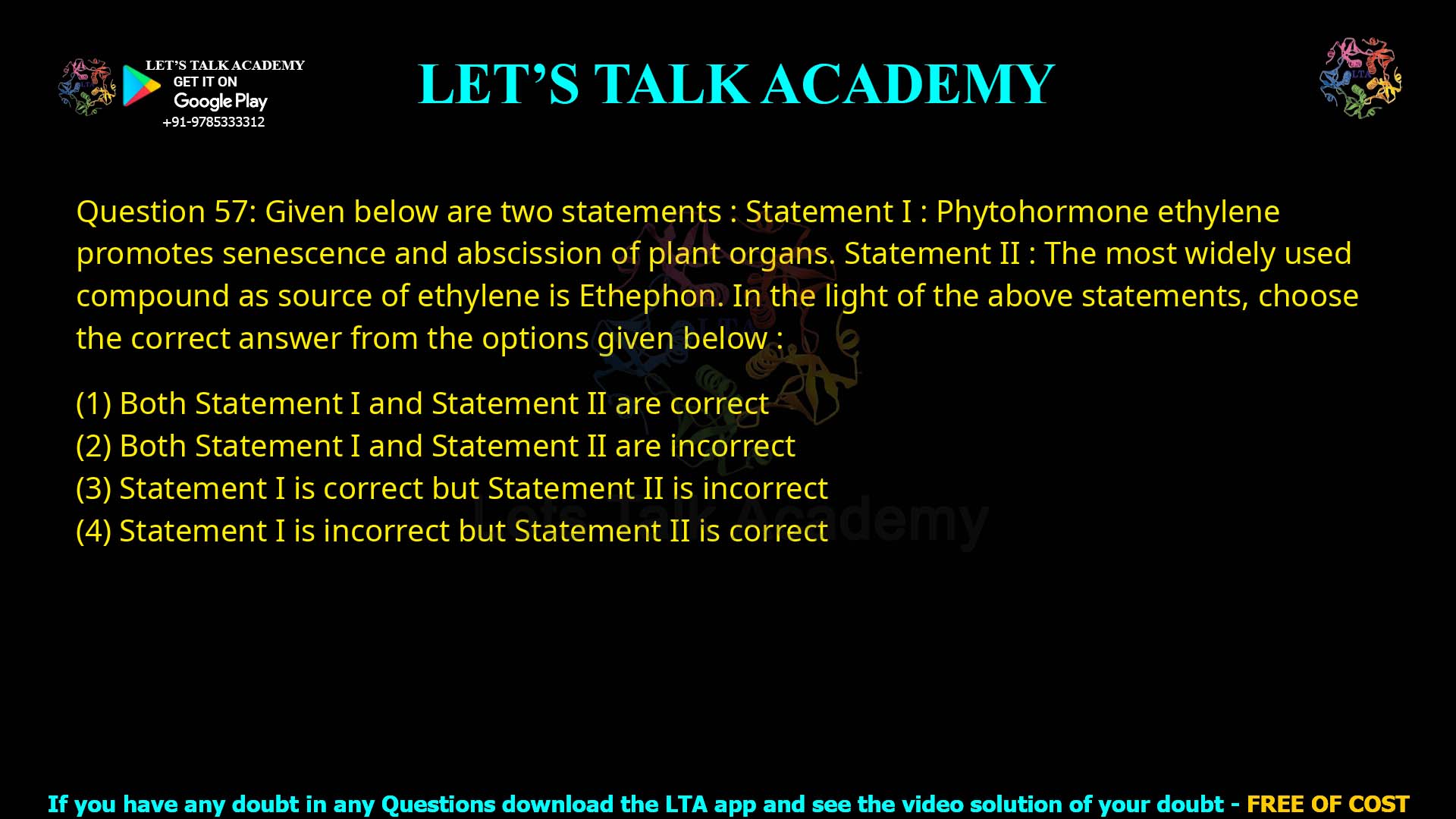
Q.57 Given below are two statements:
Phytohormone ethylene promotes senescence and abscission of plant organs.
The most widely used compound as source of ethylene is Ethephon.
In the light of the above statements, choose the correct answer
from the options given below:
- Both Statement I and Statement II are correct
- Both Statement I and Statement II are incorrect
- Statement I is correct but Statement II is incorrect
- Statement I is incorrect but Statement II is correct
Both Statement I and Statement II are correct.
Statement I Analysis
Ethylene, a gaseous phytohormone, indeed promotes senescence (aging) in leaves and flowers, as well as abscission (shedding) of plant organs like leaves, fruits, and flowers. This occurs by breaking cell walls in abscission zones and activating genes for ripening and deterioration.
Statement II Analysis
Ethephon (2-chloroethylphosphonic acid) is the most widely used commercial source of ethylene; in water at pH >4, it decomposes to release ethylene gas slowly, which plants absorb and transport. It is applied in agriculture for fruit ripening (e.g., tomatoes, apples) and abscission control.
Option Breakdown
Option Evaluation Reason Both Statement I and Statement II are correct Correct Matches verified facts on ethylene’s roles and ethephon’s use. Both Statement I and Statement II are incorrect Incorrect Contradicts established plant physiology. Statement I is correct but Statement II is incorrect Incorrect Ethephon is the standard ethylene source. Statement I is incorrect but Statement II is correct Incorrect Ethylene definitively promotes senescence/abscission. Phytohormone ethylene plays a key role in senescence and abscission, with ethephon as the most widely used ethylene source in agriculture. This guide breaks down the science for biology students preparing for competitive exams like NEET and GATE Life Sciences.
Role of Phytohormone Ethylene in Senescence
Phytohormone ethylene accelerates senescence by inducing enzyme activity that breaks down chlorophyll and proteins in leaves and flowers. It triggers yellowing and wilting, signaling the end of organ life cycles. In fruits, it promotes ripening alongside senescence.
Ethylene and Abscission Mechanism
Ethylene promotes abscission by forming a separation layer at the base of petioles or pedicels, where cellulase enzymes dissolve middle lamella. This leads to organ shedding in leaves, flowers, and fruits, aiding plant adaptation to stress.
Ethephon: Most Widely Used Ethylene Source
Ethephon releases ethylene slowly in aqueous solutions (pH >4), making it ideal for foliar sprays in crops like tomatoes, apples, and cotton. It hastens ripening, thins fruits, and controls abscission without needing gas chambers.
Exam Relevance
In questions on phytohormone ethylene senescence abscission ethephon, both statements are correct—ideal for assertion-reason types in NEET/GATE.


