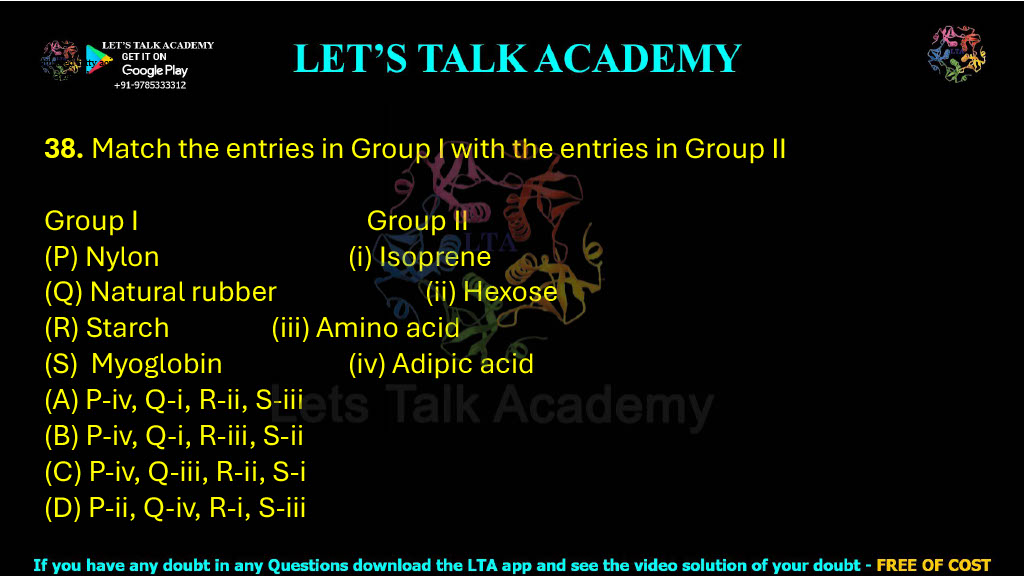
38. Match the entries in Group I with the entries in Group II
Group I Group II
(P) Nylon (i) Isoprene
(Q) Natural rubber (ii) Hexose
(R) Starch (iii) Amino acid
(S) Myoglobin (iv) Adipic acid
(A) P-iv, Q-i, R-ii, S-iii
(B) P-iv, Q-i, R-iii, S-ii
(C) P-iv, Q-iii, R-ii, S-i
(D) P-ii, Q-iv, R-i, S-iii
Nylon, Natural Rubber, Starch, and Myoglobin Match the Following
Correct Answer
(A) P-iv, Q-i, R-ii, S-iii
Introduction
Polymers are giant macromolecules formed by joining numerous small molecules known as monomers. These polymers may occur naturally in living organisms or may be synthesized artificially for industrial applications. Understanding the relationship between a polymer and its building block is one of the most fundamental concepts in biochemistry, polymer chemistry, and molecular biology.
Among the polymers listed in this question, nylon represents a synthetic polymer, natural rubber is a naturally occurring hydrocarbon polymer, starch is the major storage polysaccharide in plants, and myoglobin is a globular protein responsible for oxygen storage in muscle tissue. Although these molecules differ greatly in structure and function, each is formed from characteristic building blocks. Correctly identifying these building blocks is essential for understanding polymer synthesis, biological function, and molecular organization.
Understanding the Concept Behind the Question
The objective of this question is to correctly match each polymer or biomolecule with its fundamental monomer or precursor.
- Nylon is synthesized using adipic acid.
- Natural rubber is formed by polymerization of isoprene.
- Starch is composed of repeating glucose (hexose) molecules.
- Myoglobin is a protein made from amino acids.
Thus, the correct matching becomes:
- P → iv
- Q → i
- R → ii
- S → iii
This corresponds to Option (A).
Why Option (A) Is Correct
Nylon → Adipic Acid (P → iv)
Nylon is one of the most widely used synthetic polyamide polymers. The common form, Nylon-6,6, is synthesized by condensation polymerization between adipic acid and hexamethylenediamine. Adipic acid provides the carboxyl groups that react with amino groups to form strong amide bonds. Because adipic acid is one of the principal monomers used in Nylon synthesis, Nylon correctly matches with Adipic Acid (iv).
Natural Rubber → Isoprene (Q → i)
Natural rubber is obtained from the latex of the rubber tree and consists of long chains of cis-1,4-polyisoprene. The monomer from which natural rubber is formed is isoprene (2-methyl-1,3-butadiene). Polymerization of thousands of isoprene molecules produces the highly elastic polymer used in tyres, gloves, footwear, and numerous industrial products. Therefore, Natural Rubber correctly matches with Isoprene (i).
Starch → Hexose (R → ii)
Starch is the principal storage carbohydrate in plants and consists entirely of glucose molecules, which belong to the class of sugars known as hexoses because they contain six carbon atoms. Both amylose and amylopectin are composed exclusively of glucose units. Hence, Starch correctly matches with Hexose (ii).
Myoglobin → Amino Acid (S → iii)
Myoglobin is a globular protein present in muscle tissue that stores oxygen for cellular respiration. Like all proteins, myoglobin is synthesized by linking amino acids together through peptide bonds. Therefore, Myoglobin correctly matches with Amino Acid (iii).
Hence, the correct sequence is:
P-iv, Q-i, R-ii, S-iii
Therefore,
Option (A) is correct.
Why Option (B) Is Incorrect
Although this option correctly matches Nylon with adipic acid and Natural Rubber with isoprene, it incorrectly matches starch with amino acids and myoglobin with hexose.
Starch is a carbohydrate polymer composed of glucose molecules, whereas myoglobin is a protein composed of amino acids.
Therefore,
Option (B) is incorrect.
Why Option (C) Is Incorrect
This option incorrectly associates Natural Rubber with amino acids and Myoglobin with isoprene.
Natural rubber is produced from isoprene, while myoglobin is a protein composed of amino acid residues.
Therefore,
Option (C) is incorrect.
Why Option (D) Is Incorrect
This option incorrectly matches almost every entry.
Nylon is not composed of hexose sugars.
Natural rubber is not synthesized from adipic acid.
Starch is not made of isoprene.
Only the myoglobin–amino acid association is correct.
Therefore,
Option (D) is incorrect.
Comparison of the Four Biomolecules
| Biomolecule | Building Block | Polymer Type | Major Function |
| Nylon | Adipic Acid | Synthetic Polymer | Industrial fibre |
| Natural Rubber | Isoprene | Natural Polymer | Elastic material |
| Starch | Glucose (Hexose) | Polysaccharide | Energy storage |
| Myoglobin | Amino Acids | Protein | Oxygen storage |
Biological and Industrial Importance
These four polymers demonstrate the remarkable diversity of macromolecules found in nature and industry. Starch functions as the principal carbohydrate reserve of plants and serves as a major energy source in the human diet. Myoglobin stores oxygen in skeletal and cardiac muscles, ensuring a continuous oxygen supply during muscular activity.
In contrast, natural rubber provides elasticity because of its cis-polyisoprene structure and is widely used in automobile tyres and medical products. Nylon, one of the earliest synthetic polymers, revolutionized textile and engineering industries because of its exceptional strength, flexibility, and durability.
Understanding these polymer–monomer relationships helps explain how molecular structure determines biological and industrial function.
High-Yield Points
- Nylon-6,6 → Adipic acid + Hexamethylenediamine.
- Natural Rubber → Polymer of cis-isoprene.
- Starch → Polymer of glucose (hexose).
- Myoglobin → Protein composed of amino acids.
- Proteins contain peptide bonds.
- Starch contains glycosidic bonds.
Frequently Asked Questions
Why is adipic acid matched with Nylon?
Because Nylon-6,6 is synthesized by condensation polymerization between adipic acid and hexamethylenediamine.
Why is starch matched with hexose instead of glucose?
Glucose is a hexose sugar. Since “hexose” appears in the options, it correctly represents the building block of starch.
Is myoglobin composed of amino acids?
Yes. Myoglobin is a globular protein consisting of approximately 153 amino acid residues folded into a compact three-dimensional structure surrounding a heme group.
Key Takeaways
Matching polymers with their building blocks is an essential concept in biochemistry and polymer chemistry. Nylon is synthesized using adipic acid, natural rubber is formed from isoprene, starch is composed of glucose (hexose) units, and myoglobin is a protein built from amino acids. These relationships illustrate how different monomers produce materials with distinct structures, properties, and biological functions.
Final Answer
Correct Option: (A) P-iv, Q-i, R-ii, S-iii
Explanation
The correct matching is:
- Nylon → Adipic Acid (iv) because Nylon-6,6 is synthesized from adipic acid and hexamethylenediamine.
- Natural Rubber → Isoprene (i) because it is composed of repeating cis-isoprene units.
- Starch → Hexose (ii) because starch is a polysaccharide composed of glucose, which is a six-carbon (hexose) sugar.
- Myoglobin → Amino Acid (iii) because it is a globular protein made of amino acid residues joined by peptide bonds.
Therefore, the correct combination is P-iv, Q-i, R-ii, S-iii, making Option (A) the correct answer.


