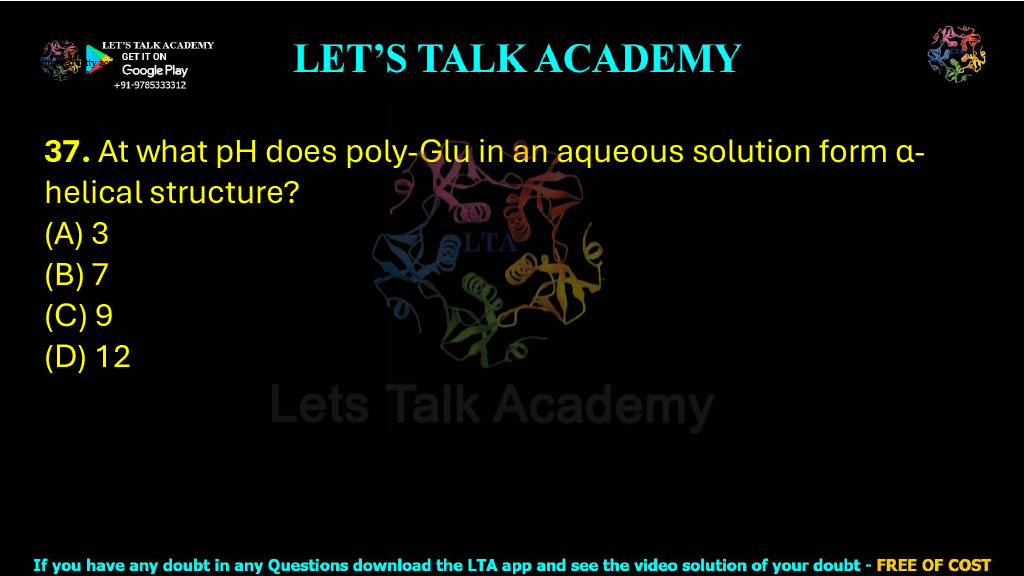
37. At what pH does poly-Glu in an aqueous solution form α-helical structure?
(A) 3
(B) 7
(C) 9
(D) 12
At What pH Does Polyglutamic Acid (Poly-Glu) Form an α-Helical Structure? | Complete CSIR NET MCQ Explanation
Correct Answer
(A) 3
Introduction
Proteins acquire their biological activity only after folding into precise three-dimensional structures. One of the most common secondary structural elements found in proteins is the α-helix, a right-handed helical arrangement stabilized primarily by intramolecular hydrogen bonds between the carbonyl oxygen of one amino acid and the amide hydrogen of another amino acid located four residues ahead. Although hydrogen bonding provides the basic framework of the α-helix, the stability of this structure is strongly influenced by the chemical properties of amino acid side chains and the surrounding environmental conditions, particularly pH.
Polyglutamic acid (poly-Glu) is an excellent model system for studying the influence of pH on protein conformation because every residue contains a glutamic acid side chain. The ionization state of these side chains changes dramatically with pH, altering electrostatic interactions within the polymer. At acidic pH, the side chains become protonated, allowing the polymer to adopt a stable α-helical conformation. At neutral and alkaline pH, however, negatively charged side chains repel one another, destabilizing the helix. This concept is frequently examined in CSIR NET Life Sciences, GATE Biotechnology, IIT JAM, CUET PG, NEET PG, and university examinations because it links protein chemistry, acid-base chemistry, and structural biology.
Understanding the Concept Behind the Question
Glutamic acid possesses a side-chain carboxyl group (-COOH) with a pKa of approximately 4.1.
The ionization state depends on pH:
- Below the pKa → Side chains remain protonated (-COOH).
- Above the pKa → Side chains become negatively charged (-COO⁻).
When poly-Glu is placed in a strongly acidic solution such as pH 3, most glutamate side chains remain protonated.
Because the side chains are electrically neutral, electrostatic repulsion disappears, allowing hydrogen bonding to stabilize the α-helical structure.
At higher pH values such as 7, 9, or 12, the side chains become negatively charged. Strong electrostatic repulsion between neighboring glutamate residues destabilizes the α-helix and favors a random coil conformation.
Therefore, poly-Glu forms an α-helix at acidic pH, specifically around pH 3.
Hence, Option (A) is correct.
Why Option (A) Is Correct
pH 3
At pH 3, the glutamic acid side chains are predominantly present in the protonated (-COOH) form.
Since the side chains carry little or no negative charge, adjacent residues do not repel each other. The absence of electrostatic repulsion allows the peptide backbone to form stable hydrogen bonds, producing a well-defined α-helical structure.
This acidic environment is therefore highly favorable for α-helix formation in poly-Glu.
Hence,
Option (A) is correct.
Why Option (B) Is Incorrect
pH 7
At physiological pH, glutamic acid side chains are almost completely deprotonated (-COO⁻).
Each residue carries a negative charge, leading to strong electrostatic repulsion between neighboring side chains.
These repulsive forces destabilize the tightly packed α-helix and promote an unfolded or random coil conformation.
Therefore,
Option (B) is incorrect.
Why Option (C) Is Incorrect
pH 9
At pH 9, every glutamate side chain remains fully ionized and negatively charged.
Electrostatic repulsion becomes even more pronounced than at neutral pH, making α-helix formation highly unfavorable.
Consequently, poly-Glu remains predominantly in an extended or random coil conformation.
Therefore,
Option (C) is incorrect.
Why Option (D) Is Incorrect
pH 12
At this highly alkaline pH, glutamate side chains remain completely deprotonated.
The large number of negative charges generates maximum electrostatic repulsion, resulting in the greatest destabilization of the α-helix.
Therefore, α-helical structure is least favored under these conditions.
Hence,
Option (D) is incorrect.
Why Does pH Affect Poly-Glu Structure?
The stability of an α-helix depends on balancing two opposing forces:
- Hydrogen bonds stabilize the helix.
- Electrostatic repulsion destabilizes the helix.
For poly-Glu:
Low pH
↓
Glutamate side chains become protonated
↓
Charges disappear
↓
Hydrogen bonds dominate
↓
Stable α-helix forms
At higher pH:
Negative charges increase
↓
Electrostatic repulsion increases
↓
Helix destabilizes
↓
Random coil predominates
Role of Glutamic Acid Side Chains
Glutamic acid contains two carboxyl groups:
- α-Carboxyl group
- Side-chain carboxyl group
The side-chain carboxyl group is responsible for the pH-dependent conformational changes.
Below its pKa:
–COOH (neutral)
Above its pKa:
–COO⁻ (negative)
This change in charge directly controls helix stability.
Comparison of Poly-Glu Structure at Different pH Values
| pH | Side Chain | Charge | α-Helix Stability |
|---|---|---|---|
| 3 | –COOH | Neutral | Highest |
| 7 | –COO⁻ | Negative | Low |
| 9 | –COO⁻ | Negative | Very Low |
| 12 | –COO⁻ | Strongly Negative | Lowest |
Biological Importance
The effect of pH on poly-Glu illustrates a fundamental principle of protein folding. Changes in proton concentration alter the ionization state of amino acid side chains, modifying electrostatic interactions that stabilize or destabilize protein structures.
Many biological proteins undergo pH-dependent conformational changes that regulate enzyme activity, ligand binding, intracellular transport, and protein stability. Thus, poly-Glu serves as a simple experimental model for understanding how environmental conditions influence protein secondary structure.
High-Yield Points
- Glutamic acid side-chain pKa ≈ 4.1.
- Below pKa → Protonated (–COOH).
- Above pKa → Deprotonated (–COO⁻).
- Protonated glutamate favors α-helix formation.
- Negatively charged glutamate destabilizes α-helices.
- Poly-Glu forms a stable α-helix at acidic pH.
Frequently Asked Questions
Why does poly-Glu form an α-helix only at low pH?
At low pH, glutamate side chains become protonated and lose their negative charge. Without electrostatic repulsion, hydrogen bonds stabilize the α-helical structure.
Why is the α-helix unstable at neutral pH?
At neutral pH, glutamate side chains are negatively charged. Repulsion between neighboring side chains destabilizes the tightly packed α-helix.
Does every amino acid behave like glutamate?
No. The effect depends on the chemical properties and ionization state of each amino acid side chain. Glutamate is particularly sensitive because of its acidic carboxyl group.
Key Takeaways
Polyglutamic acid demonstrates how pH influences protein secondary structure through changes in side-chain ionization. At acidic pH (around pH 3), glutamate side chains remain protonated and electrically neutral, eliminating electrostatic repulsion and allowing stable α-helical formation. At neutral and alkaline pH values, the side chains become negatively charged, causing strong repulsive interactions that destabilize the helix. This classic example highlights the relationship between amino acid chemistry, protein folding, and environmental conditions.
Final Answer
Correct Option: (A) 3
Explanation
Polyglutamic acid (poly-Glu) forms an α-helical structure under acidic conditions, particularly at pH 3. At this pH, the side-chain carboxyl groups of glutamic acid remain protonated (-COOH) and therefore carry little or no negative charge. The absence of electrostatic repulsion between neighboring glutamate residues allows intramolecular hydrogen bonds to stabilize the α-helix. At pH 7, 9, and 12, the side chains become deprotonated (-COO⁻), generating strong repulsive forces that destabilize the helical conformation and favor a random coil structure. Therefore, the correct answer is Option (A) – pH 3.


