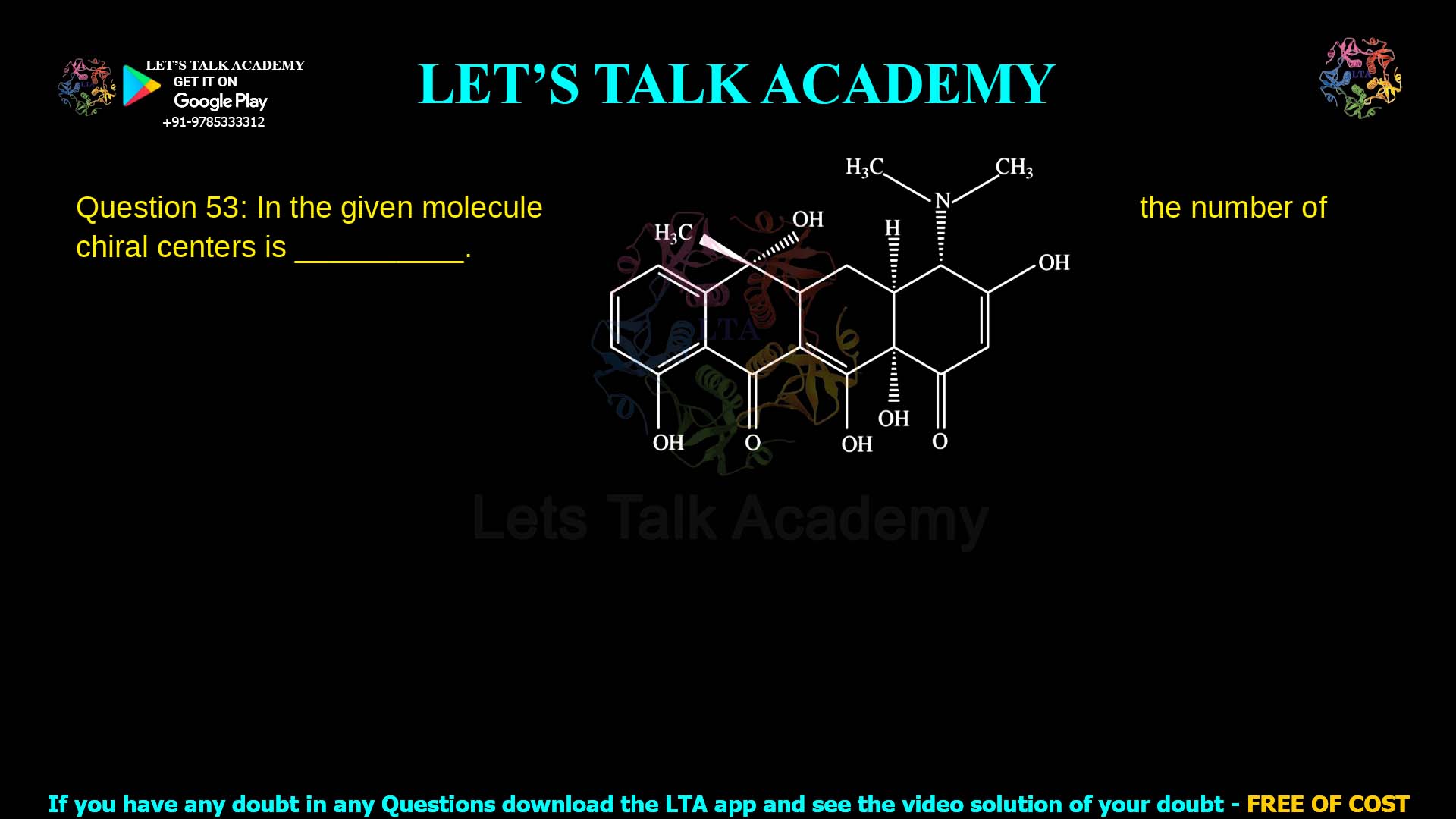
Q.53 In the given molecule,
the number of chiral centers is __________.
The number of chiral centers in the given molecule is 4.
Detailed identification of chiral centers
The molecule shown is a polycyclic system with several saturated ring carbons, carbonyl groups, hydroxyl groups and an N,N‑dimethylamino substituent. Each potential chiral center must be a tetrahedral (sp³) atom attached to four different groups.
1. Chiral carbon bearing the left methoxy group
-
This sp³ carbon is bonded to:
-
The methoxy group (–OCH₃).
-
A hydrogen atom (implicit).
-
One side of the fused ring system (toward the left aromatic/quinone portion).
-
The other side of the fused ring (toward the central ring).
-
-
All four substituents differ, so this carbon is a chiral center (one stereocenter).
2. Chiral carbon bearing the left OH group (vicinal to the above)
-
This sp³ carbon carries:
-
A hydroxyl group (–OH).
-
A hydrogen (shown with wedge).
-
The portion of the ring toward the left.
-
The portion of the ring toward the right (including the bridge that links to the carbonyl region).
-
-
Each substituent is distinct, so this is the second chiral center.
3. Chiral carbon bearing the central OH group
-
This ring carbon is drawn with wedges for the C–H and C–OH bonds.
-
It is attached to:
-
An OH group.
-
A hydrogen.
-
Ring fragment leading toward the left double‑bonded carbonyl portion.
-
Ring fragment leading toward the right, including the nitrogen‑containing ring.
-
-
Different connectivity on each side of the ring makes this carbon the third stereocenter.
4. Chiral nitrogen in the dimethylamino group
-
The nitrogen is formally sp³ and attached to:
-
Two nonequivalent methyl groups (because each lies in a different environment within the fused system).
-
The polycyclic ring carbon.
-
A lone pair.
-
-
In a rigid, bridged polycyclic framework where inversion at nitrogen is strongly hindered, such an amine nitrogen can be configurationally stable and treated as a chiral center. That gives the fourth chiral center in this molecule.
5. Why other positions are not chiral
-
Carbonyl carbons are sp²-hybridized and therefore achiral.
-
Aromatic carbons and explicitly double‑bonded carbons are sp² and cannot be chiral centers here.
-
Remaining saturated ring carbons either:
-
Bear two identical ring paths (symmetry-related), or
-
Are not attached to four different substituents.
-
-
Hence they do not qualify as chiral centers.
Therefore, counting only atoms that meet the stereochemical criteria, the molecule has 4 chiral centers.
SEO‑friendly introduction
Understanding how to count the number of chiral centers in the given molecule is a crucial stereochemistry skill for competitive exams like NEET, JEE and CSIR‑NET. This question features a fused polycyclic system with multiple functional groups, testing your ability to identify sp³ atoms with four different substituents and to recognise when atoms like nitrogen can also become stereogenic. By following a systematic method, you can reliably arrive at the correct answer, 4 chiral centers, without overlooking or overcounting any stereocenters.


