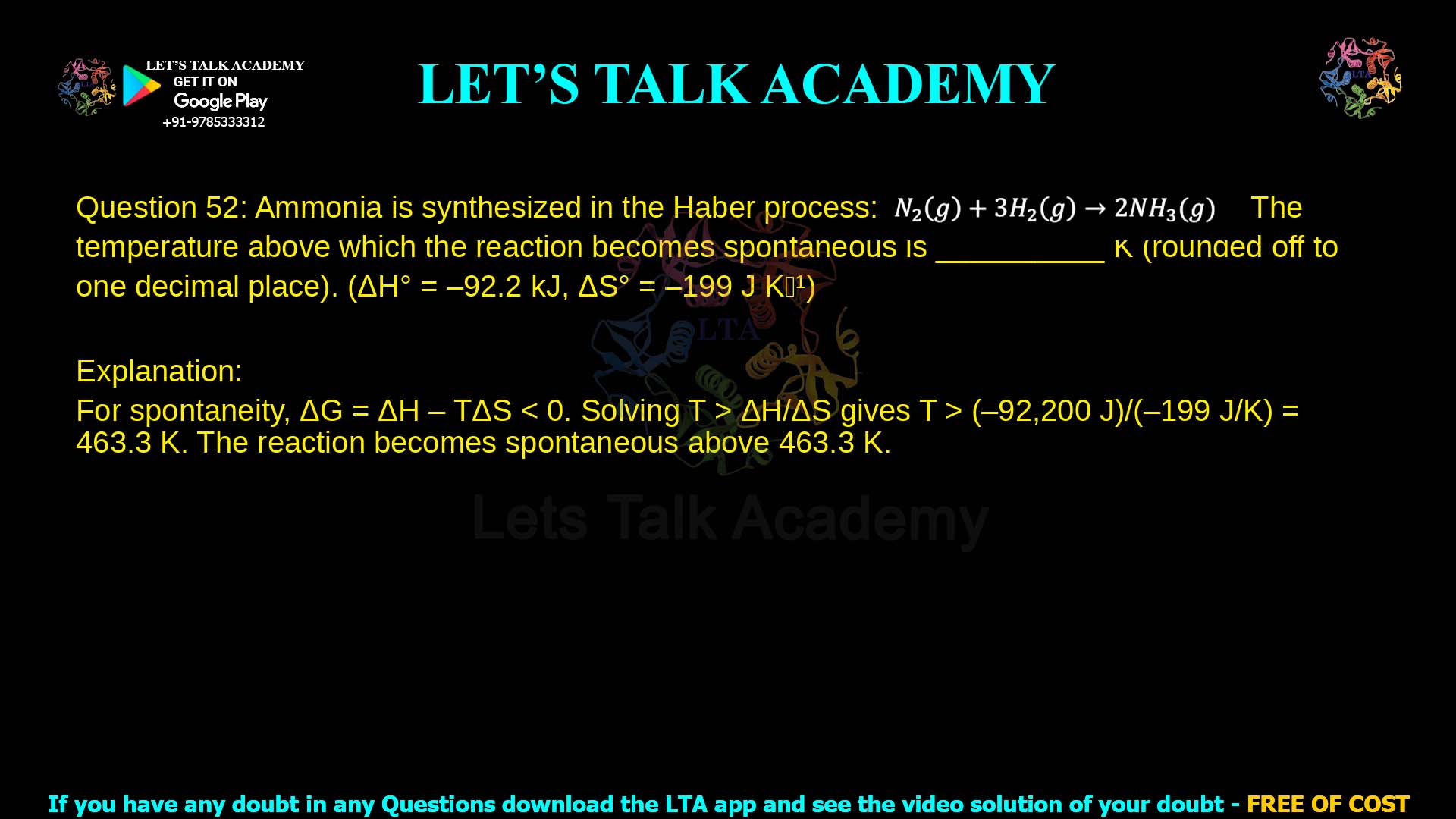
Q.52 Ammonia is synthesized in the Haber process in the following reaction.
𝑁2(𝑔) + 3𝐻2(𝑔) → 2𝑁𝐻3(𝑔)
The temperature above which the reaction becomes spontaneous
is __________ 𝐾 (rounded off to one decimal place).
(
𝐻0 = −92.2 𝑘𝐽,
𝑆0 = −199 𝐽𝐾−1)
Question Statement
In the Haber process for ammonia synthesis:
Given: ΔH° = -92.2 kJ mol⁻¹, ΔS° = -199 J K⁻¹mol⁻¹ = -0.199 kJ K⁻¹mol⁻¹
Find the temperature above which the reaction becomes spontaneous, rounded to one decimal place.
Thermodynamic Concept (Gibbs Free Energy)
Spontaneity at constant pressure and temperature is governed by Gibbs free energy: ΔG° = ΔH° – TΔS°.
If ΔG° < 0, the reaction is spontaneous in the forward direction. If ΔG° > 0, the reaction is non-spontaneous (spontaneous in reverse). The threshold temperature occurs when ΔG° = 0.
For an exothermic process with negative entropy change (ΔH<0, ΔS<0), the reaction is spontaneous only at low temperatures; at higher temperatures the TΔS term dominates and ΔG becomes positive.
Step-by-Step Numerical Solution
- Convert units of entropy: ΔS° = -199 J K⁻¹mol⁻¹ = -0.199 kJ K⁻¹mol⁻¹ (both ΔH and ΔS now in kJ).
- Set ΔG° = 0: 0 = ΔH° – TΔS° ⇒ T = ΔH° / ΔS°
- Substitute values: T = (-92.2 kJ mol⁻¹) / (-0.199 kJ K⁻¹mol⁻¹)
- Calculate T: T = 92.2 / 0.199 ≈ 463.3 K
At 463.3 K, ΔG° = 0 and the system is at equilibrium.
Interpretation of Spontaneity
For T < 463.3 K: ΔG° = -92.2 – T(-0.199). The negative enthalpy dominates, so ΔG° < 0, forward Haber process (ammonia formation) is spontaneous.
For T > 463.3 K: The T|ΔS°| term becomes large making ΔG° > 0, forward reaction non-spontaneous, reverse reaction (ammonia decomposition) spontaneous.
CSIR NET Application
This calculation tests understanding of Gibbs free energy temperature dependence for exothermic reactions with ΔS < 0. The threshold T = |ΔH°/ΔS°| determines spontaneity direction switch. Practice similar problems with varying ΔH, ΔS values for exam success.
| Temperature Range | ΔG° Sign | Spontaneous Direction |
|---|---|---|
| T < 463.3 K | Negative | Forward (Synthesis) |
| T = 463.3 K | Zero | Equilibrium |
| T > 463.3 K | Positive | Reverse (Decomposition) |
Final Answer: The temperature above which the reverse reaction becomes spontaneous is 463.3 K.


