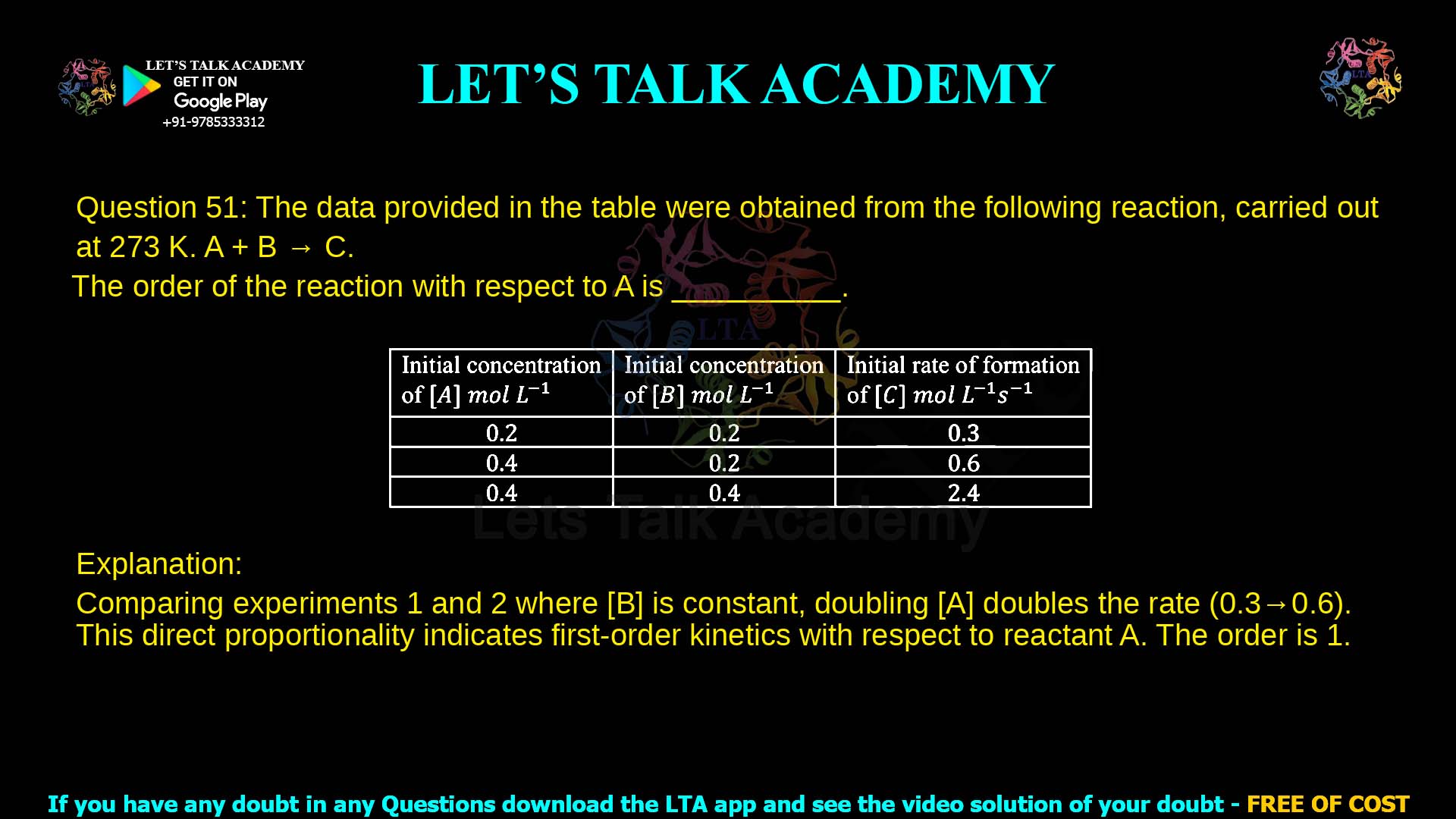
Q.51 The data provided in the table were obtained from the following reaction,
carried out at 273 𝐾.
𝐴 + 𝐵 → 𝐶
The order of the reaction with respect to 𝐴 is __________.
Question statement
For the gas‑phase reaction A + B → C at 273 K, the following initial concentrations and initial rates of formation of C are given:
- Experiment 1: [A] = 0.2 mol L−1, [B] = 0.2 mol L−1, rate = 0.3 mol L−1s−1
- Experiment 2: [A] = 0.4 mol L−1, [B] = 0.2 mol L−1, rate = 0.6 mol L−1s−1
- Experiment 3: [A] = 0.4 mol L−1, [B] = 0.4 mol L−1, rate = 2.4 mol L−1s−1
Required: Order of the reaction with respect to A.
General rate law
For a reaction A + B → C, the general rate law is:
Rate = k[A]m[B]n
where m and n are the partial orders with respect to A and B, respectively.
1. Find order with respect to A
Choose two experiments where [B] is constant so that any rate change comes only from [A]. Here, use experiments 1 and 2.
Experiment 1: Rate1 = 0.3, [A]1 = 0.2, [B]1 = 0.2
Experiment 2: Rate2 = 0.6, [A]2 = 0.4, [B]2 = 0.2
Write the ratio of the two rate laws:
Rate2 / Rate1 = (k[A]2m[B]2n) / (k[A]1m[B]1n) = ([A]2 / [A]1)m ([B]2 / [B]1)n
Since [B]2 = [B]1, the [B] term cancels:
0.6 / 0.3 = (0.4 / 0.2)m ⇒ 2 = 2m
So m = 1. Thus the reaction is first order with respect to A.
2. (Extra) Order with respect to B and complete rate law
Even though the question only asks about A, the full analysis is useful for exam preparation.
Choose two experiments where [A] is constant: experiments 2 and 3.
Experiment 2: Rate2 = 0.6, [A]2 = 0.4, [B]2 = 0.2
Experiment 3: Rate3 = 2.4, [A]3 = 0.4, [B]3 = 0.4
Form the ratio:
Rate3 / Rate2 = ([A]3 / [A]2)m ([B]3 / [B]2)n
With m = 1 and equal [A]:
2.4 / 0.6 = (0.4 / 0.2)n ⇒ 4 = 2n ⇒ n = 2
So the reaction is first order in A and second order in B, and the rate law is:
Rate = k[A][B]2
The overall order is 1 + 2 = 3.
3. Exam‑style options discussion
In a typical CSIR NET or competitive exam, the options for “order of reaction with respect to A” for this question would likely be:
- Option (a): Zero order in A
- Option (b): First order in A
- Option (c): Second order in A
- Option (d): Third order in A
Zero order in A (incorrect)
If the reaction were zero order in A, doubling [A] (0.2 → 0.4) at constant [B] would not change the rate. Experiment 1 to 2 shows rate changing from 0.3 to 0.6, a clear increase, so zero order is not possible.
First order in A (correct)
Doubling [A] at constant [B] doubles the rate: [A]: 0.2 → 0.4 (factor of 2), Rate: 0.3 → 0.6 (factor of 2). A factor‑of‑2 change in rate for a factor‑of‑2 change in [A] corresponds exactly to first order: 2m = 2 ⇒ m = 1.
Second order in A (incorrect)
For second order, doubling [A] would quadruple the rate. Expected: rate should go from 0.3 to 1.2 if m = 2. Observed rate is only 0.6, so the data contradict second order.
Third order in A (incorrect)
For m = 3, doubling [A] would increase the rate by a factor of 23 = 8. Expected rate would be 2.4; actual rate is 0.6, so third order is clearly ruled out.
Thus, only first order in A matches the experimental pattern, confirming the correct option as “first order with respect to A.”
4. Brief introduction for SEO (article style)
Understanding how to calculate the order of reaction with respect to A from initial rate data is essential for mastering chemical kinetics in exams like CSIR NET, GATE, IIT‑JAM and university entrance tests.
By comparing changes in initial concentration of reactants with corresponding changes in initial reaction rate, students can quickly determine partial orders and write the correct rate law expression for a reaction such as A + B → C. This powerful technique not only helps in solving table‑based numerical questions but also deepens conceptual understanding of reaction mechanisms and rate‑determining steps.


