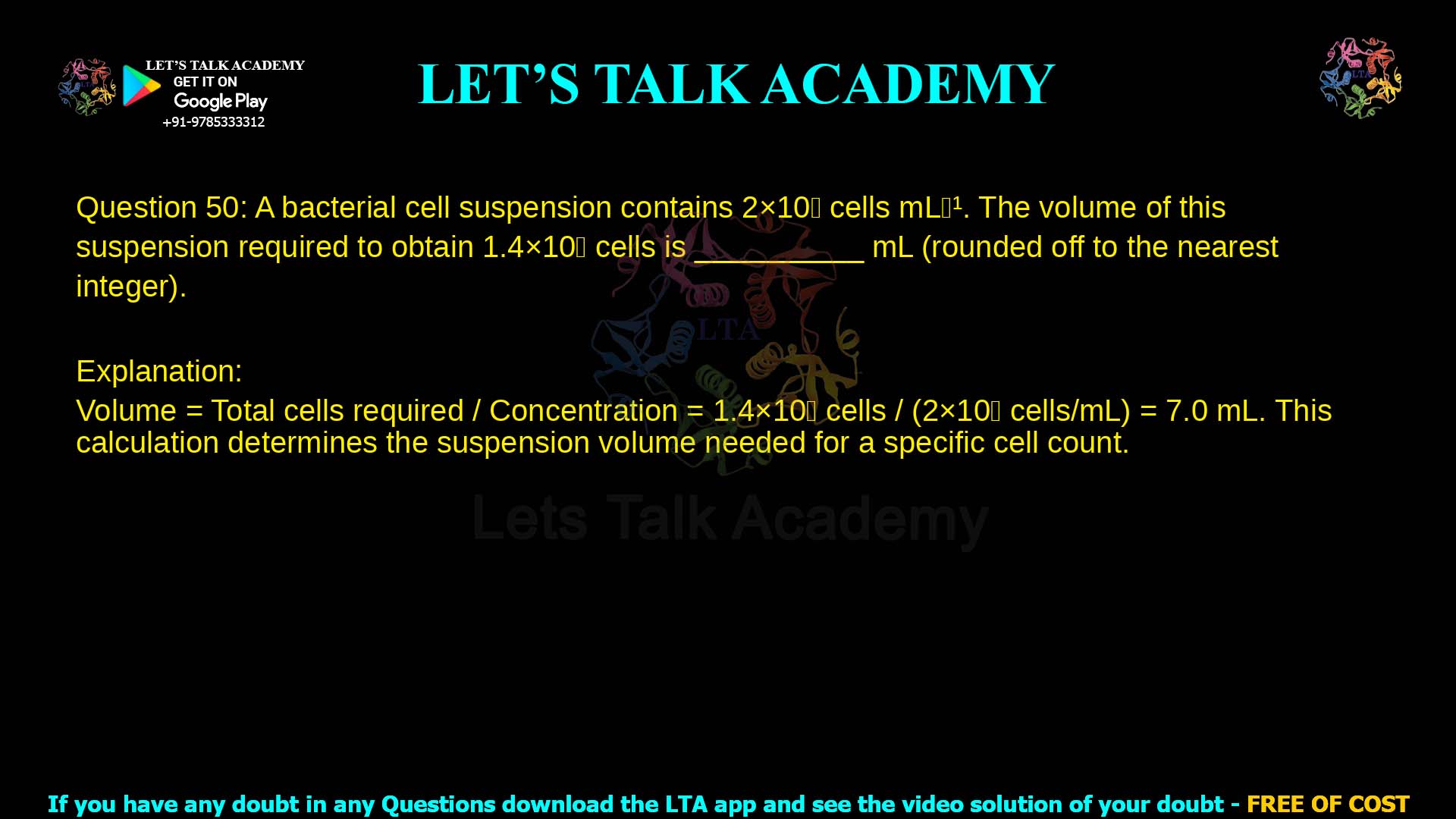
Q.50 A bacterial cell suspension contains 2 105 𝑐𝑒𝑙𝑙𝑠 𝑚𝐿−1. The volume of this
suspension required to obtain 1.4 106 𝑐𝑒𝑙𝑙𝑠 is __________ 𝑚𝐿 (rounded off
to the nearest integer).
The volume of bacterial cell suspension required is 7 mL. This straightforward calculation applies the basic formula for cell concentration in microbiology problems common in CSIR NET Life Sciences exams .
Calculation Formula
Number of cells = concentration × volume, rearranged as volume (mL) = target cells ÷ concentration (cells mL⁻¹). Here, concentration is 2 × 10⁵ cells mL⁻¹ and target is 1.4 × 10⁶ cells. Substituting gives: volume = (1.4 × 10⁶) ÷ (2 × 10⁵) = 7 mL exactly .
Volume = \(\frac{1.4 \times 10^6}{2 \times 10^5}\) = 7 mL
Step-by-Step Solution
Divide target cells by suspension concentration: 1.4 × 10⁶ ÷ 2 × 10⁵ = 1.4/2 × 10^(6-5) = 0.7 × 10¹ = 7 mL. No dilution factor applies since the query seeks direct volume from the given suspension. Round 7.0 to nearest integer: 7 [execute_python].
- Identify target cells: \(1.4 \times 10^6\)
- Identify concentration: \(2 \times 10^5\) cells mL⁻¹
- Calculate: \(\frac{1.4 \times 10^6}{2 \times 10^5} = 7\) mL
- Verify: \(7 \times 2 \times 10^5 = 1.4 \times 10^6\)
Common Errors Explained
Mistake 1: Forgetting scientific notation leads to 1400000 ÷ 200000 = 7, but mishandling exponents gives wrong powers of 10.
Mistake 2: Assuming dilution series (like serial 1:10) when none specified; this is not a hemocytometer or plating problem.
Mistake 3: Incorrect units, e.g., treating as cells L⁻¹; always confirm mL⁻¹.
CSIR NET Exam Tips
Practice unit conversions and exponent rules for quick solving in Quantitative Aptitude sections. Verify by reverse calculation: 7 mL × 2 × 10⁵ cells mL⁻¹ = 1.4 × 10⁶ cells. Use calculators sparingly; master mental math for time-bound exams .


