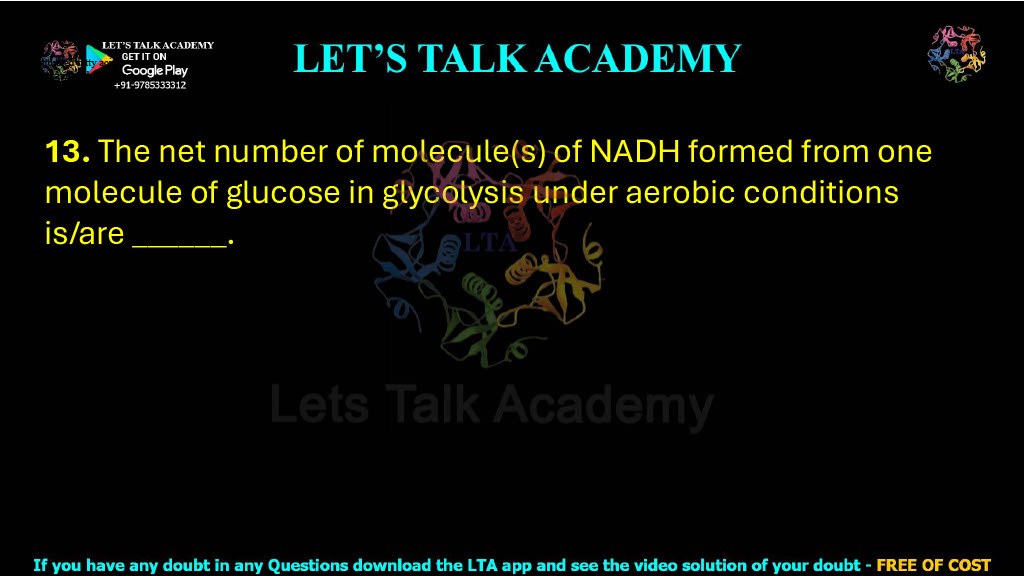
13. The net number of molecule(s) of NADH formed from one molecule of glucose in glycolysis under aerobic conditions is/are ______.
Number of NADH Molecules Produced in Aerobic Glycolysis
Correct Answer
Correct Answer: 2 NADH Molecules
Introduction
Glycolysis is the first and one of the most fundamental pathways of cellular respiration. It occurs in the cytoplasm of both prokaryotic and eukaryotic cells and converts one molecule of glucose into two molecules of pyruvate through a series of ten enzyme-catalyzed reactions. During this process, the cell not only generates ATP through substrate-level phosphorylation but also produces NADH, a high-energy electron carrier that plays a crucial role in aerobic respiration. Questions regarding the number of NADH molecules produced during glycolysis are among the most frequently asked in CSIR NET, GATE, IIT JAM, CUET PG, DBT BET, and MSc Life Science examinations because they test the understanding of energy metabolism rather than simple memorization.
Correct Answer Explained
The correct answer is 2 NADH molecules because one molecule of glucose is ultimately converted into two molecules of glyceraldehyde-3-phosphate (G3P) during glycolysis. Each G3P molecule undergoes oxidation in a reaction catalyzed by the enzyme glyceraldehyde-3-phosphate dehydrogenase, where one molecule of NAD⁺ accepts electrons and is reduced to NADH.
Since two G3P molecules are formed from one glucose molecule and each produces one NADH, the total number of NADH molecules generated during glycolysis is two.
The reaction can be represented as follows:
2 Glyceraldehyde-3-phosphate + 2 NAD⁺ + 2 Pi → 2 1,3-Bisphosphoglycerate + 2 NADH + 2 H⁺
Thus, the net production from one glucose molecule is 2 NADH molecules.
Where Exactly is NADH Produced During Glycolysis?
NADH is formed during the sixth step of glycolysis, which is catalyzed by the enzyme Glyceraldehyde-3-phosphate Dehydrogenase (GAPDH). This is the only oxidation-reduction reaction present in the glycolytic pathway. In this reaction, glyceraldehyde-3-phosphate is oxidized while NAD⁺ is reduced to NADH. Simultaneously, inorganic phosphate is incorporated into the molecule to produce 1,3-bisphosphoglycerate, a high-energy intermediate that later contributes to ATP production.
Because glucose splits into two glyceraldehyde-3-phosphate molecules, this reaction occurs twice for every glucose molecule metabolized, resulting in the production of two NADH molecules.
Why Does Aerobic Glycolysis Produce NADH?
Under aerobic conditions, oxygen is available to serve as the final electron acceptor in the electron transport chain. Therefore, the NADH produced during glycolysis is not wasted. Instead, it carries high-energy electrons into the mitochondria through shuttle systems such as the Malate-Aspartate Shuttle or the Glycerol-3-Phosphate Shuttle, depending on the cell type. Inside the mitochondria, NADH donates these electrons to the electron transport chain, leading to oxidative phosphorylation and the synthesis of additional ATP molecules.
This is why NADH is considered one of the most important products of aerobic glycolysis. Although glycolysis directly produces only two ATP molecules, the NADH generated significantly increases the total ATP yield of glucose metabolism.
Net Products of Glycolysis
The overall net reaction of aerobic glycolysis is:
Glucose + 2 ADP + 2 Pi + 2 NAD⁺ → 2 Pyruvate + 2 ATP + 2 NADH + 2 H₂O + 4 H⁺
From this equation, it is clear that one molecule of glucose produces:
- 2 Pyruvate
- 2 ATP (Net Gain)
- 2 NADH
- 2 Water Molecules
- 4 Hydrogen Ions
Among these products, NADH represents the reducing power that will later be utilized for ATP synthesis in aerobic respiration.
Why the Answer is Not One or Four NADH Molecules
Students often become confused regarding the number of NADH molecules because glycolysis contains ten enzymatic reactions. However, only one of these reactions involves the reduction of NAD⁺ to NADH. Since this reaction occurs twice due to the formation of two glyceraldehyde-3-phosphate molecules, the final yield becomes 2 NADH molecules rather than one.
Similarly, glycolysis never produces four NADH molecules because there are only two oxidation events per glucose molecule. Remembering this concept helps eliminate many incorrect options in competitive examinations.
Relationship Between NADH Production and ATP Generation
Although glycolysis directly produces only two ATP molecules through substrate-level phosphorylation, the NADH molecules generated during glycolysis have much greater energetic significance. Under aerobic conditions, these NADH molecules enter the electron transport chain and contribute to ATP synthesis through oxidative phosphorylation.
Depending on the shuttle system used to transport electrons into the mitochondria, each cytosolic NADH can produce approximately 2.5 ATP (Malate-Aspartate Shuttle) or approximately 1.5 ATP (Glycerol-3-Phosphate Shuttle). Consequently, the two NADH molecules produced during glycolysis contribute substantially to the total ATP yield of aerobic respiration.
Aerobic vs Anaerobic Conditions
The production of NADH during glycolysis is the same under both aerobic and anaerobic conditions. In both cases, glycolysis initially generates 2 NADH molecules. The difference lies in what happens afterward.
Under aerobic conditions, NADH transfers its electrons to the mitochondrial electron transport chain, where ATP is synthesized through oxidative phosphorylation.
Under anaerobic conditions, however, NADH is rapidly oxidized back to NAD⁺ during the conversion of pyruvate into lactate (in animals) or ethanol (in yeast). As a result, although glycolysis initially forms two NADH molecules, there is no net accumulation of NADH because it is immediately consumed to regenerate NAD⁺, allowing glycolysis to continue.
Note:-
One of the most common mistakes is confusing ATP production with NADH production. Many students remember that glycolysis produces a net of two ATP molecules but forget that it also produces two NADH molecules. Another frequent error is assuming that NADH is produced only inside mitochondria. In reality, glycolysis occurs entirely in the cytoplasm, and the NADH formed there is later transported into mitochondria through specialized shuttle systems. Some students also mistakenly believe that anaerobic glycolysis does not produce NADH at all. In fact, NADH is produced initially but is immediately oxidized during fermentation, resulting in no net gain.
One Glucose → Two Glyceraldehyde-3-Phosphate → Two NADH → Two Pyruvate
This simple sequence explains why the pathway always produces 2 NADH molecules. Whenever an examination asks about the number of NADH molecules formed during glycolysis, immediately remember that the oxidation step occurs twice because glucose is split into two three-carbon molecules.
A simple memory trick is:
“One Glucose → Two G3P → Two NADH → Two Pyruvate.”
This mnemonic is extremely useful for quickly answering glycolysis-based MCQs in competitive examinations.
Final Answer
During aerobic glycolysis, one molecule of glucose is converted into two molecules of pyruvate through ten enzyme-catalyzed reactions. The oxidation of the two glyceraldehyde-3-phosphate molecules by glyceraldehyde-3-phosphate dehydrogenase produces two molecules of NADH. These NADH molecules subsequently enter the mitochondrial electron transport chain under aerobic conditions and contribute to additional ATP synthesis through oxidative phosphorylation.
Therefore, the net number of NADH molecules formed from one molecule of glucose during glycolysis under aerobic conditions is:


