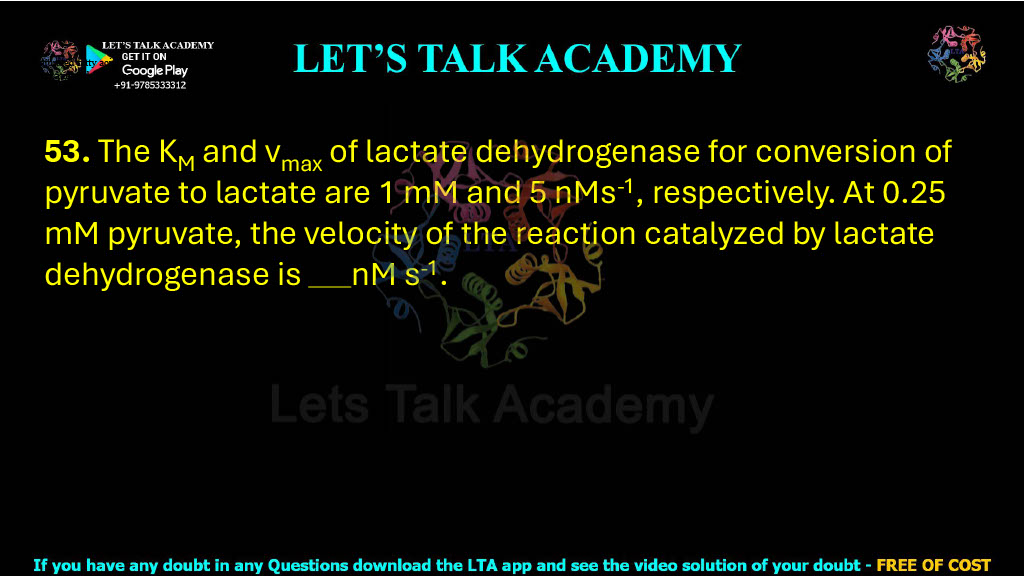
53. The KM and vmax of lactate dehydrogenase for conversion of pyruvate to lactate are 1 mM and 5 nMs-1, respectively. At 0.25 mM pyruvate, the velocity of the reaction catalyzed by lactate dehydrogenase is nM s-1.
How to Calculate Reaction Velocity Using the Michaelis–Menten Equation?
Correct Answer
1.00 nM s⁻¹
Introduction
The Michaelis–Menten equation is one of the most fundamental equations in enzyme kinetics and provides a quantitative relationship between substrate concentration and the initial reaction velocity. Proposed by Leonor Michaelis and Maud Menten in 1913, this model explains how enzymes behave under steady-state conditions and predicts how rapidly an enzyme converts substrate into product at different substrate concentrations. The equation introduces two important kinetic parameters: Km (Michaelis constant), which reflects the apparent affinity of the enzyme for its substrate, and Vmax, the maximum reaction velocity achieved when all enzyme active sites are saturated.
Lactate dehydrogenase (LDH) is an oxidoreductase enzyme that catalyzes the reversible conversion of pyruvate into lactate with the simultaneous oxidation of NADH to NAD⁺. This reaction is especially important during anaerobic glycolysis in muscle cells and many microorganisms.
Understanding the Concept Behind the Question
The Michaelis–Menten equation is:
v = (Vmax × [S]) / (Km + [S])
where,
v = Initial reaction velocity
Vmax = Maximum reaction velocity
Km = Michaelis constant
[S] = Substrate concentration
The given values are:
Km = 1 mM
Vmax = 5 nM s⁻¹
[S] = 0.25 mM
The objective is to substitute these values into the Michaelis–Menten equation to calculate the reaction velocity.
Step 1. Write the Michaelis–Menten Equation
v = (Vmax × [S]) / (Km + [S])
Step 2. Substitute the Given Values
v = (5 × 0.25) / (1 + 0.25)
Step 3. Calculate the Numerator
5 × 0.25 = 1.25
Therefore,
v = 1.25 / 1.25
Step 4. Calculate the Denominator
1 + 0.25 = 1.25
Therefore,
v = 1.25 / 1.25
v = 1.00 nM s⁻¹
Final Calculation
Reaction Velocity = 1.00 nM s⁻¹
Why Does the Velocity Equal 1.00 nM s⁻¹?
The substrate concentration (0.25 mM) is much lower than the enzyme’s Vmax-saturating concentration and is only one-fourth of the Km value. Under these conditions, only a fraction of the enzyme molecules possess bound substrate, so the reaction proceeds at only 20% of the maximum velocity.
Since:
20% of 5 nM s⁻¹ = 1.00 nM s⁻¹
the calculated result agrees perfectly with the Michaelis–Menten equation.
Understanding the Relationship Between Km and Reaction Velocity
The value of Km provides insight into enzyme–substrate affinity.
- When [S] = Km, the reaction velocity equals Vmax/2.
- When [S] < Km, the enzyme is far from saturation and the reaction velocity increases almost linearly with substrate concentration.
- When [S] >> Km, the enzyme approaches saturation and the reaction velocity becomes nearly equal to Vmax.
In this problem:
[S] = 0.25 Km
Therefore, the enzyme operates well below its maximum catalytic capacity.
Formula Summary
Michaelis–Menten Equation
v = (Vmax × [S]) / (Km + [S])
where:
- v = Initial velocity
- Vmax = Maximum velocity
- Km = Michaelis constant
- [S] = Substrate concentration
Biological Importance
Lactate dehydrogenase plays an essential role in maintaining glycolysis under anaerobic conditions by regenerating NAD⁺ from NADH. This regeneration allows glycolysis to continue producing ATP when oxygen availability is limited, such as during intense muscular activity.
The Michaelis–Menten equation enables researchers to predict enzyme behavior under varying substrate concentrations and is widely applied in enzyme characterization, drug discovery, metabolic engineering, and clinical diagnostics. Determining Km and Vmax also provides valuable information about enzyme efficiency and substrate affinity.
High-Yield Points
- Michaelis–Menten equation:
v = (Vmax × [S]) / (Km + [S])
- Km is the substrate concentration at which:
v = Vmax/2
- When [S] << Km, velocity is approximately proportional to substrate concentration.
- When [S] >> Km, velocity approaches Vmax.
- Lower Km indicates higher apparent substrate affinity.
- Lactate dehydrogenase catalyzes:
Pyruvate + NADH ⇌ Lactate + NAD⁺
Frequently Asked Questions
What is the significance of Km?
Km represents the substrate concentration at which the reaction velocity reaches half of Vmax. It provides an indication of the enzyme’s apparent affinity for its substrate.
Why is the reaction velocity much lower than Vmax in this problem?
The substrate concentration (0.25 mM) is considerably lower than Km (1 mM). Therefore, only a small fraction of enzyme molecules are occupied by substrate, resulting in a relatively low reaction velocity.
Can the reaction velocity exceed Vmax?
No. Vmax represents the maximum possible reaction velocity when every enzyme active site is occupied by substrate. Under standard Michaelis–Menten conditions, the reaction velocity cannot exceed Vmax.
Key Takeaways
The Michaelis–Menten equation quantitatively describes how reaction velocity depends on substrate concentration. In this problem, Km = 1 mM, Vmax = 5 nM s⁻¹, and the substrate concentration is 0.25 mM. Substituting these values into the Michaelis–Menten equation gives:
v = (5 × 0.25) / (1 + 0.25)
= 1.25 / 1.25
= 1.00 nM s⁻¹
This result demonstrates that when substrate concentration is much lower than Km, the enzyme operates far below its maximum velocity.
Final Answer
Reaction Velocity = 1.00 nM s⁻¹
Explanation
Using the Michaelis–Menten equation:
v = (Vmax × [S]) / (Km + [S])
Substituting the given values:
v = (5 × 0.25) / (1 + 0.25)
= 1.25 / 1.25
= 1.00 nM s⁻¹
Therefore, at a pyruvate concentration of 0.25 mM, the reaction catalyzed by lactate dehydrogenase proceeds at a velocity of 1.00 nM s⁻¹.


