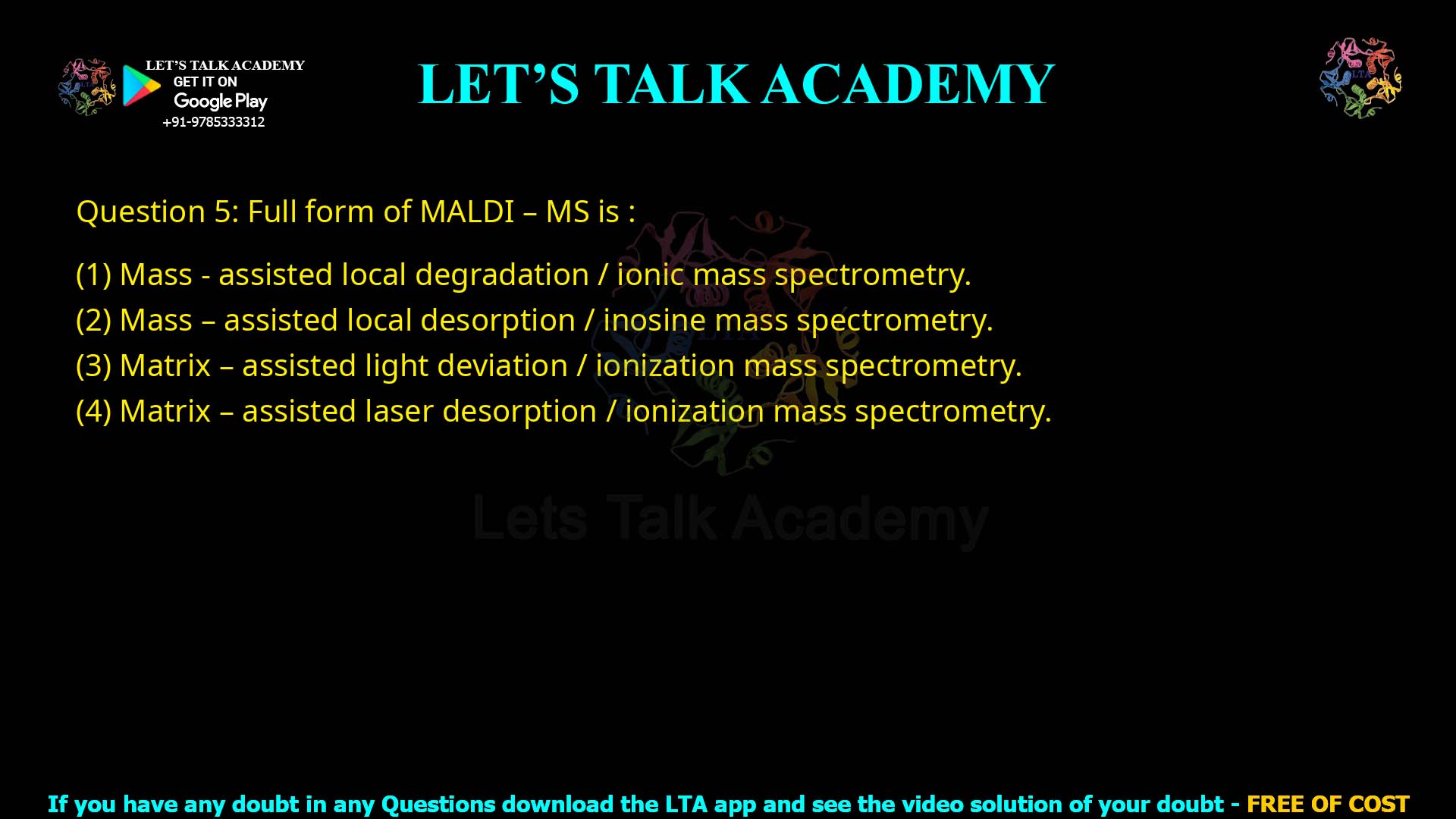
Q.5 Full form of MALDI – MS is :
- Mass – assisted local degradation / ionic mass spectrometry.
- Mass – assisted local desorption / inosine mass spectrometry.
- Matrix – assisted light deviation / ionization mass spectrometry.
- Matrix – assisted laser desorption / ionization mass spectrometry.
The full form of MALDI-MS is Matrix-assisted laser desorption/ionization mass spectrometry, a key ionization technique in proteomics and molecular biology for analyzing large biomolecules without fragmentation.
Question Breakdown
This question tests knowledge of mass spectrometry acronyms, crucial for graduate-level biotech exams like GATE Life Sciences, where MALDI-MS is used for protein identification and microbial analysis.
Option Explanations
-
Mass-assisted local degradation / ionic mass spectrometry: Incorrect; “degradation” implies sample breakdown, unlike MALDI’s soft ionization that preserves intact molecules. No such technique exists.
-
Mass-assisted local desorption / inosine mass spectrometry: Wrong; “mass-assisted” misstates the matrix role, and “inosine” (a nucleoside) is unrelated to MS naming or function.
-
Matrix-assisted light deviation / ionization mass spectrometry: Incorrect; “light deviation” confuses laser desorption with refraction; the process involves absorption, not deviation.
-
Matrix-assisted laser desorption / ionization mass spectrometry: Correct; MALDI uses a UV-absorbing matrix mixed with analytes, hit by a laser to desorb and ionize large molecules (e.g., proteins) for MS analysis.
Introduction to MALDI-MS Full Form
The full form of MALDI-MS is Matrix-assisted laser desorption/ionization mass spectrometry, revolutionizing biomolecular analysis in biochemistry and microbiology. This soft ionization method enables intact protein and peptide profiling.
How MALDI-MS Works
A sample co-crystallizes with a matrix (e.g., sinapinic acid), then a nitrogen laser desorbs/ionizes analytes into gas-phase ions for time-of-flight MS detection. It handles masses from 100 Da to >100 kDa with minimal fragmentation.
Comparison of Options
Option Key Terms Accuracy Mass-assisted local degradation / ionic MS Degradation, ionic Wrong; promotes fragmentation, not soft ionization Mass-assisted local desorption / inosine MS Mass-assisted, inosine Incorrect; matrix-driven, no nucleoside link Matrix-assisted light deviation / ionization MS Light deviation Flawed; laser desorption/ionization, not deviation Matrix-assisted laser desorption / ionization MS Laser desorption/ionization Correct full form; standard in proteomics MALDI-MS dominates for its sensitivity in tissue imaging and pathogen ID.
Applications in Life Sciences
Essential for protein sequencing, lipidomics, and drug discovery; aligns with molecular biology techniques like PCR in competitive exams.
-


