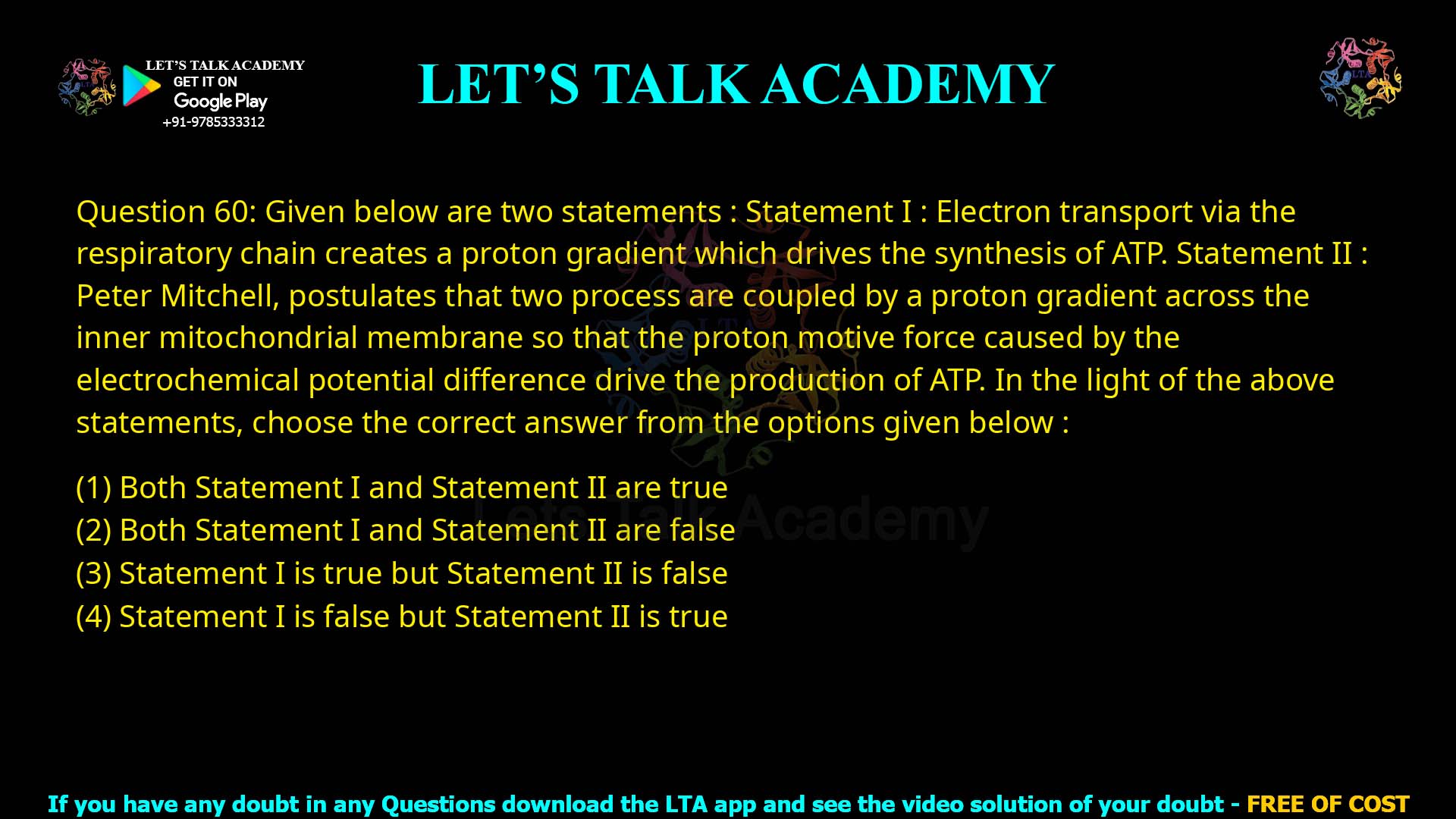
Q.60 Given below are two statements:
Electron transport via the respiratory chain creates a proton gradient
which drives the synthesis of ATP.
Peter Mitchell postulates that two processes are coupled by a proton gradient
across the inner mitochondrial membrane so that the proton motive force
caused by the electrochemical potential difference drives the production of ATP.
In the light of the above statements, choose the correct answer
from the options given below:
- Both Statement I and Statement II are true
- Both Statement I and Statement II are false
- Statement I is true but Statement II is false
- Statement I is false but Statement II is true
Both Statement I and Statement II are true.
Statement I Analysis
The electron transport chain (ETC) in the inner mitochondrial membrane pumps protons into the intermembrane space during electron transfer from NADH/FADH₂ to oxygen, creating an electrochemical proton gradient (ΔpH and Δψ). This proton motive force drives ATP synthesis via ATP synthase (Complex V), which harnesses proton flow back into the matrix.
Statement II Analysis
Peter Mitchell’s 1961 chemiosmotic hypothesis posits that electron transport and ATP synthesis are coupled indirectly via a proton gradient across the inner mitochondrial membrane. The proton motive force (ΔμH⁺ = Δψ – 2.303RT/F·ΔpH) provides energy for ATP production, earning Mitchell the 1978 Nobel Prize.
Option Breakdown
Option Evaluation Reason Both Statement I and Statement II are true Correct Precisely describes ETC proton gradient and Mitchell’s chemiosmotic coupling mechanism. Both Statement I and Statement II are false Incorrect Core principles of oxidative phosphorylation established fact. Statement I is true but Statement II is false Incorrect Mitchell’s hypothesis directly explains Statement I mechanism. Statement I is false but Statement II is true Incorrect ETC definitively creates proton gradient driving ATP synthesis. Electron transport proton gradient ATP synthesis via Peter Mitchell’s chemiosmotic theory powers cellular respiration, producing 90% of ATP. Essential biochemistry for NEET/GATE Life Sciences.
ETC Proton Gradient Mechanism
Complexes I, III, IV pump H⁺ across inner mitochondrial membrane during NADH/FADH₂ → O₂ electron transport, creating ΔpH (pH 8 matrix vs. 7 intermembrane) and membrane potential (-180 mV matrix-negative). This proton motive force (PMF ≈ 220 mV) stores ETC redox energy.
Peter Mitchell Chemiosmotic Coupling
Mitchell postulated (1961) that PMF = Δψ – 59ΔpH (at 25°C) couples respiration to phosphorylation. ATP synthase F₀F₁ rotates as ~3-4 H⁺/ATP flow through c-ring channel, driving conformational changes (loose→tight→open) for ADP + Pi → ATP.
ATP Yield Calculation
ETC translocates ~10 H⁺/NADH (4+4+2), ~6 H⁺/FADH₂. With ~4 H⁺/ATP and 2 H⁺/ADP/ATP transport, yields ~2.5 ATP/NADH, ~1.5 ATP/FADH₂—explains 30-32 ATP/glucose.
Exam Application
Assertion-reason questions test chemiosmotic coupling linkage; both statements true as Statement II explains Statement I mechanism—key for competitive exams.


