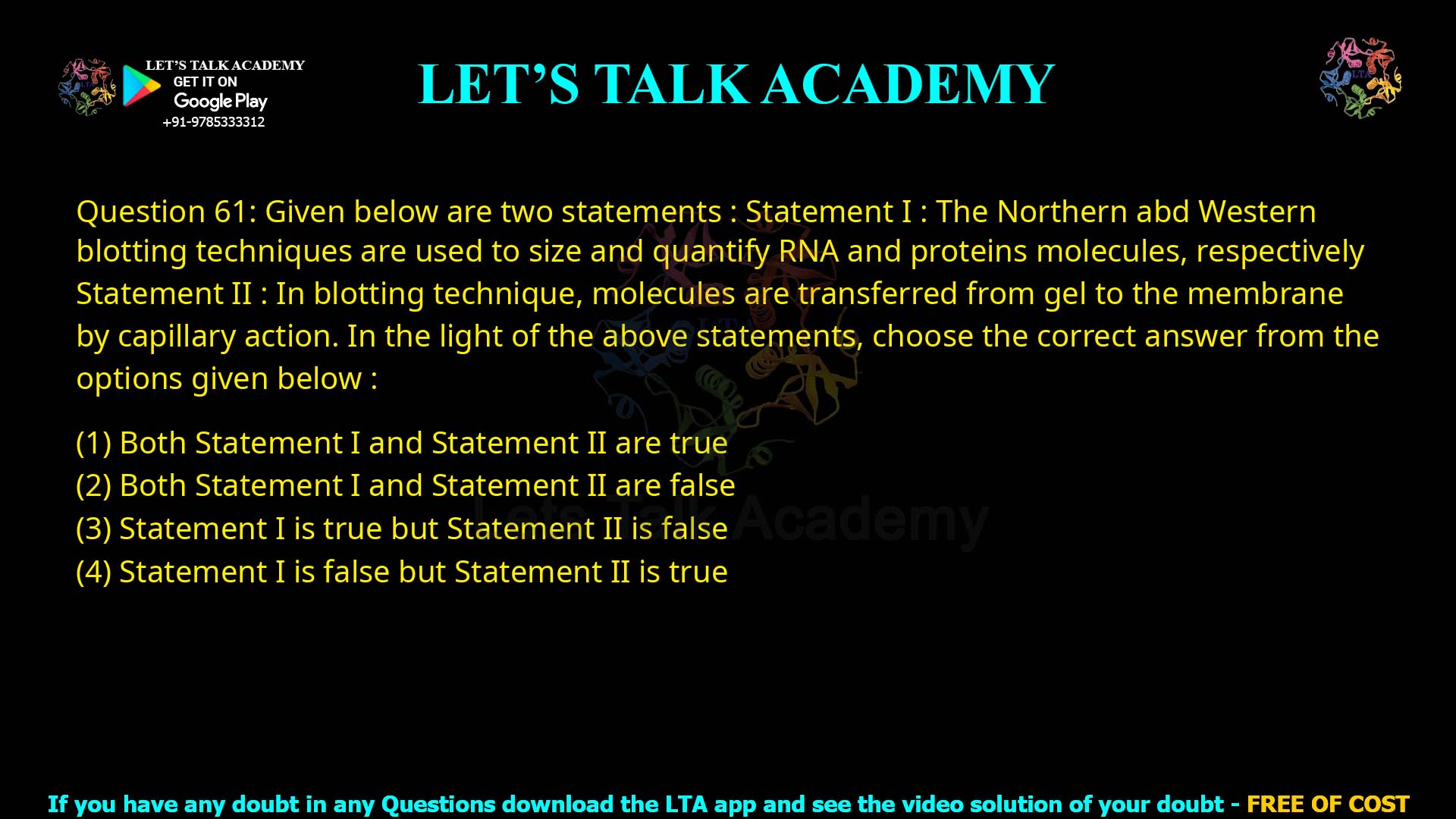
Q.61 Given below are two statements:
The Northern and Western blotting techniques are used to size and quantify
RNA and protein molecules, respectively.
In blotting technique, molecules are transferred from gel to the membrane
by capillary action.
In the light of the above statements, choose the correct answer
from the options given below:
- Both Statement I and Statement II are true
- Both Statement I and Statement II are false
- Statement I is true but Statement II is false
- Statement I is false but Statement II is true
Statement I is true but Statement II is false.
Northern blotting detects and sizes RNA molecules after gel electrophoresis, while Western blotting identifies and quantifies specific proteins using antibodies—both techniques provide size/molecular weight information and quantification capabilities.
In blotting techniques, molecules transfer from gel to membrane primarily by electrotransfer (Western blot uses electric field) or vacuum blotting (modern Northern/Southern); traditional capillary action is rarely used today due to inefficiency.
Statement I Analysis
Northern blot separates RNA by size on denaturing agarose gels, transfers to membrane, and hybridizes with labeled probes for detection/quantification of specific transcripts. Western blot uses SDS-PAGE for protein size separation, followed by antibody-based detection for quantity and identity confirmation.
Statement II Analysis
While capillary transfer was originally described for Southern blotting (1975), current protocols favor semi-dry/wet electroblotting (Western) and vacuum/electrotransfer (Northern) for speed and efficiency. Capillary action is outdated and not standard practice.
Option Breakdown
Option Evaluation Reason Both Statement I and Statement II are true Incorrect Statement II inaccurately describes modern transfer methods. Both Statement I and Statement II are false Incorrect Statement I correctly describes blotting applications. Statement I is true but Statement II is false Correct Matches verified applications vs. current transfer techniques. Statement I is false but Statement II is true Incorrect RNA/protein assignments are accurate; transfer method outdated. Northern Western blotting techniques size RNA and quantify proteins respectively, but use electrotransfer rather than capillary action in modern protocols—essential for NEET/GATE molecular biology.
Northern Blotting RNA Detection
Northern blotting separates RNA molecules by size using formaldehyde-agarose gel electrophoresis, transfers via vacuum/electroblotting, then detects specific transcripts with labeled cDNA/RNA probes. Quantifies gene expression levels accurately.
Western Blotting Protein Analysis
Western blotting resolves proteins by molecular weight via SDS-PAGE, transfers by semi-dry electroblotting (15-30 min), then uses primary/secondary antibody detection for specific protein quantification and size confirmation.
Transfer Method Evolution
Capillary transfer (original Southern method): gel-membrane-paper stack, 12-24 hours via wicking.
Modern methods: Electrotransfer (Western: 7-15V/cm), vacuum blotting (Northern: 30-60 min). Capillary action largely obsolete.Exam Application
Assertion questions test Northern=RNA, Western=protein (Statement I true) vs. transfer mechanism (Statement II false). Option C correct for competitive exams.


