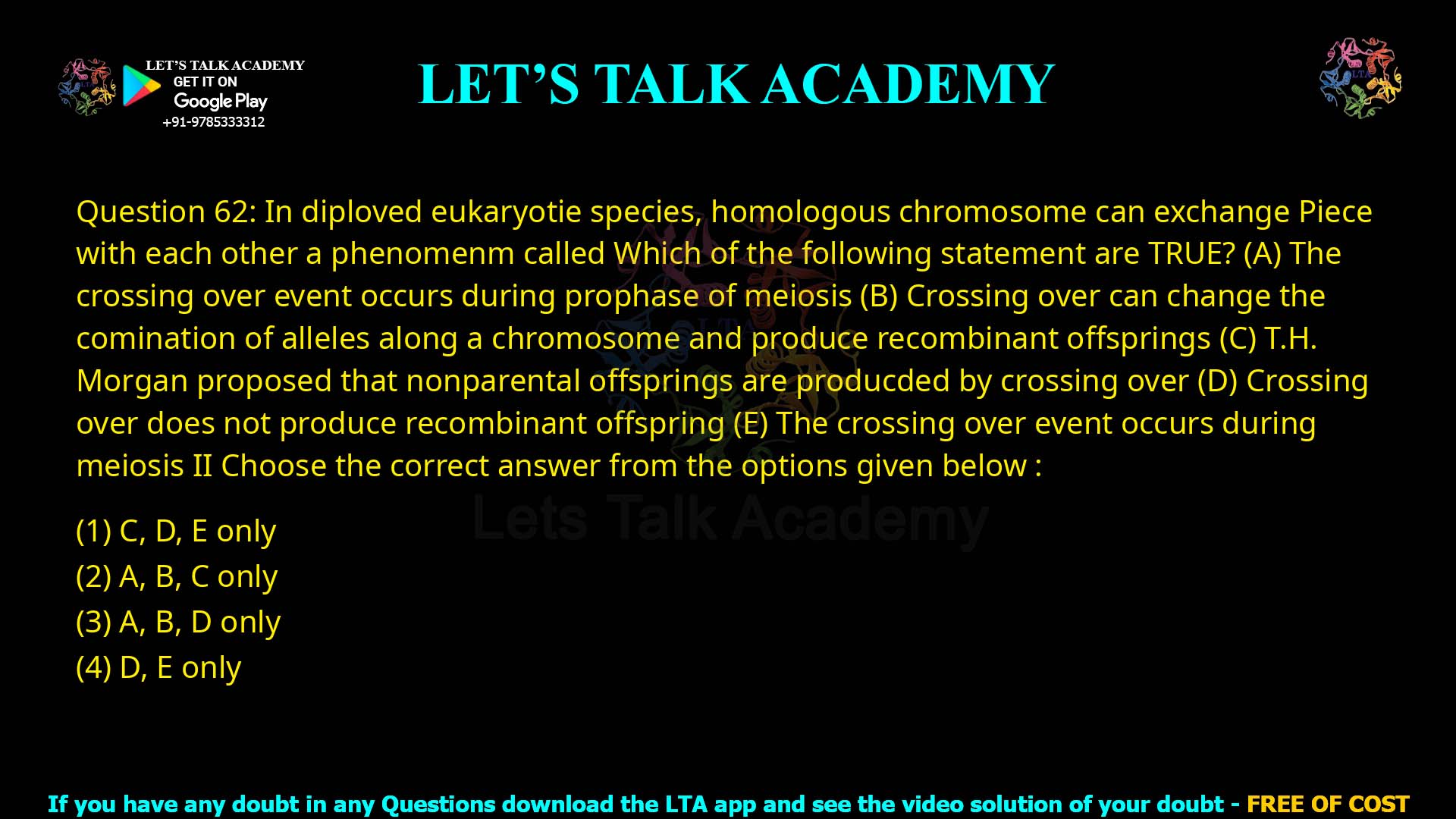
A, B, C only are true statements about crossing over in meiosis.
Statement Analysis
A. TRUE – Crossing over occurs specifically during pachytene substage of prophase I in meiosis I, when homologous chromosomes are fully synapsed and recombination nodules form between non-sister chromatids.
B. TRUE – Crossing over physically exchanges alleles between homologous chromosomes, creating new allele combinations (recombinants) that differ from parental chromosomes, producing recombinant offspring with novel genetic traits.
C. TRUE – T.H. Morgan (1910s) discovered linkage and recombination through Drosophila experiments, proposing crossing over as the physical basis for non-parental offspring ratios in his chromosome theory.
D. FALSE – Crossing over does produce recombinant offspring; this is its primary genetic consequence and evolutionary significance.
E. FALSE – Crossing over occurs only in meiosis I (prophase I); meiosis II involves equational division of already-recombined chromatids with no further crossing over.
Option Breakdown
| Option |
Evaluation |
Reason |
| A, B, C only |
Correct |
Captures timing, mechanism, history; excludes false recombinant and meiosis II claims. |
| C, D, E only |
Incorrect |
D denies recombination (false); E wrong stage. |
| A, B, D only |
Incorrect |
D contradicts core crossing over function. |
| D, E only |
Incorrect |
Both D and E factually wrong. |
Crossing over meiosis prophase generates recombinant offspring through homologous recombination, as discovered by T.H. Morgan—essential mechanism for genetic diversity tested in NEET/GATE exams.
Crossing Over Timing (Statement A)
Prophase I (pachytene substage): Homologous chromosomes synapse via synaptonemal complex; recombination nodules mediate reciprocal DNA exchange between non-sister chromatids. Chiasmata visible in diplotene.
Recombinant Offspring Production (Statement B)
Parental chromosomes: AB/ab → Crossing over between loci → Ab/aB recombinant chromatids. Gametes inherit novel allele combinations, yielding 25% recombinant offspring in testcrosses (Morgan’s discovery).
T.H. Morgan’s Contribution (Statement C)
Drosophila white/vestigial wing crosses showed 16.5% recombination (linkage map units). Morgan inferred physical crossing over between chromosome loci explained non-parental phenotypes, founding modern genetics.
Common Exam Traps
-
Meiosis II (E): No synapsis/homologs present—equational only.
-
No recombinants (D): Directly contradicts observed testcross data (1:1:1:1 vs. parental bias).
NEET Application
A,B,C only correct; tests pachytene timing, recombination function, and Morgan’s historical linkage work—recurring assertion-reason pattern.