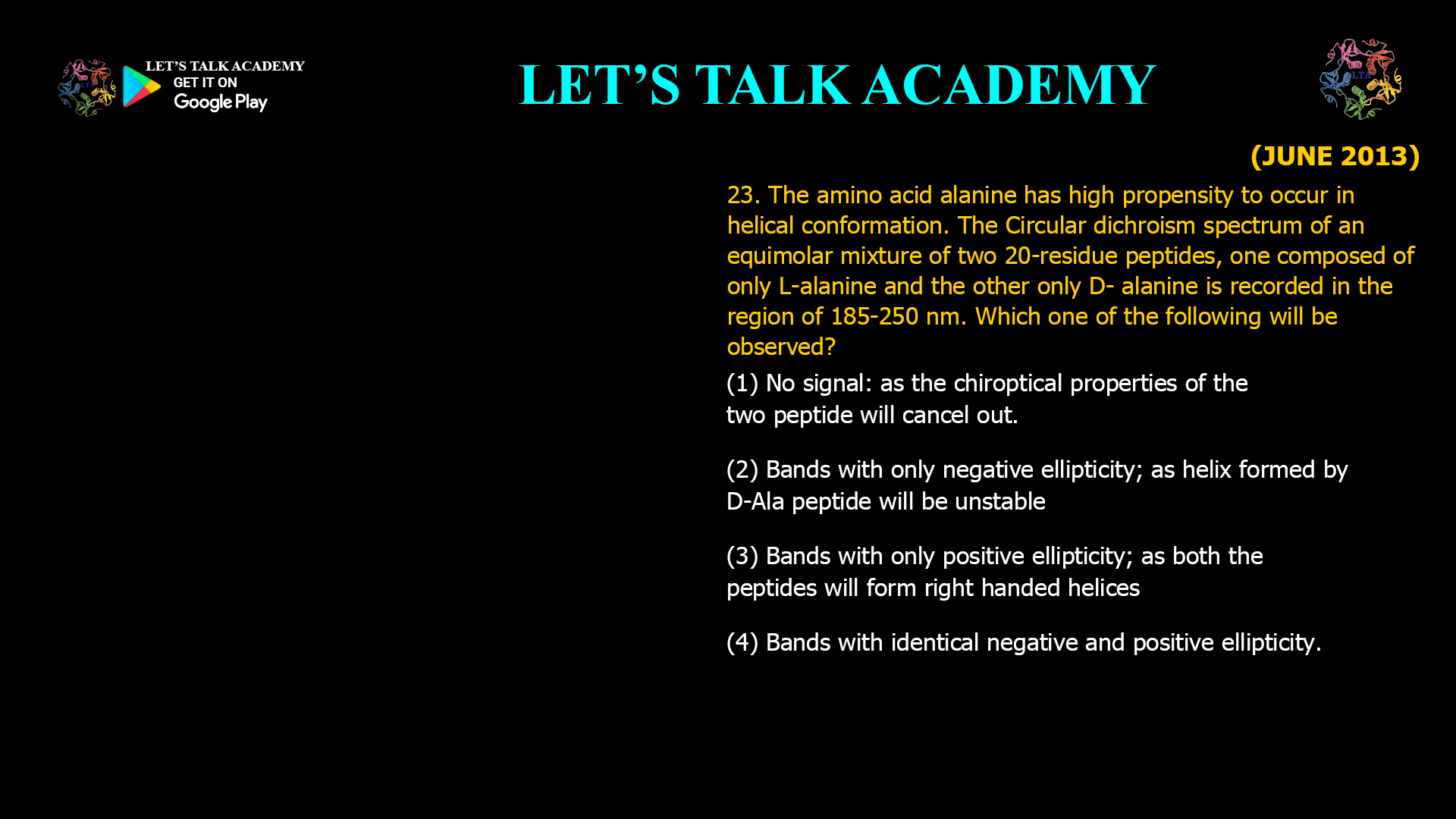
23. The amino acid alanine has high propensity to occur in helical conformation. The Circular dichroism spectrum of an equimolar mixture of two 20-residue peptides, one composed of only L-alanine and the other only D-alanine, is recorded in the region of 185-250 nm. Which one of the following will be observed?
(1) No signal; as the chiroptical properties of the two peptide will cancel out.
(2) Bands with only negative ellipticity; as helix formed by D-Ala peptide will be unstable.
(3) Bands with only positive ellipticity; as both the peptides will form right handed helices.
(4) Bands with identical negative and positive ellipticity.
Circular Dichroism Spectrum of Equimolar L-Alanine and D-Alanine Helical Peptides
Circular Dichroism (CD) spectroscopy is one of the most important techniques for studying the secondary structure and chirality of proteins and peptides. Since proteins are composed of optically active amino acids, they interact differently with left-handed and right-handed circularly polarized light. This difference in absorption generates a characteristic CD spectrum that reflects both molecular chirality and secondary structure.
Correct Answer
Option (1): No Signal Because the Chiroptical Properties Cancel Each Other
The correct answer is Option (1). L-alanine peptides naturally form right-handed α-helices, whereas D-alanine peptides form left-handed α-helices that are exact mirror images of the L-peptide helices. Since Circular Dichroism measures the difference in absorption of left and right circularly polarized light, the CD spectrum of one enantiomer is the exact mirror image of the other.
When equal amounts of both enantiomers are mixed, every positive ellipticity generated by one peptide is cancelled by an equal negative ellipticity generated by the other peptide. Because the two contributions are identical in magnitude but opposite in sign, the overall Circular Dichroism signal becomes essentially zero across the measured wavelength range. The mixture therefore behaves as a racemic system with no net optical activity.
Understanding Circular Dichroism Spectroscopy
Circular Dichroism spectroscopy measures the differential absorption of left-handed and right-handed circularly polarized light by chiral molecules. Proteins and peptides composed of naturally occurring L-amino acids generate characteristic CD spectra because their peptide bonds are arranged in specific three-dimensional conformations. The far-ultraviolet region, extending approximately from 185 to 250 nm, is particularly useful for studying peptide secondary structure because peptide bond electronic transitions occur within this range.
Different secondary structures produce distinctive CD signatures. An α-helix composed of L-amino acids exhibits strong negative bands near 208 nm and 222 nm together with a positive band around 190 nm. The corresponding D-amino acid helix generates a mirror-image spectrum in which the signs of these bands are completely reversed.
Why L-Alanine and D-Alanine Peptides Produce Opposite CD Spectra
L-alanine and D-alanine are stereoisomers that differ only in the spatial arrangement of atoms around the α-carbon. Consequently, peptides constructed entirely from these amino acids are molecular mirror images of each other. Their secondary structures are therefore also mirror images, producing opposite interactions with circularly polarized light.
As a result, the CD spectrum of the D-alanine peptide is exactly opposite to that of the L-alanine peptide. Peaks that appear positive in one spectrum appear negative in the other while retaining the same wavelength positions. This mirror-image relationship is a defining characteristic of enantiomeric molecules analyzed by Circular Dichroism spectroscopy.
Why an Equimolar Mixture Produces No Net CD Signal
When equal concentrations of two enantiomers are mixed, the system becomes racemic. A racemic mixture contains identical numbers of left-handed and right-handed molecules. Since the optical rotation and Circular Dichroism generated by one enantiomer are exactly cancelled by those of the other, the sample exhibits no overall optical activity.
Although each peptide individually remains highly chiral and strongly helical, the spectrometer records only the combined response of the mixture. Because the positive and negative ellipticities cancel perfectly, the resulting CD spectrum approaches zero throughout the measured wavelength range.
Why Option (1) is Correct
The L-alanine peptide produces a characteristic α-helical CD spectrum, while the D-alanine peptide produces its exact mirror image. Equal quantities of these two peptides generate equal but opposite ellipticity values at every wavelength. Consequently, the total Circular Dichroism signal cancels completely, resulting in essentially no observable CD spectrum. This behavior is identical to that of any racemic mixture of enantiomers.
Why Option (2) is Incorrect
This option incorrectly assumes that α-helices formed by D-amino acids are unstable. In reality, peptides composed entirely of D-amino acids can form stable α-helices, but these helices are left-handed rather than right-handed. Their CD spectra are mirror images of those formed by L-amino acid helices. Therefore, the D-alanine peptide contributes equally but with opposite ellipticity instead of producing only negative bands.
Why Option (3) is Incorrect
This statement incorrectly claims that both peptides form right-handed helices. Peptides composed of L-amino acids preferentially form right-handed α-helices, whereas peptides composed entirely of D-amino acids preferentially form left-handed α-helices. Because their helices possess opposite handedness, their CD spectra are mirror images rather than identical positive spectra.
Why Option (4) is Incorrect
Although the individual peptides produce equal magnitudes of positive and negative ellipticity, the spectrometer records the total signal of the mixture rather than the separate spectra. Since the opposite signals overlap perfectly, they cancel one another completely. Therefore, the observed spectrum is essentially zero rather than simultaneously displaying identical positive and negative bands.
Importance of Circular Dichroism in Protein Chemistry
Circular Dichroism spectroscopy is extensively used to determine protein secondary structure, investigate thermal denaturation, monitor protein folding, study ligand binding, characterize membrane proteins, and verify peptide chirality. Because CD directly measures molecular handedness, it is particularly valuable for distinguishing enantiomeric biomolecules that cannot be differentiated by mass spectrometry, amino acid analysis, or conventional UV spectroscopy. The mirror-image relationship between the CD spectra of enantiomers is one of the most important concepts in structural biology and peptide chemistry.
Final Answer
Correct Option: (1) No signal because the chiroptical properties of the two peptides cancel each other.
The peptide composed entirely of L-alanine forms a right-handed α-helix, while the peptide composed entirely of D-alanine forms a left-handed α-helix. These structures are exact mirror images and therefore generate Circular Dichroism spectra of equal magnitude but opposite sign. In an equimolar mixture, the positive and negative ellipticity values cancel completely, producing essentially no measurable Circular Dichroism signal. Hence, Option (1) is the correct answer.


