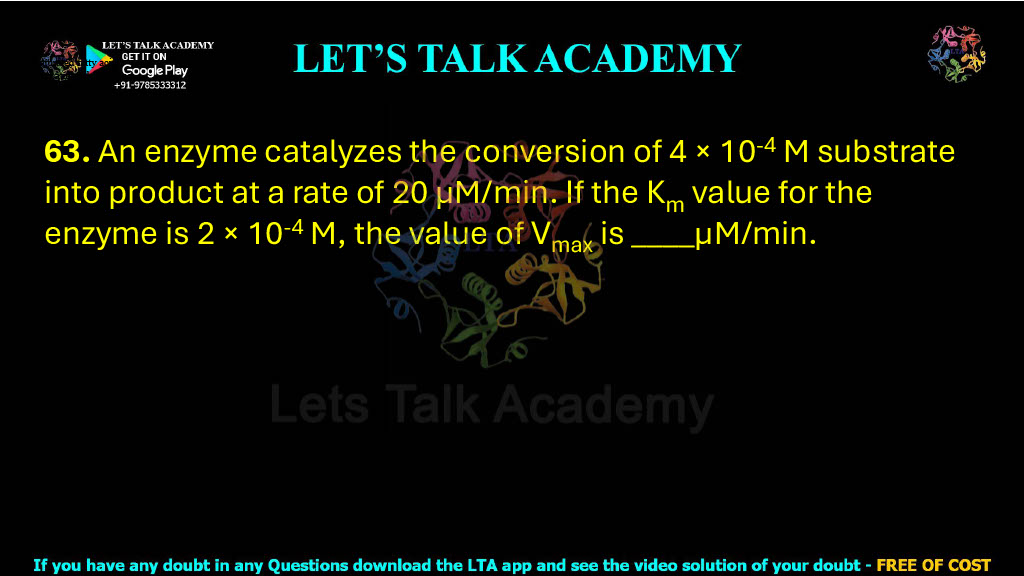
63. An enzyme catalyzes the conversion of 4 × 10⁻⁴ M substrate into product at a rate of 20 µM/min. If the Km value for the enzyme is 2 × 10⁻⁴ M, the value of Vmax is ____µM/min.
How to Calculate Vmax Using the Michaelis–Menten Equation?
Correct Answer
30 μM/min
Introduction
The Michaelis–Menten equation is the cornerstone of enzyme kinetics and describes the quantitative relationship between substrate concentration and enzyme reaction velocity. It explains how the rate of an enzyme-catalyzed reaction changes as substrate concentration increases and introduces two important kinetic parameters: the Michaelis constant (Km) and the maximum reaction velocity (Vmax). While Km reflects the substrate concentration required to achieve half of the maximum velocity, Vmax represents the highest possible reaction rate when all enzyme active sites are saturated with substrate.
Determining Vmax from experimentally measured reaction velocity is a common numerical application of the Michaelis–Menten equation. Such calculations help scientists characterize enzyme efficiency, compare catalytic activities, and study enzyme regulation.
Understanding the Concept Behind the Question
The Michaelis–Menten equation is:
v = (Vmax × [S]) / (Km + [S])
where,
- v = Initial reaction velocity
- Vmax = Maximum reaction velocity
- Km = Michaelis constant
- [S] = Substrate concentration
The given values are:
Reaction velocity (v) = 20 μM/min
Substrate concentration ([S]) = 4 × 10⁻⁴ M
Km = 2 × 10⁻⁴ M
The objective is to calculate Vmax.
Step 1. Write the Michaelis–Menten Equation
v = (Vmax × [S]) / (Km + [S])
Step 2. Rearrange the Equation to Calculate Vmax
Multiply both sides by (Km + [S]):
Vmax = v (Km + [S]) / [S]
Step 3. Substitute the Given Values
Vmax = 20 × (2 × 10⁻⁴ + 4 × 10⁻⁴) / (4 × 10⁻⁴)
Step 4. Add Km and Substrate Concentration
2 × 10⁻⁴ + 4 × 10⁻⁴ = 6 × 10⁻⁴ M
Therefore,
Vmax = 20 × (6 × 10⁻⁴) / (4 × 10⁻⁴)
Step 5. Simplify the Expression
The factor 10⁻⁴ cancels from the numerator and denominator:
Vmax = 20 × (6/4)
Vmax = 20 × 1.5
Vmax = 30 μM/min
Final Calculation
Vmax = 30 μM/min
Why Is Vmax Greater Than the Observed Velocity?
The measured reaction velocity (20 μM/min) was obtained at a substrate concentration that is only twice the Km value.
At this substrate concentration, the enzyme is not fully saturated, meaning that not all active sites are occupied by substrate molecules.
Consequently, the observed reaction rate is lower than the true maximum velocity.
Only when substrate concentration becomes much greater than Km does the reaction approach Vmax.
Formula Used
Michaelis–Menten Equation
v = (Vmax × [S]) / (Km + [S])
Rearranged Equation for Vmax
Vmax = v (Km + [S]) / [S]
This form is especially useful when reaction velocity, substrate concentration, and Km are known.
Biological Importance
The maximum reaction velocity (Vmax) is an important kinetic parameter because it reflects the catalytic capacity of an enzyme when all active sites are occupied by substrate. It is directly proportional to enzyme concentration and provides valuable information about enzyme activity under saturating conditions.
Measurements of Vmax are widely used in enzyme purification, clinical diagnostics, drug development, metabolic engineering, and biochemical research. Together with Km, Vmax helps characterize enzyme efficiency and distinguish different mechanisms of enzyme inhibition.
High-Yield Points
- Michaelis–Menten equation:
v = (Vmax × [S])/(Km + [S])
- Km is the substrate concentration at which:
v = Vmax/2
- Vmax is achieved only when the enzyme is saturated with substrate.
- Higher substrate concentration causes reaction velocity to approach Vmax.
- Vmax is directly proportional to enzyme concentration.
- Rearranged equation:
Vmax = v(Km + [S])/[S]
Frequently Asked Questions
What is Vmax?
Vmax is the maximum rate of an enzyme-catalyzed reaction when every enzyme active site is occupied by substrate.
Why is the observed velocity lower than Vmax?
The substrate concentration is not high enough to saturate all enzyme molecules. Therefore, only a fraction of the enzyme operates at maximum capacity.
Does Vmax depend on enzyme concentration?
Yes. Increasing enzyme concentration increases Vmax because more active sites become available for catalysis.
Key Takeaways
The Michaelis–Menten equation provides a direct relationship between substrate concentration and enzyme reaction velocity. By rearranging the equation, Vmax can be calculated when Km, substrate concentration, and reaction velocity are known. In this problem, the enzyme converts substrate at 20 μM/min, while Km = 2 × 10⁻⁴ M and [S] = 4 × 10⁻⁴ M. Substituting these values into the rearranged Michaelis–Menten equation gives:
Vmax = 20 × (6/4) = 30 μM/min
Thus, the enzyme’s maximum reaction velocity is 30 μM/min.
Final Answer
Vmax = 30 μM/min
Explanation
Using the Michaelis–Menten equation:
v = (Vmax × [S])/(Km + [S])
Rearranging,
Vmax = v(Km + [S])/[S]
Substituting the given values:
Vmax = 20 × (2 × 10⁻⁴ + 4 × 10⁻⁴)/(4 × 10⁻⁴)
= 20 × (6 × 10⁻⁴)/(4 × 10⁻⁴)
= 20 × 1.5
= 30 μM/min
Therefore, the maximum reaction velocity (Vmax) of the enzyme is 30 μM/min.


