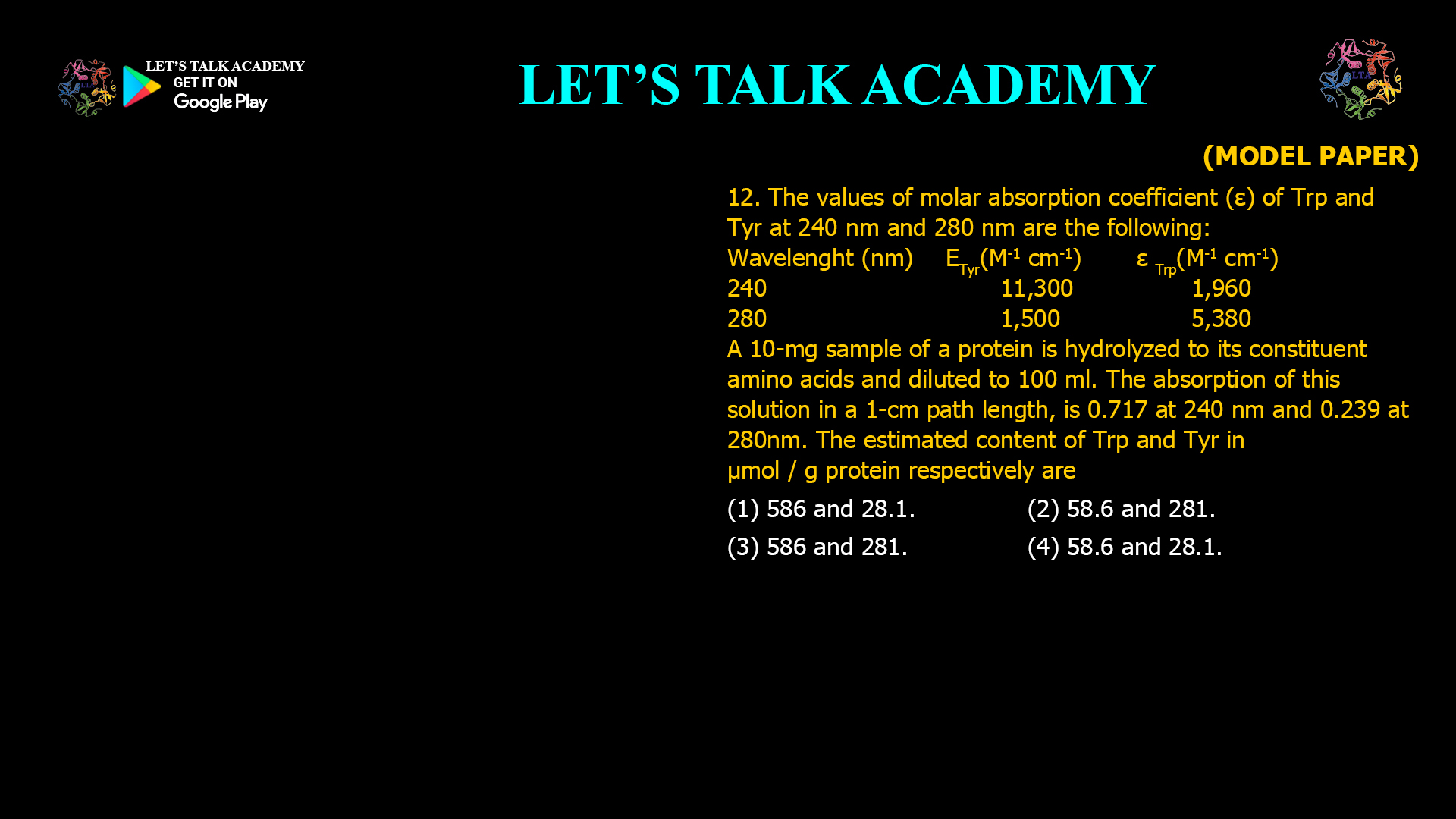
12. The values of molar absorption coefficient (ε) of Trp and Tyr at 240 nm and 280 nm are the following:
| Wavelength (nm) | εTyr (M−1 cm−1) | εTrp (M−1 cm−1) |
|---|---|---|
| 240 | 11,300 | 1,960 |
| 280 | 1,500 | 5,380 |
A 10-mg sample of a protein is hydrolyzed to its constituent amino acids and diluted to 100 mL.
The absorption of this solution in a 1-cm path length is 0.717 at 240 nm and 0.239 at 280 nm.
The estimated content of Trp and Tyr in µmol/g protein respectively are:
(1) 586 and 28.1.
(2) 58.6 and 281.
(3) 586 and 281.
(4) 58.6 and 28.1.
How to Calculate Tryptophan and Tyrosine Content Using Dual-Wavelength UV Spectroscopy
Ultraviolet-visible (UV-Vis) spectroscopy is one of the most reliable analytical techniques for estimating aromatic amino acids such as tryptophan (Trp) and tyrosine (Tyr). Since these amino acids absorb ultraviolet light at different wavelengths with different molar absorption coefficients, their concentrations can be determined simultaneously by measuring absorbance at two wavelengths and solving the resulting equations.
Understanding the Concept
According to the Beer-Lambert law, absorbance is directly proportional to the molar absorption coefficient, concentration of the absorbing molecule, and the optical path length. Since the path length is 1 cm, the absorbance at each wavelength becomes the sum of the contributions from tryptophan and tyrosine. Because both amino acids absorb differently at 240 nm and 280 nm, two independent equations can be written and solved simultaneously to determine their concentrations.
The protein has already been hydrolyzed into free amino acids, meaning the measured absorbance originates solely from individual tryptophan and tyrosine molecules present in the hydrolysate. Once their molar concentrations are calculated, they can be converted into micromoles present in the solution and finally expressed as micromoles per gram of protein.
Step 1: Write the Beer-Lambert Equations
Let the molar concentration of tyrosine be Y and that of tryptophan be W.
At 240 nm,
11300Y + 1960W = 0.717
At 280 nm,
1500Y + 5380W = 0.239
These two equations contain two unknowns and can therefore be solved simultaneously.
Step 2: Solve the Simultaneous Equations
Solving the equations gives:
Tyrosine concentration (Y) = 2.81 × 10⁻⁵ M
Tryptophan concentration (W) = 5.86 × 10⁻⁵ M
These represent the molar concentrations of the amino acids in the final 100 mL hydrolyzed solution.
Step 3: Convert Concentration into Micromoles
The total solution volume is 100 mL or 0.1 L.
Tyrosine:
2.81 × 10-5 × 0.1
=
2.81 × 10⁻⁶ mol
=
2.81 μmol
Tryptophan:
5.86 × 10-5 × 0.1
=
5.86 × 10⁻⁶ mol
=
5.86 μmol
Step 4: Express the Result Per Gram of Protein
The original protein sample weighed only 10 mg.
10 mg = 0.01 g
Therefore,
Tyrosine:
2.81 ÷ 0.01
=
281 μmol/g
Tryptophan:
5.86 ÷ 0.01
=
586 μmol/g
Correct Answer
Option (3): 586 μmol/g of Trp and 281 μmol/g of Tyr
After solving the Beer-Lambert equations and converting the calculated molar concentrations into micromoles per gram of protein, the protein contains approximately 586 μmol of tryptophan and 281 μmol of tyrosine per gram. These values exactly match Option (3), making it the correct answer.
Why Option (1) is Incorrect – 586 and 28.1
The tryptophan value is correct, but the tyrosine value is underestimated by a factor of ten. This mistake generally occurs when students forget to divide by the original protein mass or incorrectly convert milligrams into grams during the final calculation.
Why Option (2) is Incorrect – 58.6 and 281
The tyrosine calculation is correct, but the tryptophan value is underestimated by one order of magnitude. Such an error usually results from incorrect conversion between moles and micromoles or a mistake while solving the simultaneous equations.
Why Option (3) is Correct – 586 and 281
Both concentrations satisfy the Beer-Lambert equations at 240 nm and 280 nm. After converting the molar concentrations into micromoles present in the hydrolyzed solution and expressing them per gram of protein, the calculated values become 586 μmol/g for tryptophan and 281 μmol/g for tyrosine. Therefore, this option agrees perfectly with both the experimental absorbance values and the mathematical calculations.
Why Option (4) is Incorrect – 58.6 and 28.1
Both values are smaller than the correct answer by a factor of ten. This usually occurs when students stop after calculating the total micromoles in the hydrolyzed solution and forget that the question asks for micromoles per gram of protein rather than per sample.
Beer-Lambert Law in Amino Acid Quantification
The Beer-Lambert law is fundamental to UV-visible spectroscopy and quantitative biochemical analysis. Since aromatic amino acids possess characteristic absorption spectra, measurements at multiple wavelengths allow their concentrations to be determined simultaneously. This approach is routinely used in protein chemistry, enzyme purification, pharmaceutical quality control, structural biology, and analytical biochemistry. Understanding how extinction coefficients contribute to absorbance enables researchers to estimate amino acid composition accurately without directly sequencing the protein.
Final Answer
Correct Option: (3) 586 μmol/g of Tryptophan and 281 μmol/g of Tyrosine.
Using the Beer-Lambert law, the absorbance values measured at 240 nm and 280 nm generate two simultaneous equations corresponding to the contributions of tryptophan and tyrosine. Solving these equations provides the molar concentrations of both amino acids in the hydrolyzed solution. After converting these concentrations into micromoles and expressing them per gram of protein, the final values are 586 μmol/g of tryptophan and 281 μmol/g of tyrosine, confirming that Option (3) is the correct answer.


