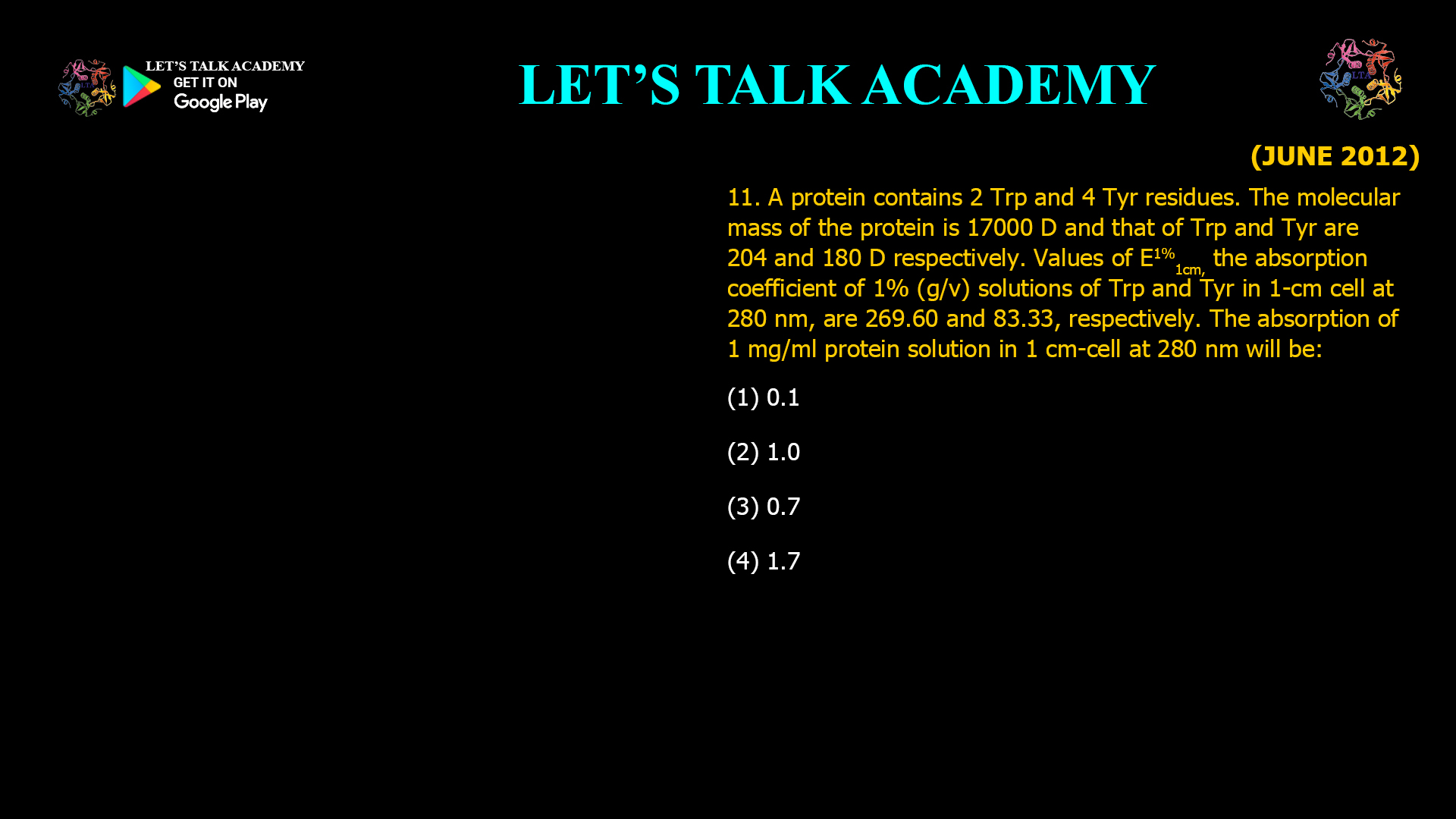
How to Calculate Protein Absorbance at 280 nm Using Tryptophan and Tyrosine Residues
Protein absorbance at 280 nm is one of the most widely used methods for estimating protein concentration in biochemistry, molecular biology, biotechnology, and analytical chemistry. Aromatic amino acids, particularly tryptophan and tyrosine, absorb ultraviolet light strongly at 280 nm due to their aromatic ring structures. Since the contribution of these amino acids to UV absorption is well characterized, it becomes possible to estimate the absorbance of a protein if the number of tryptophan and tyrosine residues is known.
Understanding the Concept
At 280 nm, proteins absorb ultraviolet light mainly because of the aromatic amino acids tryptophan and tyrosine. Each amino acid contributes independently to the overall absorbance of the protein. Therefore, the total extinction coefficient of the protein can be obtained by calculating the contribution from each aromatic residue and then adding them together.
The value E1%1cm represents the absorbance of a 1% (1 g per 100 mL) solution measured in a cuvette having a path length of 1 cm. Since the protein concentration in the question is 1 mg/mL, which is exactly equal to 0.1% (g/v), the final absorbance can easily be calculated after determining the protein’s extinction coefficient.
Step 1: Calculate the Contribution of Tryptophan
The extinction coefficient of one gram of tryptophan is given as 269.60. Since each tryptophan residue has a molecular weight of 204 Da, the contribution of one residue to the protein is proportional to its molecular weight relative to the total molecular weight of the protein.
Contribution from tryptophan:
= 2 × 269.60 × (204 / 17000)
= 6.47
Step 2: Calculate the Contribution of Tyrosine
Similarly, each tyrosine residue contributes according to its extinction coefficient and molecular weight.
Contribution from tyrosine:
= 4 × 83.33 × (180 / 17000)
= 3.53
Step 3: Calculate the Total Extinction Coefficient of the Protein
The total extinction coefficient is obtained by adding the contributions from tryptophan and tyrosine.
Protein E1%1cm
= 6.47 + 3.53
= 10.00
Step 4: Calculate the Absorbance of the Protein Solution
The concentration given is 1 mg/mL.
Since
1% (g/v) = 10 mg/mL
Therefore,
1 mg/mL = 0.1% (g/v)
Using the definition of E1%1cm,
Absorbance = 10 × 0.1
= 1.0
Correct Answer
Option (2): 1.0
The protein contains aromatic amino acids whose individual UV absorption contributions are additive. After calculating the extinction coefficient contributed by both tryptophan and tyrosine residues, the total E1%1cm of the protein becomes 10. Since the protein concentration is only one-tenth of a 1% solution, the observed absorbance is one-tenth of the extinction coefficient, giving a final absorbance value of exactly 1.0.
Why Option (1) is Incorrect – 0.1
This option results from misunderstanding the definition of E1%1cm. Some students directly use the concentration value of 0.1% without multiplying it by the calculated extinction coefficient. The extinction coefficient already represents the absorbance of a 1% solution, so the concentration must always be multiplied by that coefficient. Therefore, an absorbance of 0.1 is far smaller than the correct value.
Why Option (2) is Correct – 1.0
The extinction coefficient of the protein is calculated by adding the contributions from all aromatic residues. Once the total E1%1cm equals 10, applying the actual protein concentration of 0.1% immediately gives an absorbance of 1.0. This calculation is fully consistent with Beer-Lambert law and the definition of the specific extinction coefficient.
Why Option (3) is Incorrect – 0.7
This value generally appears when students either ignore one aromatic amino acid contribution or perform incorrect multiplication while calculating the extinction coefficient. Since both tryptophan and tyrosine contribute significantly to UV absorption, omitting either contribution leads to an underestimated absorbance.
Why Option (4) is Incorrect – 1.7
An absorbance of 1.7 would require either a substantially larger extinction coefficient or a higher protein concentration. Neither condition exists in the question. The calculated extinction coefficient is exactly 10, and the concentration corresponds to only 0.1% (g/v). Therefore, an absorbance of 1.7 cannot be obtained from the given data.
Beer-Lambert Law and Protein Spectroscopy
The Beer-Lambert law states that absorbance is directly proportional to the concentration of the absorbing molecule, the path length of the cuvette, and the extinction coefficient. In protein spectroscopy, aromatic amino acids serve as the primary chromophores responsible for UV absorption at 280 nm. Since the path length remains constant at 1 cm in this question, the absorbance depends entirely on the extinction coefficient and the protein concentration. This principle forms the basis of rapid protein quantification in research laboratories around the world.
Final Answer
Correct Option: (2) 1.0
The extinction coefficient contributed by two tryptophan residues and four tyrosine residues is calculated to be 10. Since the given protein concentration is 1 mg/mL, equivalent to 0.1% (g/v), the absorbance at 280 nm is obtained by multiplying the extinction coefficient by 0.1. Therefore, the protein solution exhibits an absorbance of 1.0 in a 1-cm path length cuvette.


