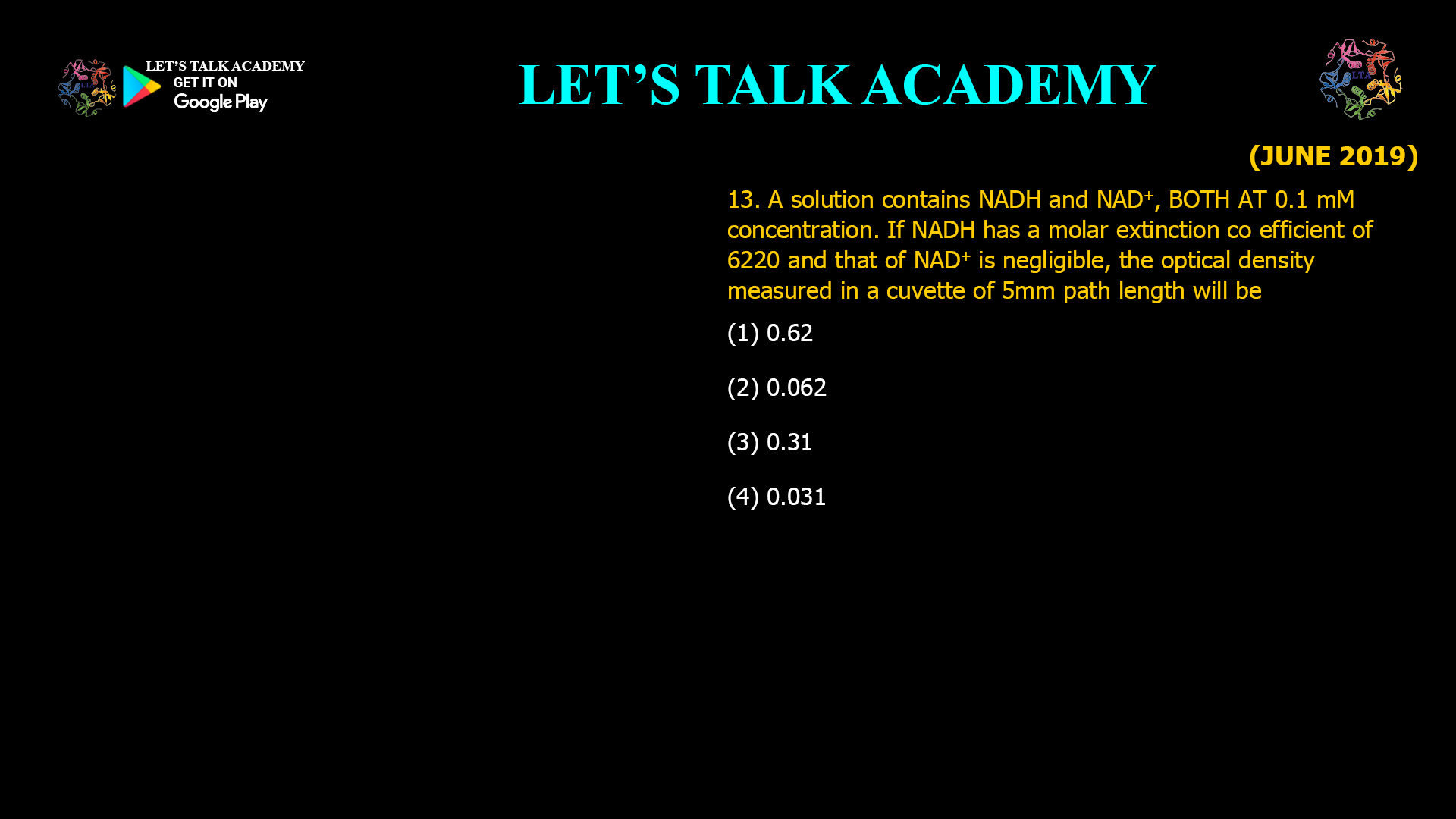
13. A solution contains NADH and NAD+, BOTH AT 0.1 mM concentration. If NADH has a molar extinction coefficient of 6220 and that of NAD+ is negligible, the optical density measured in a cuvette of 5 mm path length will be
(1) 0.62
(2) 0.062
(3) 0.31
(4) 0.031
How to Calculate the Optical Density (OD) of NADH Using Beer-Lambert Law
The Beer-Lambert law is one of the most fundamental principles in biochemistry, analytical chemistry, molecular biology, and biotechnology. It establishes a direct relationship between the absorbance of light by a solution and the concentration of the absorbing molecule. One of the most common applications of this law is the estimation of nicotinamide adenine dinucleotide in its reduced form (NADH). Since NADH exhibits strong absorption at 340 nm whereas oxidized NAD+ shows negligible absorbance at this wavelength, the change in absorbance can be directly related to enzyme activity and metabolic reactions.
Understanding the Concept
The Beer-Lambert law states that absorbance, also called optical density (OD), is directly proportional to the molar extinction coefficient, the concentration of the absorbing molecule, and the path length through which light passes. Mathematically, the relationship is expressed as:
A = ε × c × l
where A represents absorbance, ε is the molar extinction coefficient, c is the concentration in moles per litre, and l is the path length in centimetres.
In this problem, only NADH contributes to the absorbance because the extinction coefficient of NAD+ is stated to be negligible. Therefore, even though both molecules are present at equal concentrations, the optical density depends entirely on the concentration of NADH.
Step 1: Write the Given Values
Molar extinction coefficient of NADH:
ε = 6220 M-1 cm-1
Concentration of NADH:
0.1 mM = 0.0001 M = 1 × 10⁻⁴ M
Path length:
5 mm = 0.5 cm
Step 2: Apply the Beer-Lambert Law
Substituting the given values into the Beer-Lambert equation,
A = ε × c × l
A = 6220 × (1 × 10-4) × 0.5
A = 6220 × 0.00005
A = 0.311
The calculated optical density is approximately 0.31.
Correct Answer
Option (3): 0.31
Since NAD+ has negligible absorbance, only NADH contributes to the measured optical density. Using the Beer-Lambert law with the given molar extinction coefficient, concentration, and a path length of 0.5 cm gives an absorbance of approximately 0.311. After rounding to two decimal places, the optical density becomes 0.31, making Option (3) the correct answer.
Why Option (1) is Incorrect – 0.62
This value would be obtained if the calculation incorrectly used a path length of 1 cm instead of the given 5 mm. Since the cuvette is only half as long as the standard 1 cm cuvette, the absorbance must also be reduced by half. Ignoring the path length conversion leads directly to an overestimated optical density of approximately 0.62.
Why Option (2) is Incorrect – 0.062
An absorbance of 0.062 generally results from an incorrect conversion of concentration from millimolar to molar units. Students sometimes mistakenly convert 0.1 mM into 1 × 10⁻⁵ M instead of the correct value of 1 × 10⁻⁴ M. This introduces a tenfold error in the final calculation.
Why Option (3) is Correct – 0.31
The Beer-Lambert law clearly indicates that absorbance depends only on the absorbing species. Since NAD+ contributes essentially no absorbance at the measurement wavelength, only NADH is included in the calculation. Using the correct concentration and converting the path length from millimetres to centimetres produces an absorbance of 0.311, which rounds to 0.31.
Why Option (4) is Incorrect – 0.031
This value is approximately ten times smaller than the correct answer and usually arises from simultaneously making an incorrect concentration conversion and an arithmetic error during multiplication. The Beer-Lambert equation requires careful handling of units, particularly when converting millimolar concentrations into molar concentrations.
Importance of NADH Absorbance in Biochemistry
NADH is one of the most important biological cofactors involved in cellular respiration, oxidative phosphorylation, glycolysis, the tricarboxylic acid cycle, and numerous oxidoreductase reactions. Because NADH absorbs strongly at 340 nm while NAD+ does not, researchers routinely monitor changes in absorbance to measure enzyme activity, determine reaction kinetics, estimate metabolite concentrations, and study cellular metabolism. The Beer-Lambert law therefore serves as the foundation for many biochemical assays used in research laboratories, pharmaceutical industries, and clinical diagnostics.
Final Answer
Correct Option: (3) 0.31
Applying the Beer-Lambert law, the optical density is calculated by multiplying the molar extinction coefficient of NADH (6220 M-1 cm-1) by its concentration (1 × 10⁻⁴ M) and the cuvette path length (0.5 cm). Since NAD+ has negligible absorbance, it does not contribute to the calculation. The resulting absorbance is 0.311, which is approximately 0.31. Therefore, Option (3) is the correct answer.


