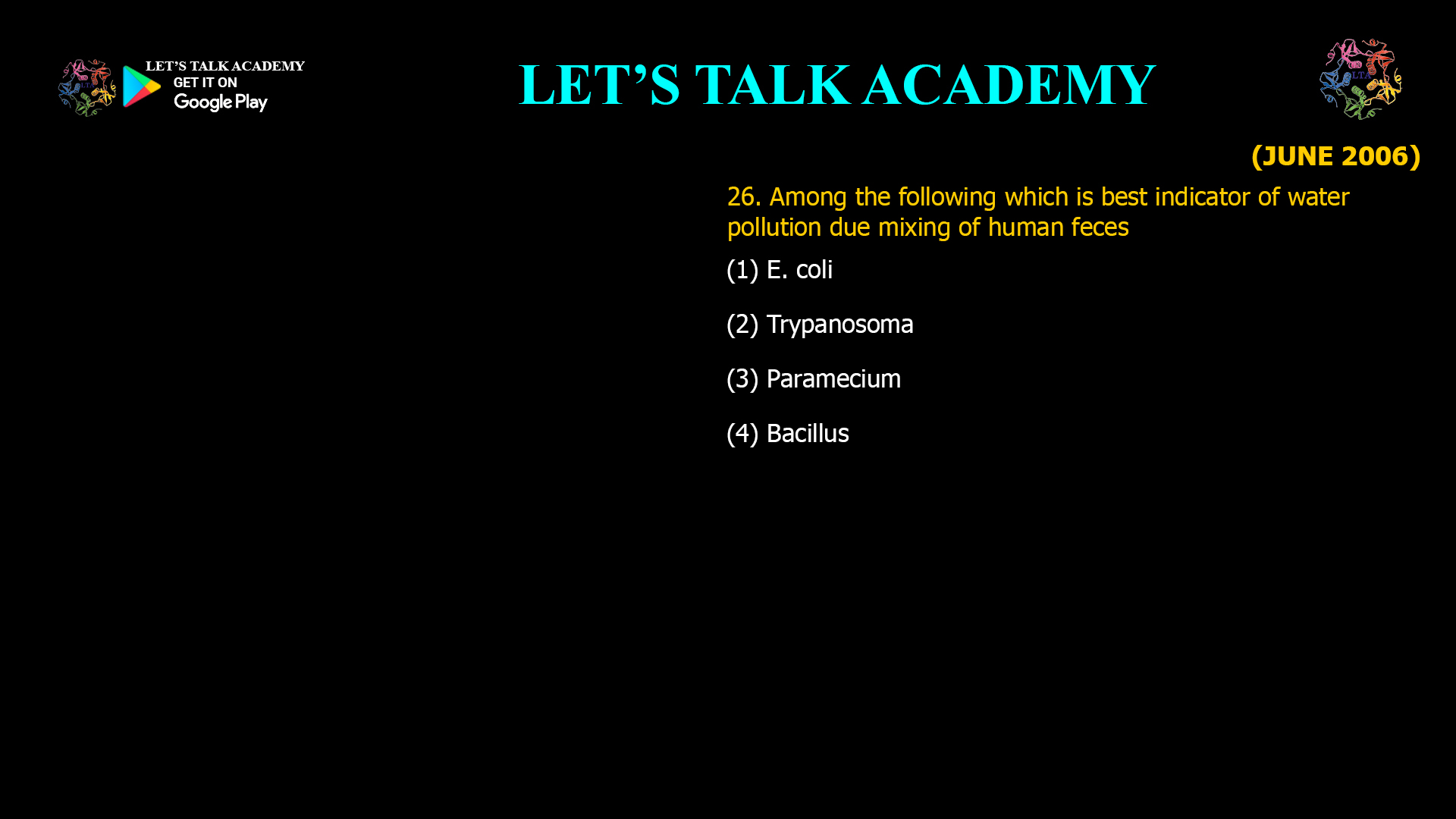
- Among the following which is best indicator of water pollution due mixing of human feces
(1) E. coli
(2) Trypanosoma
(3) Paramecium
(4) Bacillus
Water pollution caused by the mixing of human feces is a serious public health concern. Contaminated water can transmit a range of diseases, including cholera, typhoid, and dysentery. To protect public health, it is essential to detect fecal contamination quickly and reliably. Among the various microorganisms that can be found in water, Escherichia coli (E. coli) is widely recognized as the best indicator of water pollution due to the mixing of human feces. This article explores why E. coli is the preferred indicator, how it compares to other microorganisms, and its importance in water quality monitoring.
Why Monitor Water for Fecal Contamination?
Fecal contamination of water sources poses a significant risk to human health. Human feces can contain a variety of pathogens, including bacteria, viruses, and protozoa, which can cause gastrointestinal illnesses, infections, and even life-threatening diseases. Directly testing for all possible pathogens is impractical due to the diversity of microorganisms and the complexity of detection methods. Instead, scientists and public health officials use indicator organisms—microbes that are consistently present in feces and easy to detect—as a proxy for fecal contamination and the potential presence of harmful pathogens.
The Role of Indicator Organisms
Indicator organisms are used because they are:
-
Abundant in feces: They are consistently present in high numbers in human and animal waste.
-
Easy to detect: They can be identified using simple, cost-effective laboratory tests.
-
Generally harmless: While some strains can cause illness, most indicator organisms are not pathogenic themselves.
-
Correlated with pathogens: Their presence suggests that disease-causing microorganisms may also be present.
Why E. coli Is the Best Indicator
Escherichia coli (E. coli) is a Gram-negative bacterium that is a natural inhabitant of the intestines of warm-blooded animals, including humans. It is present in high concentrations in human feces and is rarely found in clean, uncontaminated water. For these reasons, E. coli has become the gold standard for detecting fecal contamination in water.
Key Reasons for Using E. coli as an Indicator
-
High Specificity to Feces: E. coli is almost exclusively found in the intestines of humans and animals, making its presence in water a strong indicator of fecal contamination.
-
Easy and Reliable Detection: E. coli can be cultured and identified using standard laboratory techniques, making it practical for routine water quality monitoring.
-
Correlation with Pathogens: The presence of E. coli in water suggests that other, more harmful fecal pathogens (such as Salmonella, Shigella, and enteric viruses) may also be present.
-
Global Standard: Regulatory agencies worldwide, including the US Environmental Protection Agency (EPA) and the World Health Organization (WHO), recommend E. coli as the primary indicator of fecal contamination in freshwater.
Comparison with Other Microorganisms
Let’s examine the other options and why they are not as suitable as E. coli for indicating fecal contamination:
1. Trypanosoma
-
Nature: Trypanosoma is a genus of parasitic protozoa that causes diseases such as African sleeping sickness and Chagas disease.
-
Relevance: These parasites are not commonly found in human feces and are not associated with typical fecal contamination of water.
-
Indicator Value: Trypanosoma is not used as an indicator of fecal pollution.
2. Paramecium
-
Nature: Paramecium is a free-living, ciliated protozoan commonly found in freshwater environments.
-
Relevance: Paramecium is not associated with human feces and is not considered an indicator of fecal contamination.
-
Indicator Value: Its presence in water does not indicate fecal pollution.
3. Bacillus
-
Nature: Bacillus is a genus of Gram-positive, spore-forming bacteria found in soil, water, and air.
-
Relevance: While some species of Bacillus can be found in feces, they are also widespread in the environment and are not specific to fecal contamination.
-
Indicator Value: Bacillus is not a reliable indicator of fecal pollution because its presence does not necessarily indicate fecal contamination.
The Science Behind Fecal Indicator Bacteria
Fecal indicator bacteria, such as E. coli and enterococci, have been used for over 150 years to assess water quality and the risk of waterborne disease. These bacteria are present in high numbers in sewage and are easy to culture, making them practical for routine monitoring. E. coli is particularly valuable because it is highly specific to fecal sources and is rarely found in uncontaminated water.
How E. coli Testing Works
-
Sample Collection: Water samples are collected from rivers, lakes, wells, or other sources.
-
Laboratory Analysis: Samples are cultured on selective media that allow E. coli to grow while inhibiting other bacteria.
-
Interpretation: High levels of E. coli indicate recent fecal contamination and a potential health risk.
Health Implications of Fecal Contamination
The presence of E. coli in water signals the possible presence of pathogenic microorganisms that can cause illnesses such as:
-
Gastroenteritis: Symptoms include diarrhea, vomiting, and abdominal pain.
-
Dysentery: Severe diarrhea with blood and mucus.
-
Typhoid fever: Caused by Salmonella Typhi.
-
Cholera: Caused by Vibrio cholerae.
Limitations of E. coli as an Indicator
While E. coli is the best available indicator of fecal contamination, it has some limitations:
-
Source Identification: Standard E. coli tests cannot distinguish between human and animal sources of fecal contamination. Advanced techniques, such as microbial source tracking, are needed to identify the specific source.
-
Environmental Survival: E. coli can survive and even grow in the environment under certain conditions, which may complicate interpretation of test results.
-
Not All Strains Are Pathogenic: Most E. coli strains are harmless, but some can cause illness.
Other Fecal Indicator Bacteria
In addition to E. coli, other bacteria are used as fecal indicators in specific contexts:
-
Enterococci: Often used as an indicator in marine waters, where E. coli may not survive as well.
-
Coliforms: A broader group of bacteria that includes E. coli and other related species. Total coliforms are less specific to fecal contamination than E. coli.
The Importance of Regular Monitoring
Regular monitoring of water sources for E. coli is essential for:
-
Protecting Public Health: Ensuring that drinking water and recreational waters are safe for use.
-
Preventing Outbreaks: Early detection of fecal contamination can help prevent waterborne disease outbreaks.
-
Regulatory Compliance: Meeting water quality standards set by national and international agencies.
Key Takeaways
-
E. coli is the best indicator of water pollution caused by the mixing of human feces.
-
It is highly specific to fecal sources, easy to detect, and correlated with the presence of harmful pathogens.
-
Other microorganisms, such as Trypanosoma, Paramecium, and Bacillus, are not reliable indicators of fecal contamination.
-
Regular monitoring of E. coli in water is essential for protecting public health and ensuring safe water supplies.
Summary Table
| Microorganism | Indicator of Fecal Contamination | Notes |
|---|---|---|
| E. coli | Yes | Best indicator; highly specific to feces |
| Trypanosoma | No | Parasitic protozoa, not fecal indicator |
| Paramecium | No | Free-living protozoa, not fecal indicator |
| Bacillus | No | Found in many environments, not specific to feces |
Conclusion
Among the options provided, E. coli is the best indicator of water pollution due to the mixing of human feces. Its presence in water is a reliable signal of fecal contamination and the potential risk of waterborne disease. Regular monitoring of E. coli is a cornerstone of water quality management and public health protection worldwide.
In summary, the correct answer is:
(1) E. coli.
Using E. coli as an indicator helps ensure that water is safe for drinking, recreation, and other uses, safeguarding communities from the dangers of fecal contamination.


3 Comments
Kirti Agarwal
November 6, 2025E. Coli
Kajal
November 15, 2025E.coli
Sakshi Kanwar
November 28, 2025E. coli