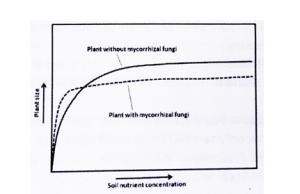
- Mycorrhizal fungi are associated with a large variety of plant species. The diagram below shows the cost- benefit curves from individual plants with or without mycorrhizal fungi associated with the roots across a soil nutrient concentration gradient.
Which one of the following options best describes the association between the plant and mycorrhiza when soil nutrient concentrations are high?
(1) Parasitism (2) Mutualism
(3) Competition (4) CommensalismThe symbiotic relationship between mycorrhizal fungi and plants is one of the most widespread and significant partnerships in terrestrial ecosystems. Mycorrhizal fungi colonize plant roots, extending their hyphal networks deep into the soil, and in return for photosynthates from the plant, they help the plant absorb water and essential nutrients, particularly phosphorus and nitrogen. This mutualistic association is vital for plant health, especially in nutrient-poor soils. But what happens when soil nutrient concentrations are high?
The Mutualism-Parasitism Continuum
The relationship between plants and mycorrhizal fungi is typically mutualistic: both partners benefit. The plant receives enhanced nutrient and water uptake, while the fungus obtains carbohydrates produced by the plant through photosynthesis. This mutualism is especially advantageous in nutrient-deficient soils, where the plant’s own roots are unable to access sufficient nutrients without fungal assistance.However, the nature of this relationship is not fixed. It exists along a continuum that can shift depending on environmental conditions—most notably, the availability of soil nutrients.
What Happens at High Soil Nutrient Concentrations?
When soil nutrient levels, particularly phosphorus and nitrogen, are high, the plant can easily obtain what it needs directly from the soil without the help of mycorrhizal fungi. In this scenario, the cost of supporting the fungus (providing it with sugars and other organic compounds) may outweigh the benefits the plant receives. The fungus continues to extract carbohydrates from the plant, but the plant gains little or no additional nutrient uptake in return. As a result, the relationship can shift from mutualism to parasitism.Key Points:
Mutualism: Occurs when the plant benefits from improved nutrient and water uptake, especially in nutrient-poor soils.Parasitism: Occurs at high soil nutrient concentrations, where the plant pays a cost (supplying carbohydrates to the fungus) but receives little or no benefit in return.
Supporting Evidence
Research shows that in nutrient-rich soils, plants associated with mycorrhizal fungi may actually have reduced growth compared to non-mycorrhizal plants because the carbon cost of supporting the fungus is not offset by increased nutrient uptake.The mutualistic benefit is context-dependent: it is strongest under nutrient-limited conditions and can become neutral or even negative (parasitic) when nutrients are abundant.
Why Not Mutualism, Competition, or Commensalism?
Mutualism is accurate only when both partners benefit, which is not the case at high nutrient levels.Competition does not describe this relationship, as the fungus and plant are not competing for the same resource.
Commensalism would mean the fungus benefits while the plant is unaffected, but in reality, the plant is harmed by the carbon drain imposed by the fungus when it gains no nutrient benefit.
Conclusion
When soil nutrient concentrations are high, the association between the plant and mycorrhizal fungi is best described as parasitism. The fungus continues to draw resources from the plant, but the plant receives little or no benefit in return, resulting in a net cost to the plant.Correct answer: (1) Parasitism


4 Comments
Neelam Sharma
October 27, 2025Parasitism
Manisha choudhary
November 6, 2025Low nutrient condition m plant mychoryza m relation mutualism kaa hota
High nutrient m parasitism kaa hoga
Kajal
November 8, 2025Parasitism
Sakshi Kanwar
November 27, 2025Plant and mycorriza show mutualism but at high nutrient level in soil plant is harmed as it drew all nutrient from plant and does not give anything in return hence converted to parasitism