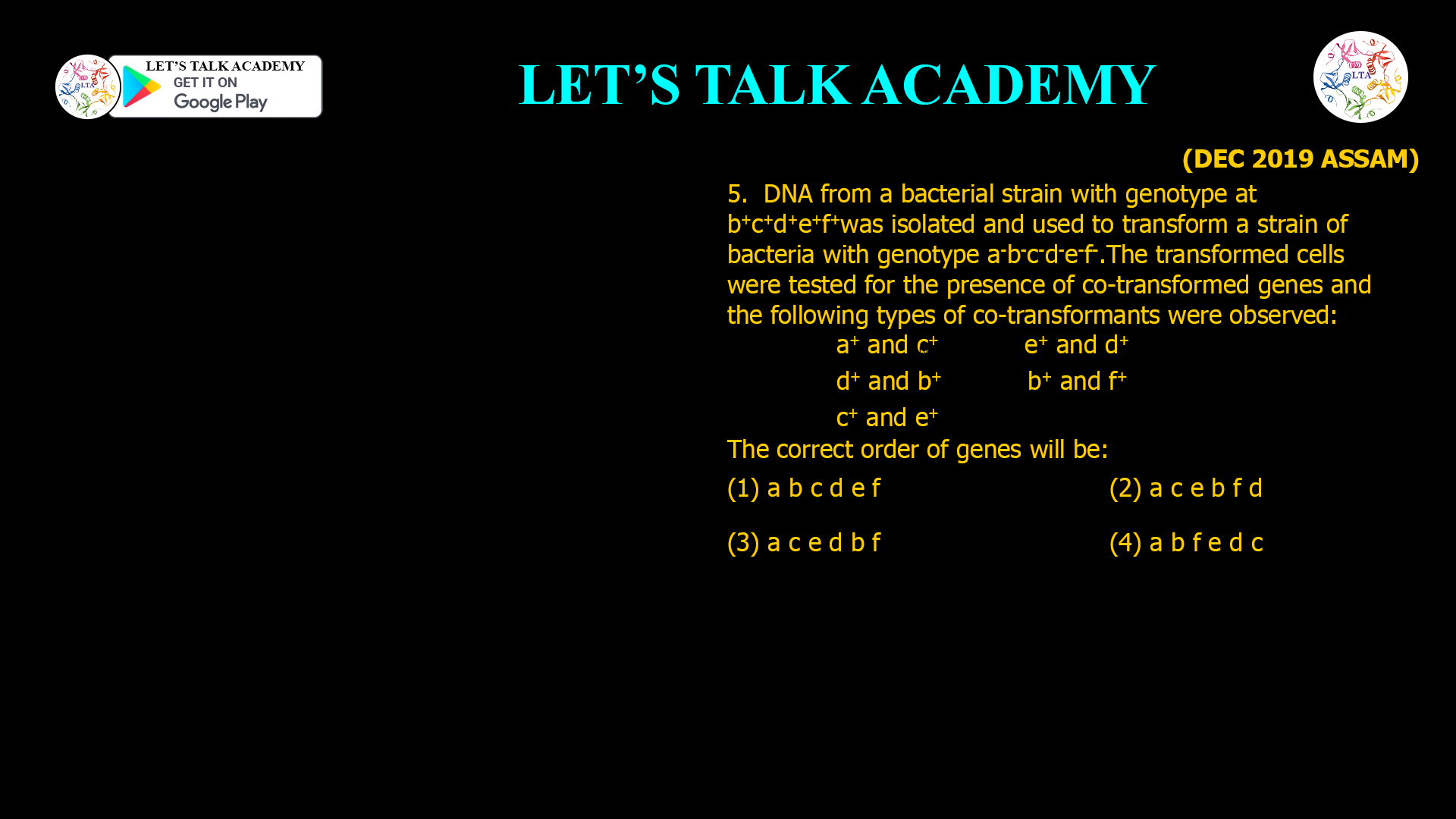
5. DNA from a bacterial strain with genotype at b+c+d+e+f+ was isolated and used to transform a strain of bacteria with genotype a–b–c–d–e–f–.The transformed cells were tested for the presence of co-transformed genes and the following types of co-transformants were observed:
a+ and c+ e+ and d+
d+ and b+ b+ and f+
c+ and e+
The correct order of genes will be:
(1) a b c d e f (2) a c e b f d
(3) a c e d b f (4) a b f e d c
Cotransformation in bacterial genetics occurs when DNA fragments from a donor strain (a⁺b⁺c⁺d⁺e⁺) are taken up by a recipient strain (a⁻b⁻c⁻d⁻e⁻), and closely linked genes on the same fragment are inherited together. The observed cotransformed pairs—a⁺b⁺, c⁺e⁺, d⁺c⁺, b⁺d⁺—indicate linkage, as only nearby genes appear on the same transforming DNA fragment (~2% of the genome). The correct gene order is a b d c e (option 4), deduced by linking overlapping pairs: a-b, b-d, d-c, c-e.
Cotransformation Principle
Genes co-transform at higher frequencies if proximal on the chromosome, as random DNA fragments capture linked markers. Absent pairs (e.g., no a⁺c⁺ or b⁺e⁺) imply separation beyond fragment size. Mapping treats pairs as edges in a linkage graph: a-b, b-d, d-c, c-e form a linear path a-b-d-c-e without branches or contradictions.
Option Analysis
-
(1) a b c d e: Fails as b⁺d⁺ cotransform (skipping c), but c lies between; contradicts d⁺c⁺ linkage without b-d proximity.
-
(2) a c b e d: Invalid—no a⁺c⁺ or c⁺b⁺ observed; d isolated from core linkages.
-
(3) a b c e d: Wrong—d⁺c⁺ and b⁺d⁺ require d between/near b-c, not after e; no b⁺e⁺ support.
-
(4) a b d c e: Matches all—fragments cover a-b-d, b-d-c, d-c-e, c-e; no unobserved pairs needed.


1 Comment
Juber Khan
February 21, 2026Option 3 is right