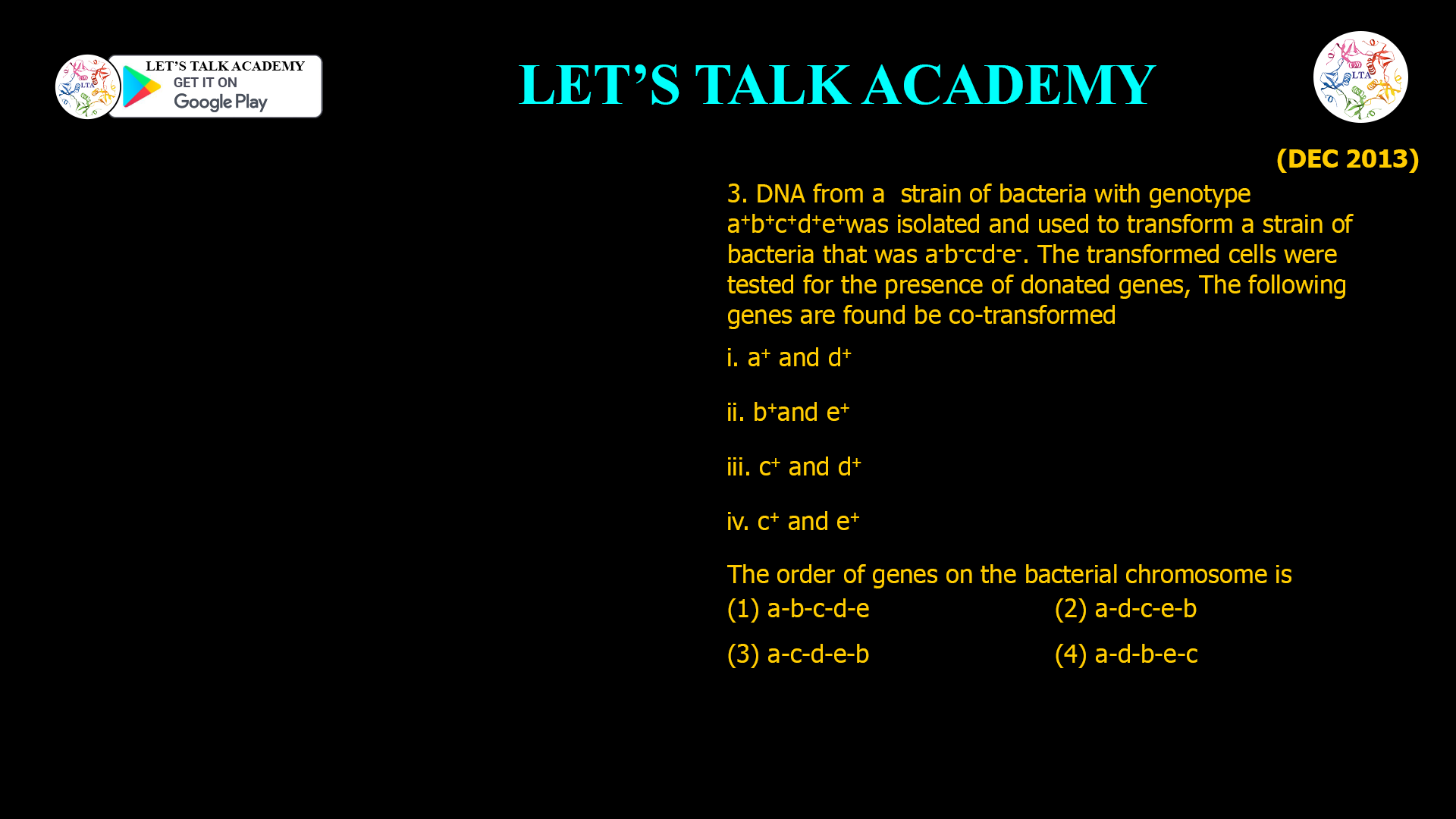
- DNA from a strain of bacteria with genotype a+b+c+d+e+ was isolated and used to transform a strain of bacteria that was a–b–c–d–e–. The transformed cells were tested for the presence of donated genes, The following genes are found be co-transformed
i. a+ and d+
- b+ and e+
iii. c+ and d +
iv. c+ and e+
The order of genes on the bacterial chromosome is
(1) a-b-c-d-e (2) a-d-c-e-b
(3) a-c-d-e-b (4) a-d-b-e-c
DNA from a donor bacterial strain (a⁺b⁺c⁺d⁺e⁺) transforms a recipient strain (a⁻b⁻c⁻d⁻e⁻), with co-transformed gene pairs i. a⁺ and d⁺, ii. b⁺ and e⁺, iii. c⁺ and d⁺, iv. c⁺ and e⁺ indicating close chromosomal proximity, as only nearby genes fit on the same DNA fragment during transformation. The correct gene order is a-d-c-e-b (option 2), deduced by linking overlapping co-transformed pairs to form a linear map where all observed linkages are satisfied without contradictions.
Cotransformation Principle
Cotransformation occurs when donor DNA fragments carry multiple linked genes, allowing simultaneous uptake and recombination in competent recipient cells, with frequency inversely proportional to intergenic distance. Genes far apart rarely co-transform due to fragmentation limits (~20 kb pieces), enabling fine-scale mapping in bacteria like Bacillus subtilis. Here, the four pairs reflect adjacency: a⁺d⁺ links a-d, c⁺d⁺ links c-d, c⁺e⁺ links c-e, b⁺e⁺ links b-e.
Option Analysis
-
Option 1: a-b-c-d-e fails because a⁺ and d⁺ co-transform (skipping b,c), but b⁺e⁺ requires b near e (distant here); c⁺e⁺ fits but overall mismatches b-e linkage.
-
Option 2: a-d-c-e-b succeeds: a-d (direct), d-c (via c-d), c-e (direct), e-b (via b-e); all pairs adjacent or very close, no skips contradict data.
-
Option 3: a-c-d-e-b contradicts a⁺d⁺ (a skips to d over c) and b⁺e⁺ fits but a-d proximity unexplained without c in between.
-
Option 4: a-d-b-e-c violates c⁺d⁺ (c distant from d) and c⁺e⁺ (c skips b,e); b between d-e breaks expected linkages.
Mapping Logic Steps
Co-transformed pairs form a graph: connect a-d, d-c, c-e, e-b to yield a-d-c-e-b chain, verified by no unobserved distant pairs. This method mirrors transduction mapping but uses naked DNA transformation for naturally competent species. For CSIR NET, recognize overlaps exclude linear alternatives, confirming option 2 as the sole consistent order.


1 Comment
Juber Khan
February 21, 2026The order of genes on bacterial chro. Is option (b)
a d c e b