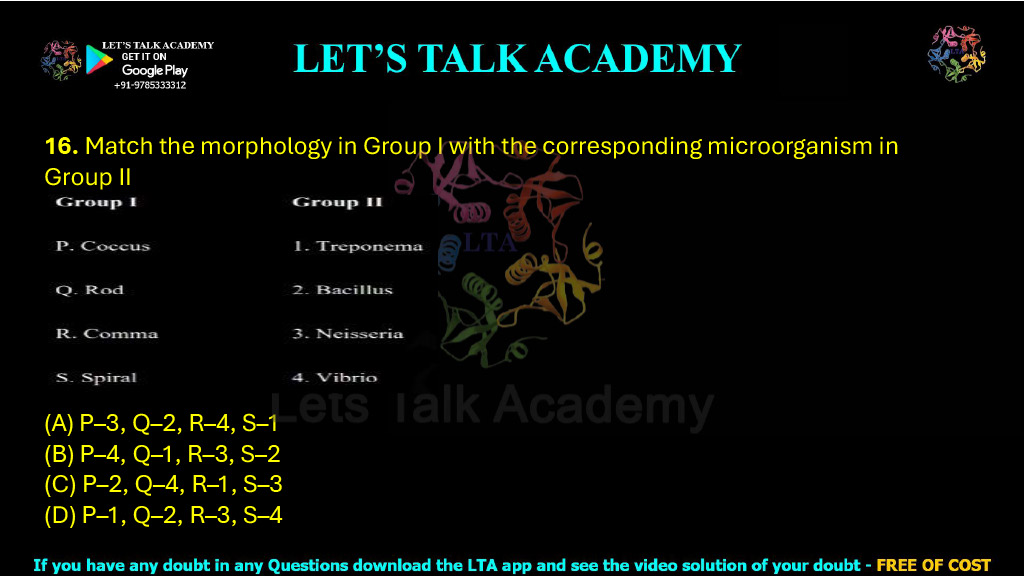
16. Match the morphology in Group I with the corresponding microorganism in Group II
| Group I | Group II |
|---|---|
| P. Coccus | 1. Treponema |
| Q. Rod | 2. Bacillus |
| R. Comma | 3. Neisseria |
| S. Spiral | 4. Vibrio |
Options:
(A) P–3, Q–2, R–4, S–1
(B) P–4, Q–1, R–3, S–2
(C) P–2, Q–4, R–1, S–3
(D) P–1, Q–2, R–3, S–4
Bacterial Morphology Explained: Cocci, Rods, Comma-Shaped and Spiral Bacteria
Introduction
Bacterial morphology is one of the most fundamental topics in microbiology because the shape of a bacterium is often closely related to its classification, identification, ecology, and pathogenicity. Although bacteria are microscopic organisms, they exhibit remarkable diversity in their cell shapes. These characteristic morphologies help microbiologists identify unknown bacterial species during microscopic examination and laboratory diagnosis.
The four most commonly encountered bacterial shapes are cocci (spherical), bacilli or rods (rod-shaped), vibrios (comma-shaped), and spiral bacteria (spirilla or spirochetes). Each morphological type contains medically and industrially important microorganisms.
Correct Answer
Correct Option: (A)
P – 3, Q – 2, R – 4, S – 1
Detailed Explanation
Bacteria are traditionally classified according to their cellular morphology. The spherical bacteria are known as cocci, rod-shaped bacteria are called bacilli, comma-shaped bacteria belong to the genus Vibrio, and flexible spiral-shaped bacteria such as Treponema are classified as spirochetes. These characteristic morphologies are routinely used in microscopy, Gram staining, bacterial identification, and clinical diagnosis.
Neisseria species, including Neisseria gonorrhoeae and Neisseria meningitidis, occur as kidney-shaped diplococci and therefore represent cocci. Members of the genus Bacillus are classic rod-shaped bacteria. Species of Vibrio, including Vibrio cholerae, possess a distinctive comma-shaped appearance. Treponema, including Treponema pallidum, is a flexible spiral bacterium belonging to the spirochetes.
Therefore, the correct matching is:
- Coccus → Neisseria
- Rod → Bacillus
- Comma → Vibrio
- Spiral → Treponema
Explanation of Each Match
P. Coccus → Neisseria
This match is correct. Neisseria species are Gram-negative cocci that typically occur in pairs (diplococci). They are responsible for diseases such as gonorrhea and meningococcal meningitis.
Q. Rod → Bacillus
This match is correct. Members of the genus Bacillus are rod-shaped bacteria. Examples include Bacillus subtilis and Bacillus anthracis.
R. Comma → Vibrio
This match is correct. Vibrio species possess a curved rod or comma-shaped morphology. The best-known example is Vibrio cholerae, the causative agent of cholera.
S. Spiral → Treponema
This match is correct. Treponema belongs to the spirochetes, which are long, flexible, spiral-shaped bacteria. Treponema pallidum causes syphilis.
Why Option (A) is Correct
Option (A) correctly matches every bacterial morphology with its corresponding microorganism:
- Coccus → Neisseria
- Rod → Bacillus
- Comma → Vibrio
- Spiral → Treponema
Why the Other Options are Incorrect
Option (B)
This option incorrectly identifies Vibrio as a coccus and Bacillus as a spiral bacterium.
Option (C)
This option incorrectly matches Bacillus with cocci and Treponema with comma-shaped bacteria.
Option (D)
This option incorrectly assigns Treponema as a coccus and Neisseria as a comma-shaped bacterium.
Comparison of All Options
| Option | Matching | Status |
|---|---|---|
| A | P–3, Q–2, R–4, S–1 | Correct |
| B | P–4, Q–1, R–3, S–2 | Incorrect |
| C | P–2, Q–4, R–1, S–3 | Incorrect |
| D | P–1, Q–2, R–3, S–4 | Incorrect |
Common Bacterial Morphologies
| Morphology | Description | Representative Example |
|---|---|---|
| Coccus | Spherical cells | Neisseria, Staphylococcus, Streptococcus |
| Bacillus (Rod) | Rod-shaped cells | Bacillus, Escherichia coli |
| Comma-shaped | Curved rod | Vibrio cholerae |
| Spiral (Spirochete) | Flexible spiral cells | Treponema pallidum |
Medical Importance of These Bacteria
| Bacterium | Disease |
|---|---|
| Neisseria gonorrhoeae | Gonorrhea |
| Neisseria meningitidis | Meningococcal meningitis |
| Bacillus anthracis | Anthrax |
| Vibrio cholerae | Cholera |
| Treponema pallidum | Syphilis |
Biological Significance
Bacterial morphology plays a critical role in microbial survival, motility, nutrient acquisition, and pathogenicity. Cell shape influences how bacteria interact with their environment, colonize host tissues, evade immune responses, and adapt to different ecological niches. Combined with Gram staining and biochemical tests, bacterial morphology remains one of the first and most reliable methods for identifying microorganisms in clinical and research laboratories.
Final Answer
Correct Option: (A)
P – 3, Q – 2, R – 4, S – 1
The correct matching is:
- Coccus → Neisseria
- Rod → Bacillus
- Comma → Vibrio
- Spiral → Treponema


