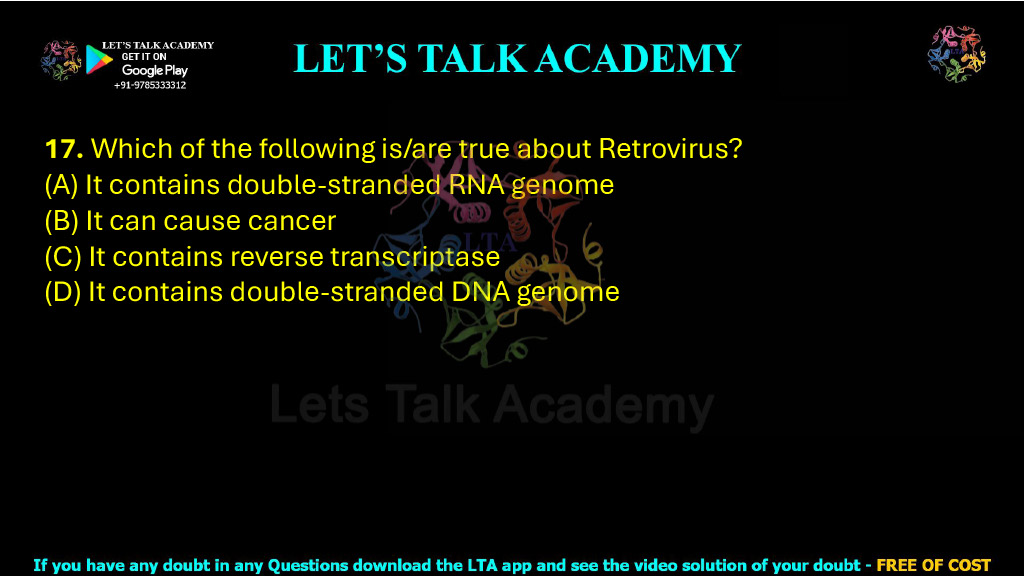
17. Which of the following is/are true about Retrovirus?
(A) It contains double-stranded RNA genome
(B) It can cause cancer
(C) It contains reverse transcriptase
(D) It contains double-stranded DNA genome
Retrovirus Characteristics Explained | Genome, Reverse Transcriptase, Cancer Association
Introduction
Retroviruses are among the most fascinating and medically important viruses because they possess a unique replication strategy that distinguishes them from all other viral groups. Unlike most viruses that directly replicate their genetic material, retroviruses first convert their RNA genome into DNA using a specialized enzyme called reverse transcriptase. The newly synthesized viral DNA then integrates into the host chromosome, allowing the virus to replicate along with the host cell.
This remarkable replication mechanism makes retroviruses important not only in infectious diseases but also in cancer biology, molecular genetics, gene therapy, and biotechnology. The Human Immunodeficiency Virus (HIV), the causative agent of AIDS, is the best-known retrovirus.
Correct Answer
Correct Options: (B) and (C)
Detailed Explanation
Retroviruses belong to Baltimore Group VI and possess a single-stranded positive-sense RNA (ssRNA) genome. Although each viral particle carries two identical copies of its RNA genome, the genome is not double-stranded RNA. This is an important distinction because double-stranded RNA viruses belong to an entirely different viral group known as the Reoviridae.
The hallmark feature of retroviruses is the presence of the enzyme reverse transcriptase, also known as RNA-dependent DNA polymerase. This enzyme synthesizes complementary DNA (cDNA) from the viral RNA genome after infection. The newly formed viral DNA integrates into the host chromosome with the help of another viral enzyme called integrase, producing a provirus that serves as the template for viral gene expression and replication.
Several retroviruses are also associated with cancer. Certain animal retroviruses carry viral oncogenes, while others activate host proto-oncogenes after integration into the genome. In humans, Human T-cell Leukemia Virus type 1 (HTLV-1) is a retrovirus that causes Adult T-cell Leukemia/Lymphoma. Therefore, retroviruses possess significant oncogenic potential in addition to causing infectious diseases such as AIDS.
Explanation of Each Option
Option (A): It Contains Double-Stranded RNA Genome
This option is incorrect. Retroviruses possess two identical copies of single-stranded positive-sense RNA. They do not contain double-stranded RNA genomes.
Option (B): It Can Cause Cancer
This option is correct. Several retroviruses are oncogenic. Human T-cell Leukemia Virus (HTLV-1) causes Adult T-cell Leukemia, while many animal retroviruses induce tumors by activating oncogenes.
Option (C): It Contains Reverse Transcriptase
This option is correct. Reverse transcriptase is the signature enzyme of retroviruses and converts viral RNA into DNA during replication.
Option (D): It Contains Double-Stranded DNA Genome
This option is incorrect. The viral particle contains an RNA genome, not DNA. Although a DNA intermediate is formed during replication inside the host cell, the mature virus itself contains RNA.
Why Options (B) and (C) are Correct
Retroviruses are unique because they contain the enzyme reverse transcriptase, enabling RNA to be converted into DNA. Some members of this viral family also possess oncogenic properties and are capable of causing leukemia, lymphoma, and other cancers.
Why the Other Options are Incorrect
Why Option (A) is Incorrect
Retroviruses contain two copies of single-stranded RNA rather than a double-stranded RNA genome.
Why Option (D) is Incorrect
Although viral DNA is produced after infection, the mature retrovirus particle never contains a double-stranded DNA genome.
Comparison of All Options
| Option | Statement | Status |
|---|---|---|
| A | Contains double-stranded RNA genome | Incorrect |
| B | Can cause cancer | Correct |
| C | Contains reverse transcriptase | Correct |
| D | Contains double-stranded DNA genome | Incorrect |
Important Characteristics of Retroviruses
| Characteristic | Description |
|---|---|
| Genome | Two copies of positive-sense single-stranded RNA |
| Baltimore Group | Group VI |
| Major Enzyme | Reverse transcriptase |
| DNA Intermediate | Present during replication |
| Genome Integration | Forms a provirus inside host DNA |
| Envelope | Present |
Examples of Retroviruses
| Retrovirus | Disease |
|---|---|
| Human Immunodeficiency Virus (HIV) | Acquired Immunodeficiency Syndrome (AIDS) |
| Human T-cell Leukemia Virus-1 (HTLV-1) | Adult T-cell Leukemia/Lymphoma |
| Rous Sarcoma Virus | Sarcoma in chickens |
| Murine Leukemia Virus | Leukemia in mice |
Retrovirus Replication Cycle
| Step | Process |
|---|---|
| 1 | Virus enters host cell |
| 2 | Reverse transcriptase converts RNA into DNA |
| 3 | Integrase inserts viral DNA into host chromosome |
| 4 | Host RNA polymerase transcribes viral genes |
| 5 | Translation of viral proteins |
| 6 | Assembly and release of new viral particles |
Comparison of Major Viral Polymerases
| Polymerase | Template | Product | Found In |
|---|---|---|---|
| DNA Polymerase | DNA | DNA | Cells and DNA viruses |
| DNA-dependent RNA Polymerase | DNA | RNA | Cells and DNA viruses |
| RNA-dependent RNA Polymerase | RNA | RNA | RNA viruses |
| Reverse Transcriptase | RNA | DNA | Retroviruses |
Biological Significance
Retroviruses have transformed our understanding of molecular biology because they challenged the classical central dogma by demonstrating that genetic information can flow from RNA to DNA. Their reverse transcriptase enzyme became a fundamental tool in biotechnology for complementary DNA (cDNA) synthesis, reverse transcription PCR (RT-PCR), transcriptomics, and gene expression analysis. At the same time, the oncogenic potential of several retroviruses has greatly advanced cancer biology and the study of cellular oncogenes.
Final Answer
Correct Options: (B) and (C)
Retroviruses are enveloped viruses with a positive-sense single-stranded RNA genome. They contain the enzyme reverse transcriptase, which converts viral RNA into DNA, and certain retroviruses such as HTLV-1 are capable of causing cancer.


