





















































































Denaturation profiles of DNA are shown below The differences in the profiles arise because (1) the DNA is single stranded but of different sizes (2) A + T content of […]


Denaturation profiles of DNA are shown below The differences in the profiles arise because (1) the DNA is single stranded but of different sizes (2) A + T content of […]

The graph between the concentration of Single stranded DNA (Y-axis) and decrease in temperature (X- axis during renaturation of DNA can be represented as Analysis During DNA renaturation (as […]

The Temperature of Melting (Tm) is defined as the temperature at which 50% of double stranded DNA is changed to single-standard DNA. Tm of DNA does not depends on (1) […]

It has been observed that for the DNA double helix melting, the value of ΔH (enthalpy change of denaturation) are 80 and 90 kcal/mole at 700 and 800, respectively. Assuming […]

Protein stability is represented as Prior to development of sensitive calorimeters, thermodynamic parameters of processes were determined by following equation ΔHO and ΔSO are standard changes m enthalpy and entropy, […]

Differential scanning calorimetric study of calf thymus DNA was carried out to measure midpoint of thermal denaturation (Tm). ΔHm (enthalpy change at Tm) and ΔCP (constant-pressure heat capacity change). It […]
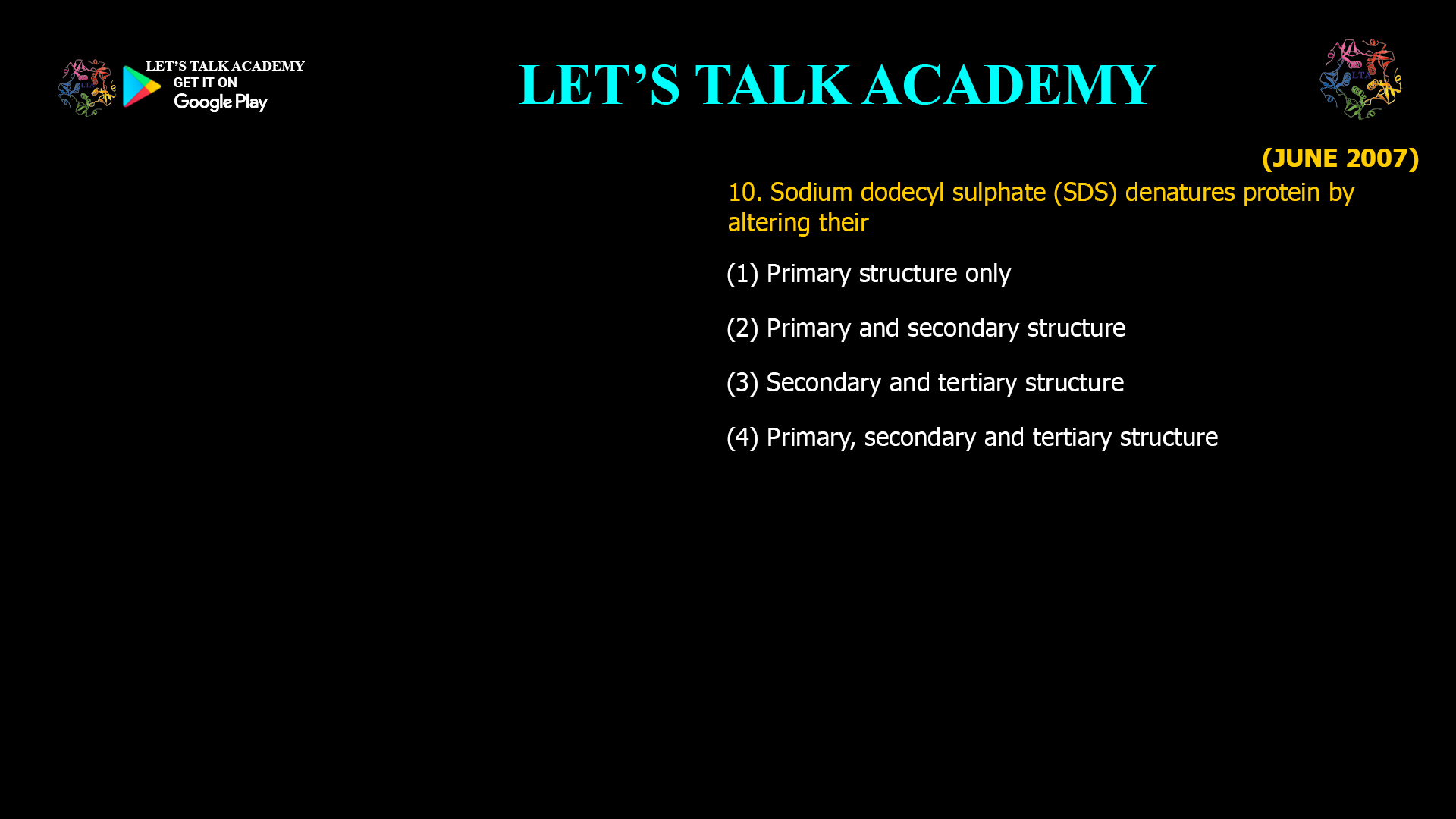
Sodium dodecyl sulphate (SDS) denatures protein by altering their (1) Primary structure only (2) Primary and secondary structure (3) Secondary and tertiary structure (4) Primary, secondary and tertiary structure […]

Most effective protein denaturant form of guanidinium when used in equimolar concentration is (1) Iodide (2) Chloride (3) Bromide (4) Sulphate Introduction Guanidinium salts are widely used chemical denaturants […]
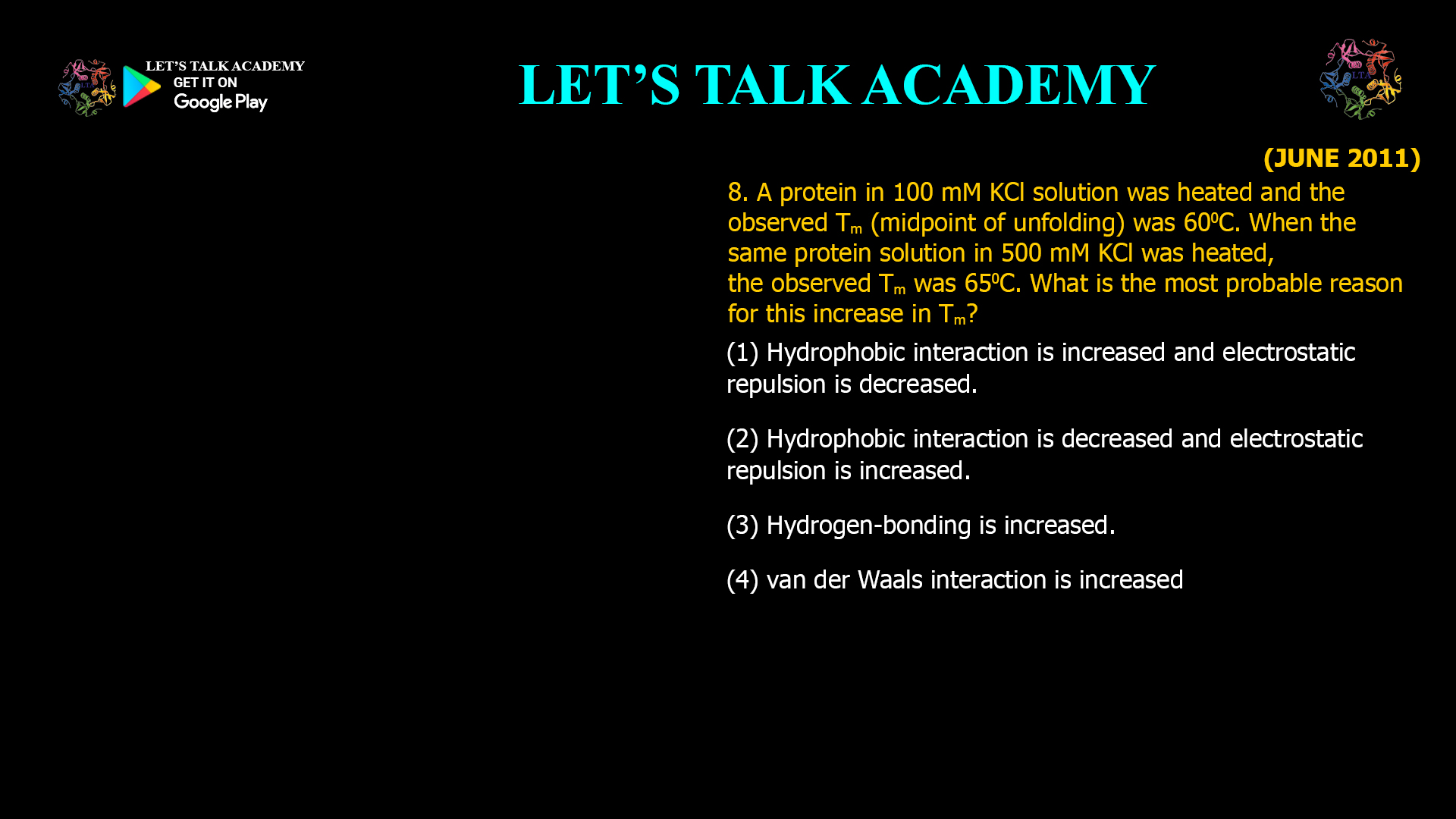
A protein in 100 mM KCl solution was heated and the observed Tm (midpoint of unfolding) was 600C. When the same protein solution in 500 mM KCl was heated, the […]

Globular protein when treated with organic solvent get denatured. The main interaction which is affected on treatment with organic solvent is (1) Hydrogen bonds (2) Covalent bonds (3) Ionic interactions […]


