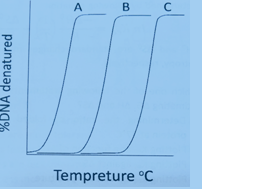
- Denaturation profiles of DNA are shown below
The differences in the profiles arise because
(1) the DNA is single stranded but of different sizes
(2) A + T content of A > B > C and the DNA are from complex genomes
(3) G + C content of C > B > A in DNA of comparable sizes isolated from simple genomes
(4) G + C content is identical but A + T content in A > B > C in DNA of comparable sizes isolated from simple genomes
Key Factors Affecting DNA Denaturation Profiles
DNA denaturation profiles vary due to intrinsic sequence composition and genome complexity:
-
GC Content:
Guanine-Cytosine (GC) pairs form three hydrogen bonds, compared to two in Adenine-Thymine (AT) pairs, making GC-rich DNA more thermally stable with higher melting temperatures (Tm). -
Genome Complexity:
Simple genomes (e.g., viral or bacterial) tend to have more uniform sequences, while complex genomes (e.g., eukaryotic) have repetitive and heterogeneous sequences, affecting melting behavior. -
DNA Size:
DNA length can influence melting profile but is less significant than base composition and complexity.
Analysis of the Given Options
-
DNA is single stranded but of different sizes
-
Incorrect. Denaturation profiles reflect double-stranded DNA melting, not single strands.
-
-
A + T content of A > B > C and the DNA are from complex genomes
-
Incorrect. Higher AT content lowers melting temperature; however, the option does not explain the observed order correctly.
-
-
G + C content of C > B > A in DNA of comparable sizes isolated from simple genomes
-
Correct. Higher GC content increases thermal stability, so DNA sample C with the highest GC content melts at the highest temperature, followed by B and A. Comparable sizes ensure size is not a confounding factor.
-
-
G + C content is identical but A + T content in A > B > C in DNA of comparable sizes isolated from simple genomes
-
Incorrect. If GC content is identical, melting profiles should be similar regardless of AT content variations.
-
Conclusion
The differences in DNA denaturation profiles arise primarily because the GC content varies among the samples, with C having the highest GC content followed by B and A, assuming comparable DNA sizes from simple genomes.
Correct answer:
(3) G + C content of C > B > A in DNA of comparable sizes isolated from simple genomes -


1 Comment
Shubhi Gargg
October 12, 2025In above graph C having the highest GC content