

































































18. In a mitochondrial respiration experiment, a researcher observed the following profile of oxygen consumption upon addition of following compounds at times I, II and III. (a) ADP + Pi […]
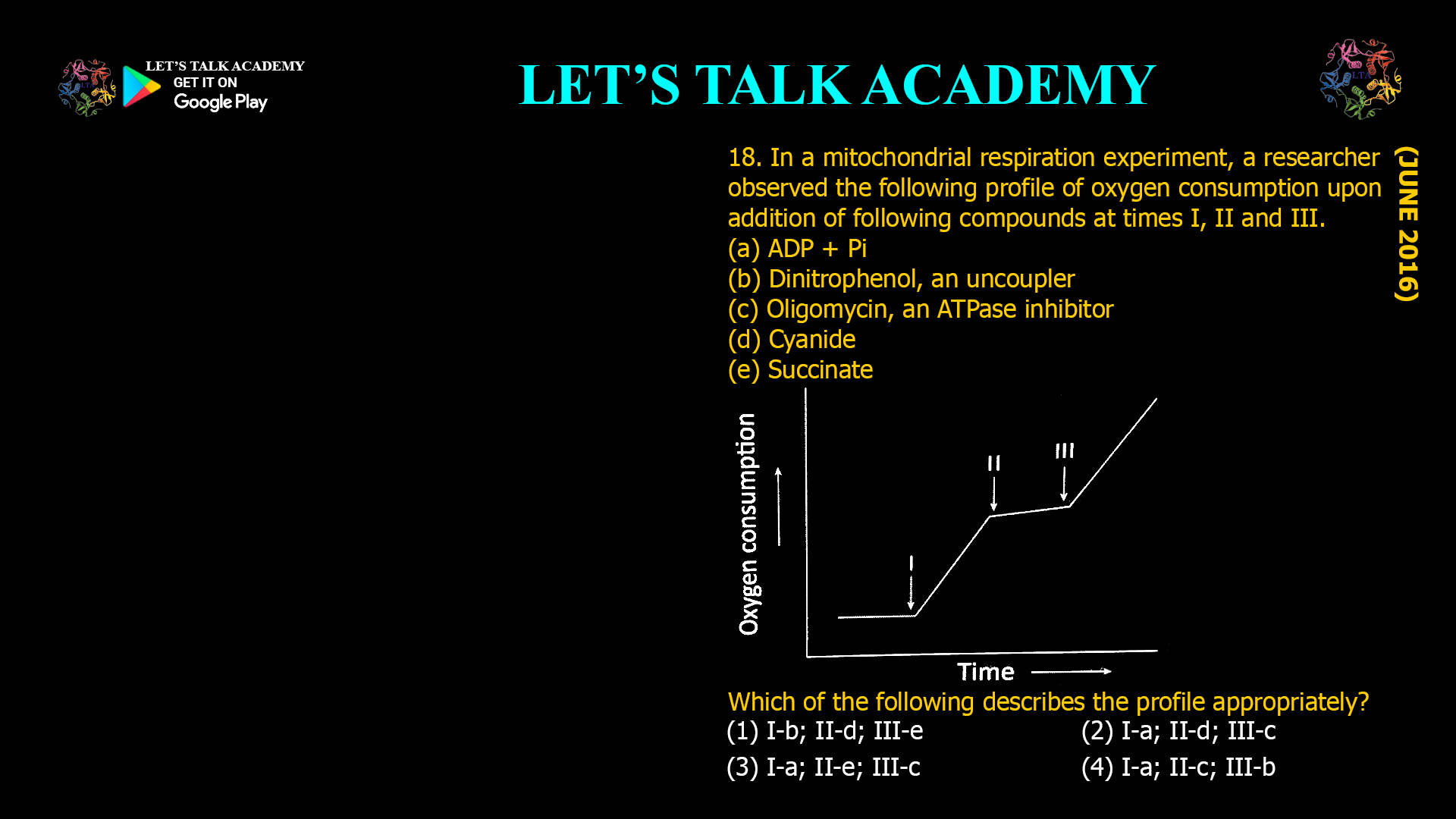

18. In a mitochondrial respiration experiment, a researcher observed the following profile of oxygen consumption upon addition of following compounds at times I, II and III. (a) ADP + Pi […]
17. The respiratory chain is relatively inaccessible to experimental manipulation in intact mitochondria. Upon disrupting mitochondria with ultrasound, however, it is possible to isolate functional sub mitochondrial particles, which consist […]
16. Coupling of the reaction centers of oxidative phosphorylation is achieved by which one of the following? (1) Making a complex of all four reaction centers. (2) Locating all four […]

15. From the following statements: A. Biosynthesis of proteins and nucleic acids from precursors results in production of chemical energy in the form of ATP. NAOH. NADPH and FADH2 B. […]

14. Among the following which chemical inhibits the mitochondrial electron transport chain- (1) Streptomycin (2) Nystatin (3) Azides (4) Penicillin The mitochondrial electron transport chain (ETC) is essential for […]

13. Which of the following proteins acts as an energy transducer? (1) G-protein. (2) Bacteriorhodopsin. (3) Hemoglobin. (4) Heat shock protein. Energy transducers are proteins that convert one form […]

12. Electron transfer from donors such as NADH and FADH2 to O2 occurs in (1) membranes of ER, chloroplast and mitochondria (2) chloroplast only (3) mitochondria only (4) organellar membranes […]
11. Proton motive force during oxidative phosphorylation is generated in mitochondria by (1) exchanging protons for sodium ions (2) pumping protons out into intermembrane space (3) pumping hydroxyl ions into […]

10. In prokaryotes, the terminal electron acceptor in anaerobic conditions are generally (1) Glucose, fructose, maltose (2) Fatty acids (3) SO42-, NO32- , S (4) Antioxidants such as Vitamin K […]

9. Iron-sulphur clusters (Fe-S) are the key prosthetic groups that carry electrons in of the below EXCEPT. (1) NADH – CoQ reductase (2) Succinate – CoQ reductase (3) Cytochrome c […]


