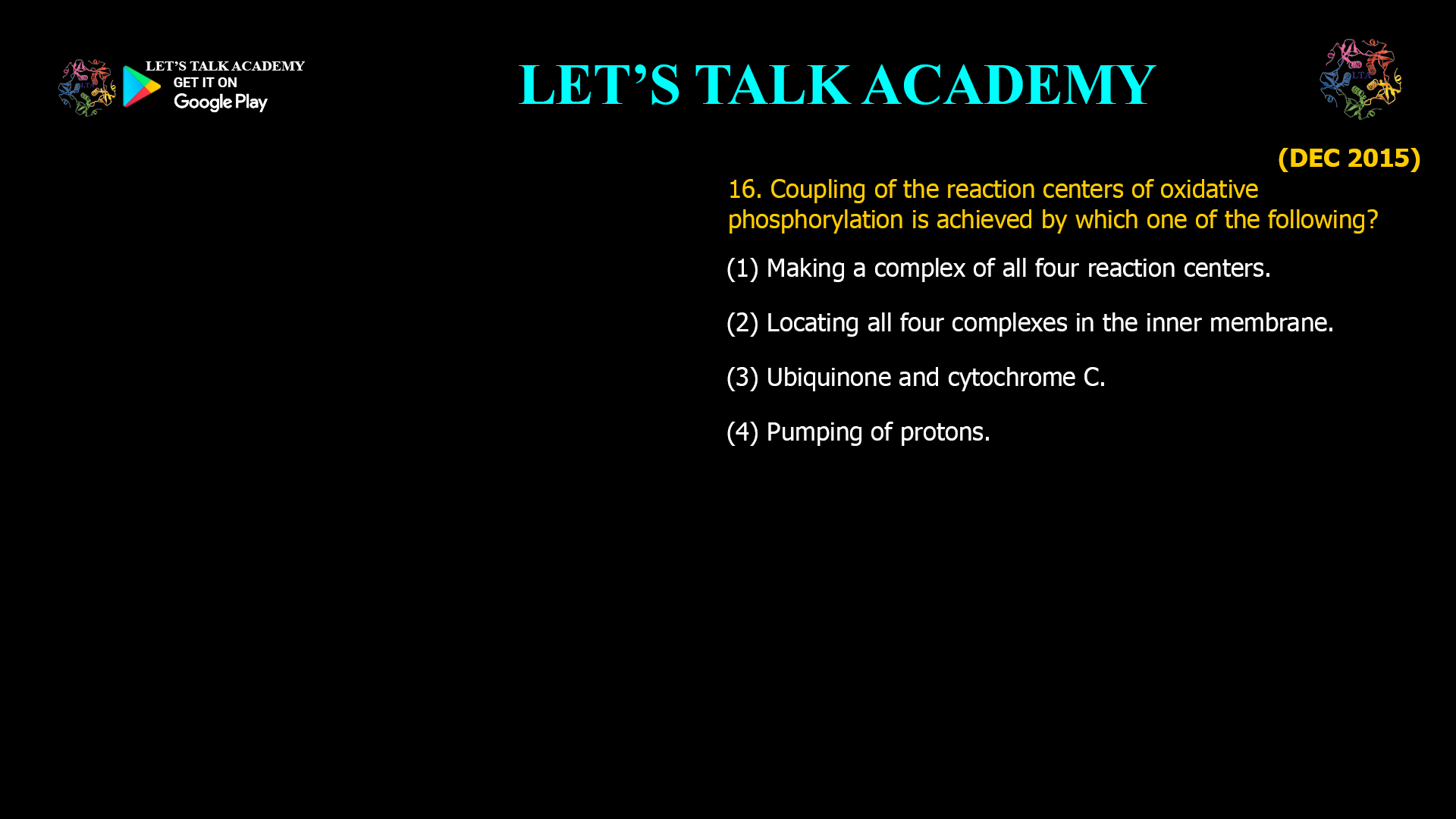
16. Coupling of the reaction centers of oxidative phosphorylation is achieved by which one of the following?
(1) Making a complex of all four reaction centers.
(2) Locating all four complexes in the inner membrane.
(3) Ubiquinone and cytochrome C.
(4) Pumping of protons.
Oxidative phosphorylation is the fundamental process by which cells convert energy from nutrients into ATP, the universal energy currency. This process involves two tightly coupled sets of reactions: electron transport through a series of complexes and the synthesis of ATP by ATP synthase. Understanding how these reactions are coupled is key to grasping cellular bioenergetics.
What Is Coupling in Oxidative Phosphorylation?
Coupling refers to the mechanism that links the energy-releasing electron transport reactions to the energy-requiring ATP synthesis. Without coupling, electron transport and ATP synthesis would occur independently, and energy would be lost as heat rather than stored in ATP.
The Four Complexes and Their Location
The electron transport chain (ETC) consists of four major protein complexes (Complexes I-IV) embedded in the mitochondrial inner membrane. Electrons flow from NADH and FADH2 through these complexes to oxygen, the terminal electron acceptor.
How Is Coupling Achieved?
The key to coupling is proton pumping:
-
As electrons pass through Complexes I, III, and IV, these complexes actively pump protons (H⁺ ions) from the mitochondrial matrix into the intermembrane space.
-
This proton translocation creates an electrochemical proton gradient across the inner membrane, known as the proton motive force (PMF).
-
The PMF stores potential energy in the form of a proton concentration gradient and an electrical potential difference.
-
ATP synthase (Complex V) harnesses this proton motive force by allowing protons to flow back into the matrix, using the energy released to phosphorylate ADP to ATP.
-
This process of using the proton gradient to drive ATP synthesis is called chemiosmosis.
Why Other Options Are Not the Primary Coupling Mechanism
| Option | Explanation | Correctness |
|---|---|---|
| (1) Making a complex of all four reaction centers | While complexes are located in the membrane, they do not form a single complex for coupling. | Incorrect |
| (2) Locating all four complexes in inner membrane | Location is necessary but not sufficient for coupling; coupling requires energy transduction. | Incorrect |
| (3) Ubiquinone and cytochrome C | These are mobile electron carriers, facilitating electron transfer but not coupling ATP synthesis. | Incorrect |
| (4) Pumping of protons | Proton pumping creates the proton motive force that couples electron transport to ATP synthesis. | Correct |
Supporting Explanation from Chemiosmotic Theory
Peter Mitchell’s chemiosmotic theory revolutionized understanding of oxidative phosphorylation by proposing that the energy from electron transport is conserved as a proton gradient across the inner mitochondrial membrane. This gradient then drives ATP synthesis.
The proton pumping by ETC complexes is the fundamental coupling mechanism that links the redox reactions to ATP production.
Summary
-
Coupling in oxidative phosphorylation is achieved by pumping protons across the inner mitochondrial membrane during electron transport.
-
This proton gradient (proton motive force) drives ATP synthesis by ATP synthase.
-
Electron carriers like ubiquinone and cytochrome c facilitate electron transfer but do not couple reactions.
-
The physical location of complexes is important but not the mechanism of coupling itself.
Final Answer:
(4) Pumping of protons


6 Comments
Pallavi Ghangas
September 23, 2025Pumping of protons
Kirti Agarwal
September 24, 2025Pumping of protons because these protons generate proton motiv force
That’s why ATP is synthase
Heena Mahlawat
September 25, 2025Pumping of protons
Roopal Sharma
September 25, 2025Pumping if protons.
Manisha choudhary
September 26, 2025Pumping of proton
Kajal
October 5, 2025Pumping of proton