















































































When an allele changes frequency not because it itself is under natural selection, but because it is near another gene that is undergoing a selective sweep and that is on […]

When an allele changes frequency not because it itself is under natural selection, but because it is near another gene that is undergoing a selective sweep and that is on […]

The phenomenon of the non-random association of alleles at different loci in a given population, where the frequency of association of their different alleles is higher or lower than what […]

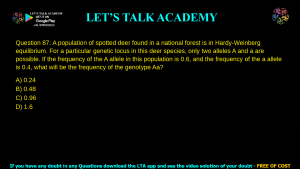
Fruit colour of wild Solanum nigrum is controlled by two alleles of a gene (A and a). The frequency of A, p=O.8 and a, q=O.2. In a neighbouring field a […]

Colour blindness affects approximately 1 in 12 men (8%). In a population that is in Hardy-Weinberg Equilibrium (HWE) where 8% of men are colour-blind due to a sex-linked recessive gene. […]

Sampling of 200 persons for their ABO blood group was done from an urban area. The types of blood group observed in the given population are as follows: A = […]

If a given gene in a randomly mating population has three alleles a, b and c in the ratio of 0.5, 0.2 and 0.3 respectively, what is the expected frequency […]

An autosomal recessive condition affects 1 newborn in 10,000 in a random mating population without any disruptive acting force. What is the approximate expected frequency of carriers in this population? […]
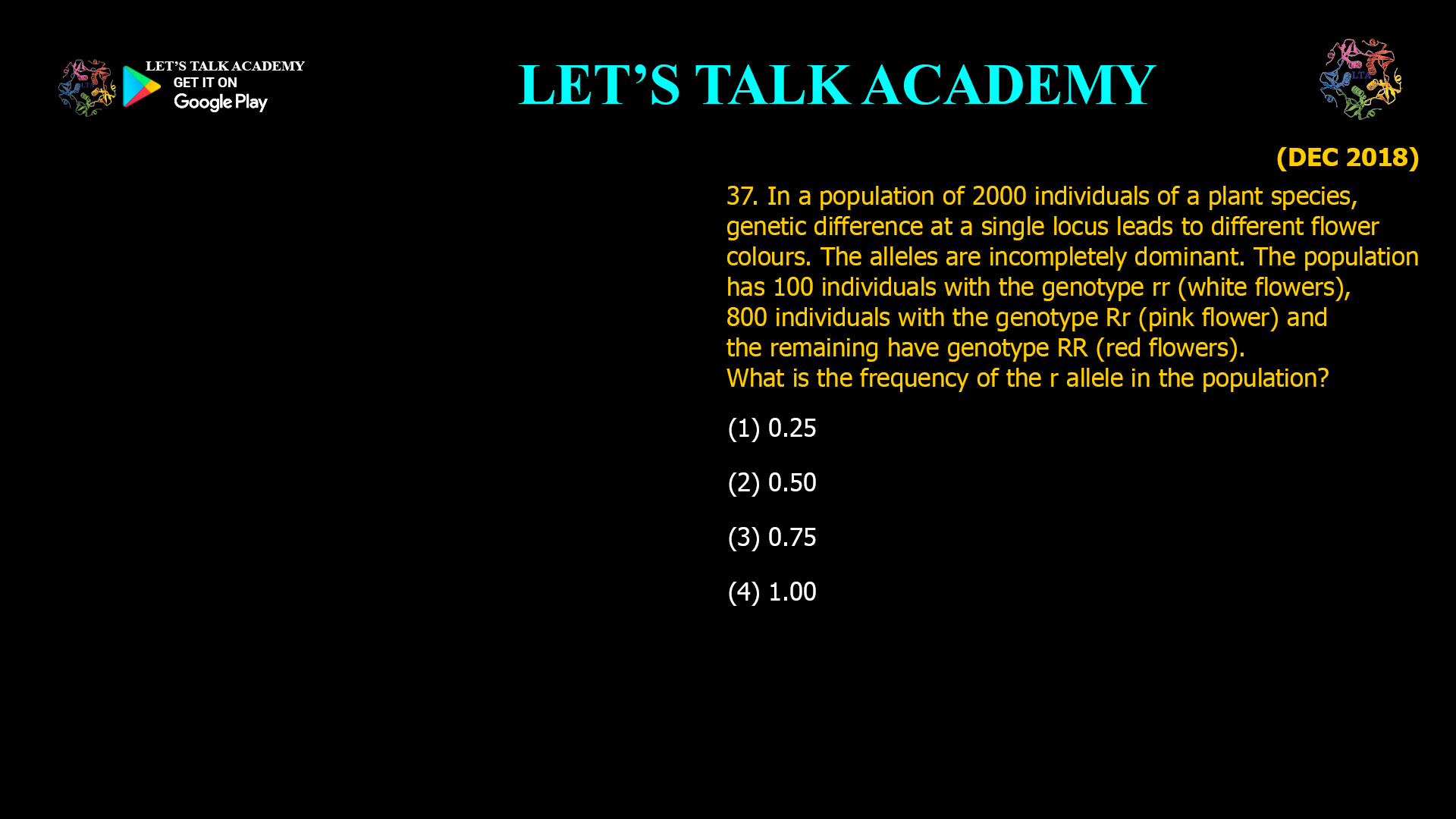
In a population of 2000 individuals of a plant species, genetic difference at a single locus leads to different flower colours. The alleles are incompletely dominant. The population has 100 […]
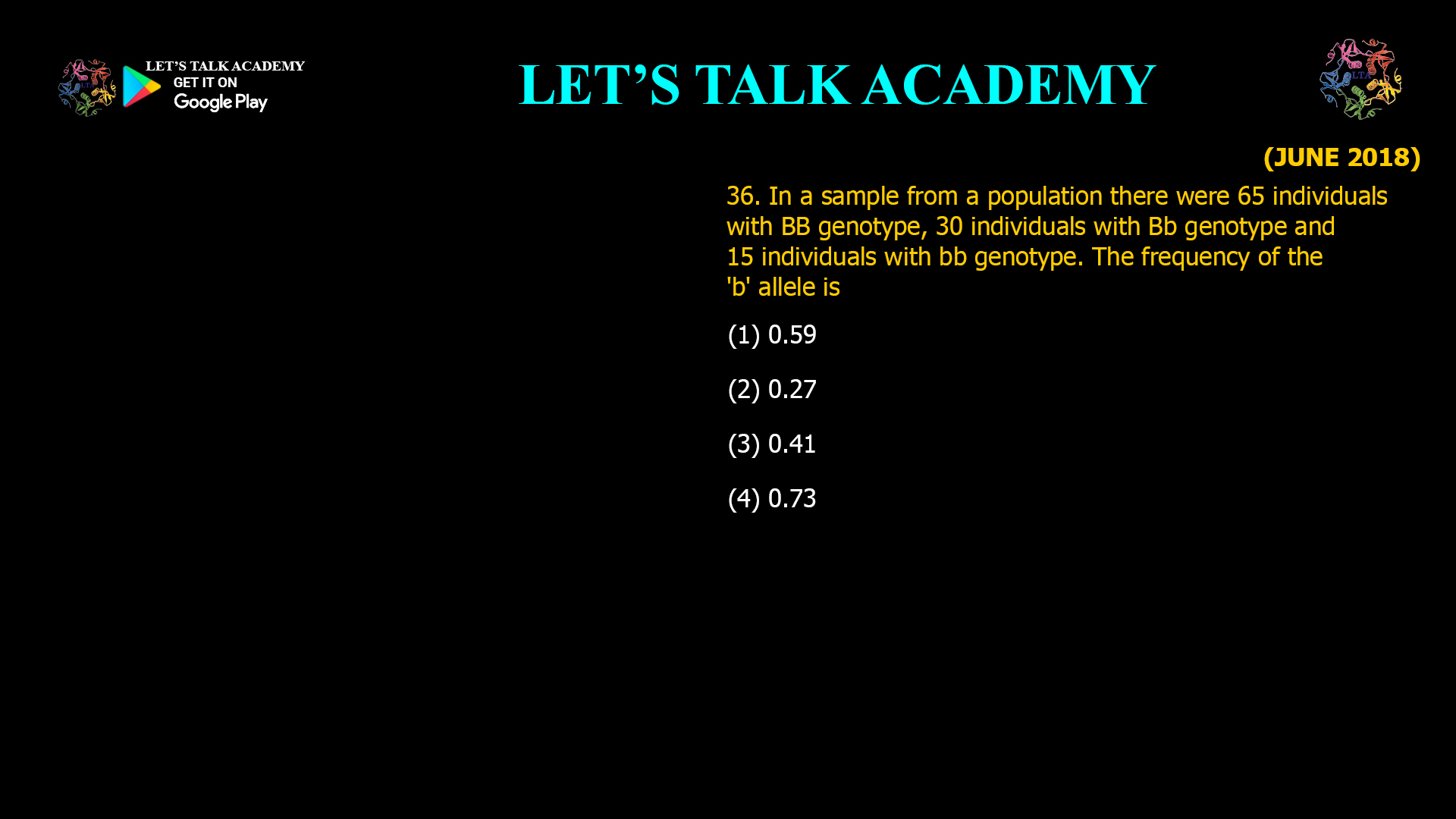
In a sample from a population there were 65 individuals with BB genotype, 30 individuals with Bb genotype and 15 individuals with bb genotype. The frequency of the ‘b’ allele […]
The frequency of homozygotes in a diploid population is 0.68. Assuming that the population is in Hardy- Weinberg equilibrium, the frequencies of the two alleles are (1) 0.1 and 0.9 […]


