














































































































The frequencies of two alleles p and q for a gene locus in a population at Hardy-Weinberg equilibrium are 0.3 and 0.7, respectively. After a few generations of inbreeding, the […]

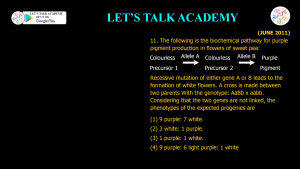
The frequencies of two alleles p and q for a gene locus in a population at Hardy-Weinberg equilibrium are 0.3 and 0.7, respectively. After a few generations of inbreeding, the […]
Which one of the following statements is INCORRECT? (1) Loss of genetic variation occurs within a small population due to genetic drift. (2) The number of deleterious alleles present in […]

Which one of the following will have the least impact on allele frequencies in small populations? (1) Inbreeding (2) Random mating (3) Genetic drift (4) Outbreeding Evolutionary Forces in […]

Which one of the following does NOT contribute to micro-evolutionary change? (1) Mutation (2) Random mating (3) Genetic drift (4) Natural selection Microevolution refers to small-scale changes in allele […]

Micro-evolution is the term used for changes in allele frequencies that occur over time. A) Within a population at species level B) within a community at genus level C) due […]

The inbreeding coefficient of offspring on marriage between brother and sister siblings will be (1) 0.5 (2) 0.05 (3) 0.25 (4) 0.75 What Is the Inbreeding Coefficient? The inbreeding […]

Small amount of lethal mutation always tend to remain in population is due to (1) Mutation-Selection balance (2) Frequency dependent selection (3) Positive selection (4) Negative selection Why Do […]

Which of the following DO NOT bring variation in population? (1) Random drift (2) Random matting (3) Mutation (4) Natural Selection Variation in a population is essential for […]

Transovarial transmission (TOT) is a widespread and efficient process through which pathogens of plants can be passed between generations of arthropod vectors. During evolution host plant will become (1) Resistance […]

In a population a single gene locus has two alleles ’A’ and ‘a’ with allele frequency of ‘a’= 0.3. If genotype ‘Aa’ is lethal and only individual with genotype ‘AA’ […]


