






















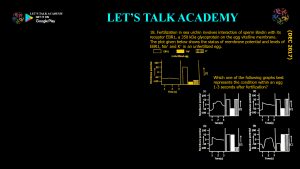



























































18. Fertilization in sea urchin involves interaction of sperm Bindin with its receptor EBR1, a 350 kDa glycoprotein on the egg vitelline membrane. The plot given below shows the status […]


18. Fertilization in sea urchin involves interaction of sperm Bindin with its receptor EBR1, a 350 kDa glycoprotein on the egg vitelline membrane. The plot given below shows the status […]

During early cleavage of Caenorabditis elegans embryos, each asymmetrical division produces one founder cell which produces differentiated descendants and one stem cell. The very first cell division produces one anterior […]

If the blastomeres of a 4 celled sea urchin embryo are isolated each blastomere can form a pluteus larvae. This is example of (1) Autonomous specification (2) Conditional specification (3) […]

Several marine organism release their gametes into the environment, where sperm attraction and subsequent events lead to successful fertilization. With reference to sea urchins, which one of the following statements […]

The fate of a cell or a tissue is specified when it is capable of differentiating autonomously on being placed in a neutral environment with respect to the developmental pathway. […]

Polyspermy results when two or more sperms fertilize an egg. It is usually lethal since it results in blastomeres with different numbers and types of chromosomes. Many species therefore, have […]

Given are certain facts which define ‘determination’ of a developing embryo. A. Cells have made a commitment to a differentiation program. B. A phase where specific biochemical actions occur in […]

15. For successful fertilization in sea urchin, interaction between the surface of the egg and acrosomal proteins, specifically a 30.5 kDa protein called bindin, is necessary. The following factors could […]

During development, if a cell has committed to a particular fate, it is said to be (1) pluripotent (2) totipotent (3) determined (4) differentiated During the development of multicellular organisms, […]

Following statements are made about fertilization occurring in sea urchins: A. Chemoattraction of the sperm to the egg is mediated by sperm activating peptides like bindin. B. Exocytosis of the […]


