
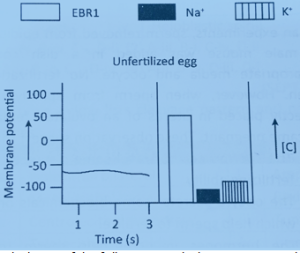
18. Fertilization in sea urchin involves interaction of sperm Bindin with its receptor EBR1, a 350 kDa glycoprotein on the egg vitelline membrane. The plot given below shows the status of membrane potential and levels of EBR1, Na+ and K+ in an unfertilized egg.18. Fertilization in sea urchin involves interaction of sperm Bindin with its receptor EBR1, a 350 kDa glycoprotein on the egg vitelline membrane. The plot given below shows the status of membrane potential and levels of EBR1, Na+ and K+ in an unfertilized egg.
Fertilization in sea urchins is a highly specific process involving interaction between the sperm protein Bindin and its receptor EBR1, a large 350 kDa glycoprotein located on the egg’s vitelline membrane. This interaction is vital for species-specific recognition and binding of sperm to the egg, ensuring successful fertilization.
Introduction
Sea urchin fertilization is a model system for studying gamete interaction due to its external fertilization and accessibility. Key to fertilization success is the molecular handshake between sperm Bindin protein and egg EBR1 receptor, which facilitates species-specific adhesion and initiates fusion of the gamete membranes.
Bindin in Sea Urchin Sperm
Bindin is a sperm acrosomal protein of about 30.5 kDa that becomes exposed on the sperm surface upon the acrosome reaction. Structurally, Bindin contains conserved peptides responsible for membrane perturbation and fusion, which may help the sperm penetrate the egg membrane after binding.
EBR1: The Egg Bindin Receptor
EBR1 is a large glycoprotein on the egg vitelline membrane characterized by multiple protein interaction domains including CUB and thrombospondin motifs. This receptor binds sperm Bindin in a species-specific manner, supporting selective fertilization among sea urchin species.
Membrane Potential and Ion Levels in Unfertilized Eggs
Before fertilization, the egg membrane maintains a resting potential typically around -70 mV. Ion concentrations, especially sodium (Na⁺) and potassium (K⁺), establish this resting membrane potential, critical for subsequent electrical responses upon sperm entry, including the fast block to polyspermy.
Sequence of Events Upon Fertilization
-
Exposure of Bindin on sperm following acrosome reaction.
-
Bindin binds specifically to EBR1 on the egg vitelline membrane.
-
Sperm-egg adhesion triggers membrane depolarization caused by sodium influx.
-
The fast electrical block to polyspermy alters membrane potential to prevent fusion with other sperms.
-
Sperm and egg membranes fuse, allowing sperm entry.
-
Calcium signaling triggers the slow block via cortical granule exocytosis.
Importance of Species-Specific Bindin-EBR1 Interaction
This interaction ensures reproductive isolation by allowing only sperm from the same species to successfully bind and fertilize the egg. Disruption of Bindin or EBR1 modifies fertilization competence without affecting embryo development, proving their critical roles are in gamete recognition.
Conclusion
The interaction between sperm Bindin and the egg EBR1 receptor is central to successful sea urchin fertilization. These molecular players govern the specificity and initiation of sperm-egg fusion, coupled with ionic membrane changes establishing blocks to polyspermy and starting embryogenesis.
This article outlines the molecular intricacies of Bindin-EBR1 interaction and membrane dynamics during sea urchin fertilization, an essential system in developmental biology.


6 Comments
Kirti Agarwal
November 9, 2025Graph 4
Soniya Shekhawat
November 9, 2025Graph 3rd is more correct bcz Na⁺ influx ↑, K⁺ efflux ↓, EBR1 ↓, membrane depolarized (+).
Priti khandal
November 10, 20253Rd graph
Kajal
November 10, 2025Option 4 is more correct
Ishika jain
November 10, 2025third option
Manisha choudhary
November 11, 20253rd option is correct answer