13. Konopka and Benzer isolated mutant fruit flies that had abnormal daily (circadian) rhythms. The graph below shows the number of fruitflies that eclose each hour of the day (eclosion […]
12. The monoamine serotonin is synthesized mainly by enterochromaffin cells in the intestine. A mouse was treated with broad range of antibiotics for a week. After a week, both the […]
11. The poison dart frog, or poison arrow frog in the family Dendrobatidae carry Batrachotoxin, among other agents. The toxin irreversibly binds to voltage-gated sodium channels and keeps them open. […]
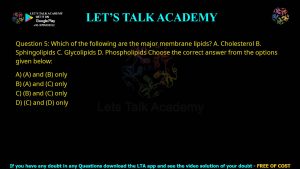
10. Which one of the following cannot form a bilayer by itself? a. Glycerophospholipids b. Cholesterol c. Phosphatidic acid d. Glycerolipids Cholesterol cannot form a bilayer by itself. This makes it […]
9. Human red blood cells (RBCs) cannot be grown in cultures because a. RBCs require a steady oxygen supply b. RBCs are extremely fragile c. RBCs are terminally differentiated cells […]
8. Galvani discovered in the 1700s that frog’s legs jerked when touched with a piece of copper and a piece of iron, simultaneously. This happens because action potentials are triggered […]
7. Of the graphs shown below, which is most representative of the kinetics of ion transport through a membrane channel? a. Graph (A) b. Graph (B) c. Graph (C) d. […]
6. In an experiment, two fly populations are separately maintained for many generations. Population A contains closely-related individuals. Population B contains a set of unrelated individuals. Over many generations it […]
5. How would you test whether a phenotypic difference between two populations of a plant is due to environmentally induced plasticity or evolutionary adaptation? a. DNA sequencing b. RNA sequencing […]
4. A geneticist crossed two pure-bred (homozygous) tall and short plants. In the F1 generation she observed that all the offspring were of intermediate height. If she crosses one of […]