









































































































Q.61. Match the following alkaloids with their uses and source plants in CORRECT combination Alkaloid […]

Q.61. Match the following alkaloids with their uses and source plants in CORRECT combination Alkaloid […]

Q.60. Select the CORRECT combination by matching the disease, causal organism and the affected plant. Disease P. Stem rust Q. Wart disease R. Tikka/leaf spot S. Downey mildew Causal organism […]

Q.59. Match the plant part (Group I) with the product obtained (Group II) and the representative plant species (Group III) in CORRECT combination Group I P. Bark Q. Leaf R. […]

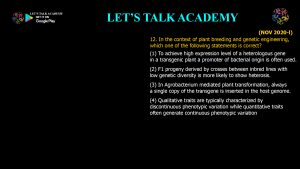
Q.58. In relation to Agrobacterium mediated genetic engineering in plants, match the following in CORRECT combination Gene name P. virA Q. virB R. virD1 S. vir 𝐺 Function i. Acetosyringone […]

Q.57. Match the following in CORRECT combination between Group I and Group II with reference to the agents that interfere with oxidative phosphorylation Group I P. Cyanide Q. Antimycin A […]

Q.56. Group I, Group II and Group III represent enzyme, product of the enzymatic reaction, and metabolic process, respectively. Group I P. Hexokinase Q. Fumarase R. PEP Carboxylase S. Glycolate […]

Q.55. An mRNA of a nuclear encoded plant gene, DSH 20 has an ORF of 1353 nucleotides. Provided that average molecular weight of amino acid is 110 Dalton (Da), calculated […]

Q.54. Which of the following chemicals is used for doubling of chromosome numbers during production of ‘doubled haploids’ in crop plants? (A) Hygromycin (B) Kanamycin (C) Colchicine (D) Glufosinate Colchicine […]

Q.53. ‘Bakanae’ disease or ‘foolish seedling’ disease is caused by (A) Fungus (B) Bacterium (C) Virus (D) Mycoplasma Here’s a SEO-friendly article on the Bakanae disease question, optimized for educational […]

Q.52. The oleo-gum resin asafoetida (hing) is obtained from the cut surface of (A) Stem (B) Root (C) Leaf (D) Fruit Asafoetida, commonly known as hing, is a pungent oleo-gum […]


