






















































Q.101. Which ONE of the following graphs represents the relationship between ventricular enddiastolic volume and cardiac output in a healthy adult individual at rest (solid line) and upon exercise (dotted […]

Q.101. Which ONE of the following graphs represents the relationship between ventricular enddiastolic volume and cardiac output in a healthy adult individual at rest (solid line) and upon exercise (dotted […]

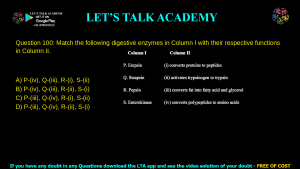
Q.100. Match the following digestive enzymes in Column I with their respective functions in Column II. Column I P. Erepsin R. Pepsin Q. Steapsin S. Enterokinase Column II (i) converts […]

Q.99. Match the following components listed in Column I with their respective organs in Column II Column I P. Endolymph Q. Vitreous humour R. Vas deferens S. Corpus luteum Column […]

Q.98. Match the following genetic disorders in Column I with associated typical chromosomal changes mentioned in Column II Column I P. Klinefelter syndrome Q. Down syndrome R. Turner syndrome S. […]

Q.97. Match the following subcellular organelles in Column I with associated functions in Column II Column I P. Nucleolus Q. Peroxisomes R. Endoplasmic reticulum S. Golgi bodies Column II (i) […]

Q.96. Tarantulas and mosquitoes both belong to the phylum Arthropoda. Which ONE of the following represents the correct number of legs in them respectively? (A) 6 and 6 (B) 6 […]

Q.95. Which ONE of the following glial cells is NOT derived from the ectoderm? (A) Astrocytes (B) Microglial cells (C) Oligodendrocytes (D) Ependyma Microglial cells are the glial cells not […]

Q.94. Which ONE of the following phyla have choanocytes? (A) Ctenophora (B) Nematoda (C) Cnidaria (D) Porifera Choanocytes, also known as collar cells, are specialized flagellated cells unique to the […]

Q.93. “Round dance” is performed by forager bees to indicate the distance between a food source and their colony. Which ONE of the following best represents this distance? (A) 45 […]

Q.92. The genomes of both human and Drosophila code for an amylase that acts on the same substrate. However, the sequence of nucleotides in the genes encoding the two is […]


