















































Q.39 β-oxidation of a 16 carbon fatty acid and a 17 carbon fatty acid leads to formation of (A) (8 Acetyl CoA) and (8 Acetyl CoA + CO2), respectively (B) (5 […]


Q.39 β-oxidation of a 16 carbon fatty acid and a 17 carbon fatty acid leads to formation of (A) (8 Acetyl CoA) and (8 Acetyl CoA + CO2), respectively (B) (5 […]

Q.38 The CORRECT pair of amino-acid sequence and the corresponding target organelle is (A) KDEL – Golgi (B) K-K/R-X-K/R – Lysosome (C) SKL – Peroxisome (D) NPVY – Endoplasmic reticulum […]

Q.36 An amino-acid has one proton donating group in the side chain (R). The pKCOOH, pKNH2 and pKR values for this amino-acid are 2.19, 9.67 and 4.25, respectively. Which one of […]

Q.37 Which one of the following bacterial toxins does NOT have ADP-ribosyl transferase activity? (A) Pertussis toxin (B) Diphtheria toxin (C) Pseudomonas Exotoxin A (D) S. aureus α-toxin The correct answer […]

Q.35 The membrane of mature B cells have (A) both IgG and IgM (B) both IgG and IgD (C) both IgM and IgE (D) both IgM and IgD Mature B cells […]

Q.34 Leguminous plants maintain a very low concentration of free oxygen in their root nodules because (A) the nitrogen fixing bacteria living in the root nodules are anaerobic (B) of binding […]

Q.33 Upon stimulation of a eukaryotic cell, the intracellular calcium (Ca2+) is released from (A) Endoplasmic reticulum (B) Nucleus (C) Peroxisome (D) Mitochondria The correct answer to Q.33 is (A) Endoplasmic reticulum, […]

Q.32 Match the hormones in Group I with their metabolic precursor in Group II Group I 17-β estradiol Thromboxane A2 Epinephrine Retinoic acid Group II Arachidonic acid Tyrosine β-carotene Cholesterol (A) […]

Q.31 The pair of amino-acids which does NOT undergo post-translational modification is (A) Asn-His (B) Tyr-Ser (C) Asn-Ser (D) Ala-Gly The correct answer to Q.31 is (D) Ala-Gly, as alanine and […]

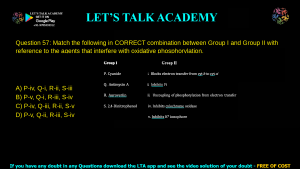
Q.30 Which one of the following compounds does NOT block electron transport? (A) Cyanide (B) Rotenone (C) Oligomycin (D) Antimycin A Oligomycin inhibits ATP synthase but allows electron transport to […]


