














































































49. Liquid chromatography is a technique for separating: A. Ions that are not dissolved in a solvent B. Ions that are dissolved in a solvent C. Ions that are dissolved […]

49. Liquid chromatography is a technique for separating: A. Ions that are not dissolved in a solvent B. Ions that are dissolved in a solvent C. Ions that are dissolved […]
48. Which of the following is not stationary phase? A. Liquid-liquid chromatography B. Gas-liquid chromatography C. Gas-solid chromatography D. Solid-solid chromatography Correct Answer: D. Solid-solid chromatography “Solid-solid chromatography” is not […]
47. There is no need of support if packed into a column when the stationary phase is: A. Gas B. Liquid C. Solid D. None of the above Correct Answer: […]
46. Chromatography involves two mutually: A. Immiscible phases B. Miscible phases C. Soluble phases D. None of the above Correct Answer: A. Immiscible phases Chromatography requires two phases that do […]
45. Chromatography is the process for identification, purification and separation of components of a mixture on the basis of: A. Difference in their boiling point B. Difference in their melting […]
44. In reversed-phase HPLC: A. A hydrophilic stationary phase is combined with a non-polar mobile phase B. A hydrophobic stationary phase is combined with a polar mobile phase C. A […]
43. In anion exchange chromatography, A. The column contains negatively charged beads where positively charged proteins bind B. The column contains positively charged beads where negatively charged proteins bind C. […]
42. The use of insulin hormone to purify its receptor is an example of (A) Ion exchange chromatography (B) Affinity chromatography (C) Gel filtration chromatography (D) Ligand mediated chromatography Answer: […]
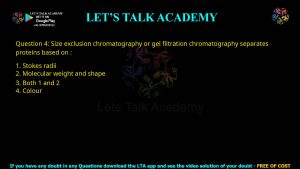
41. In gel filtration chromatography, separation of proteins are based on their (A) Size and net charge (B) Size and shape (C) Size and specific affinity (D) Shape and net […]
40. In which of the following separation method where proteins are separated on the basis of their net charge (A) Affinity chromatography (B) Ion exchange chromatography (C) Dialysis (D) Gel […]


