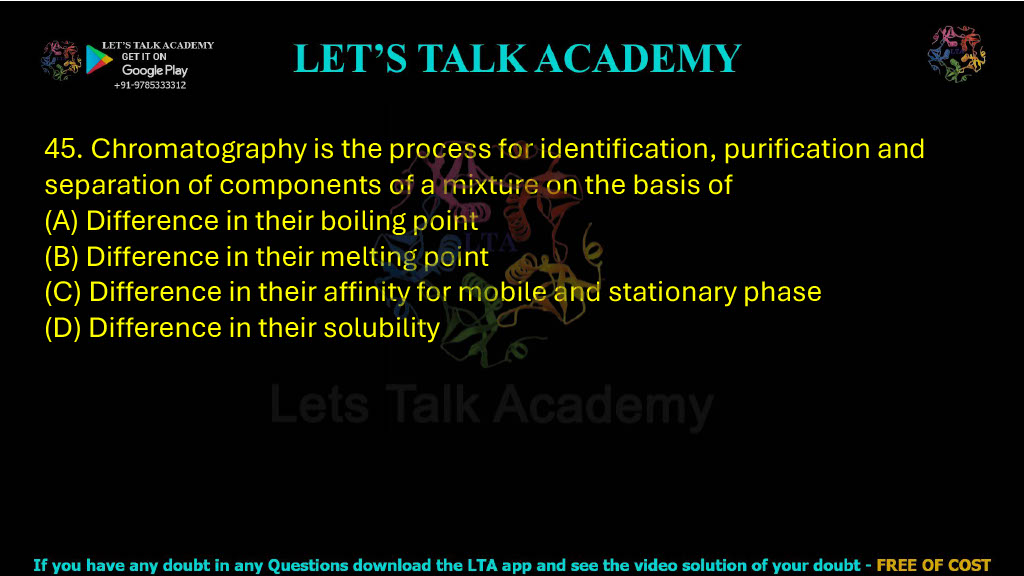
45. Chromatography is the process for identification, purification and separation of components of a mixture on the basis of:
A. Difference in their boiling point
B. Difference in their melting point
C. Difference in their affinity for mobile and stationary phase
D. Difference in their solubility
Correct Answer: C. Difference in their affinity for mobile and stationary phase
Chromatography separates mixture components based on how differently they interact with the mobile phase (moving solvent) and stationary phase (fixed material).
Option Analysis
A. Difference in their boiling point
Boiling point governs distillation, where vapor pressure differences allow separation by heating and condensing vapors. This does not apply to chromatography, which operates at ambient or controlled temperatures without relying on phase changes to gas.
B. Difference in their melting point
Melting point differences are used in fractional crystallization or solidification processes. Chromatography avoids such thermal transitions, focusing instead on selective retention in phases.
C. Difference in their affinity for mobile and stationary phase (Correct)
Components partition unevenly: some bind strongly to the stationary phase (slow elution), others favor the mobile phase (fast elution). This differential affinity enables identification, purification, and separation.
D. Difference in their solubility
Solubility alone drives extraction or precipitation but is too broad for chromatography, where specific phase interactions (adsorption, partition, ion exchange) dictate resolution.
Chromatography separation relies on the difference in affinity for mobile and stationary phase to identify, purify, and separate mixture components effectively. This core principle powers techniques vital for biochemistry, molecular biology, and competitive exams like GATE Life Sciences.
How Chromatography Works
In chromatography, a sample dissolves in the mobile phase, which flows over the stationary phase. Components with higher stationary phase affinity move slower, while those preferring the mobile phase elute faster, creating distinct bands or peaks. This outperforms crude methods like boiling or melting distinctions.
Why Not Other Properties?
-
Boiling/melting points suit thermal separations (distillation/crystallization).
-
Solubility aids basic partitioning but lacks phase-specific resolution.
Only affinity differences ensure precise, repeatable separations in diverse fields like protein purification.
Applications in Life Sciences
Used in GATE-relevant topics like genetics and microbiology for analyzing biomolecules. Examples include HPLC for drug purity and gel filtration for molecular weight sorting.


2 Comments
Vanshika Sharma
February 3, 2026Correct answer is C
Kanica Sunwalka
June 26, 2026difference in their affinity for mobile and stationary phase