


















































































































4. A microscope can distinguish two closely situated points and the distance between those points is known as the ______ of the microscope. A. Magnification B. Illumination C. Resolving power […]
Author: admin

CSIR NET Life Science Previous Year Questions and Solution on EXTENSION OF MENDELIAN PRINCIPLES (62)
CSIR NET Life Science Previous Year Questions on METHODS IN BIOLOGY – Video and Text Solutions
Actual Size of Object at 1000x Magnification
3. What would be the actual size of an object that appears as 2 µm when it is magnified 1000 times? A. 2 nm B. 20 nm C. 2 mm D. 20 µm Correct […]
CSIR NET Life Science Previous Year Questions on METHODS IN BIOLOGY – Video and Text Solutions
Function of Scanning Electron Microscopy
2. Function of scanning electron microscopy (SEM) is: A. To create a sense of depth B. To examine internal cellular structure C. To observe living specimens D. Both A and […]
CSIR NET Life Science Previous Year Questions on METHODS IN BIOLOGY – Video and Text Solutions
Electron Microscope Higher Magnification Wavelength Reason
1. Why does an electron microscope give higher magnifications than an optical microscope? A. Because the electrons have more energy than light particles B. Because the velocity of electrons is […]
CSIR NET Life Science Previous Year Questions on METHODS IN BIOLOGY – Video and Text Solutions
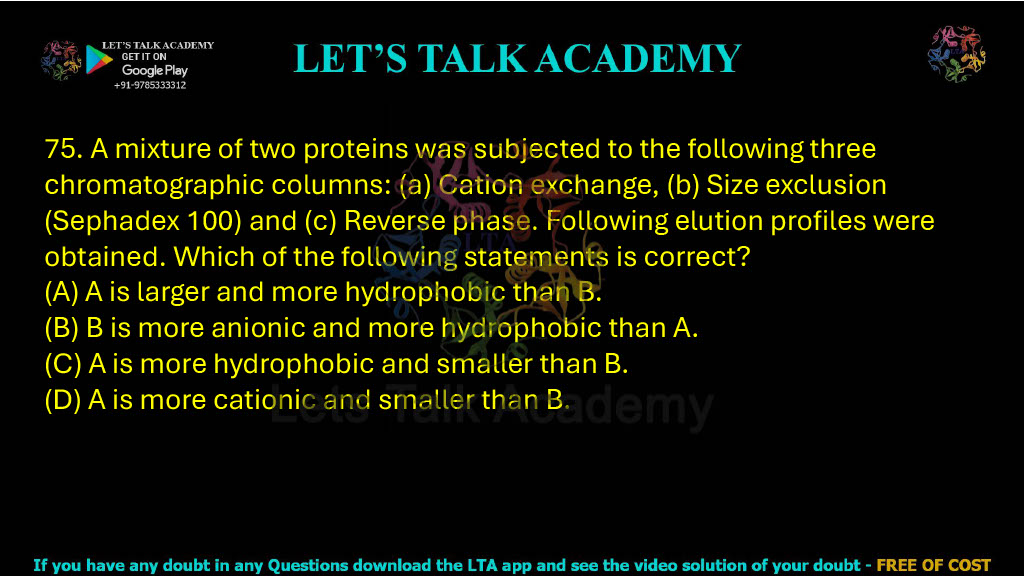
Protein Mixture Cation Exchange
75. A mixture of two proteins was subjected to following three chromatographic columns: (a) Cation exchange, (b) Size exclusion (Sephadex 100) and (c) Reverse phase. Following elution profiles were obtained. […]
CSIR NET Life Science Previous Year Questions on METHODS IN BIOLOGY – Video and Text Solutions
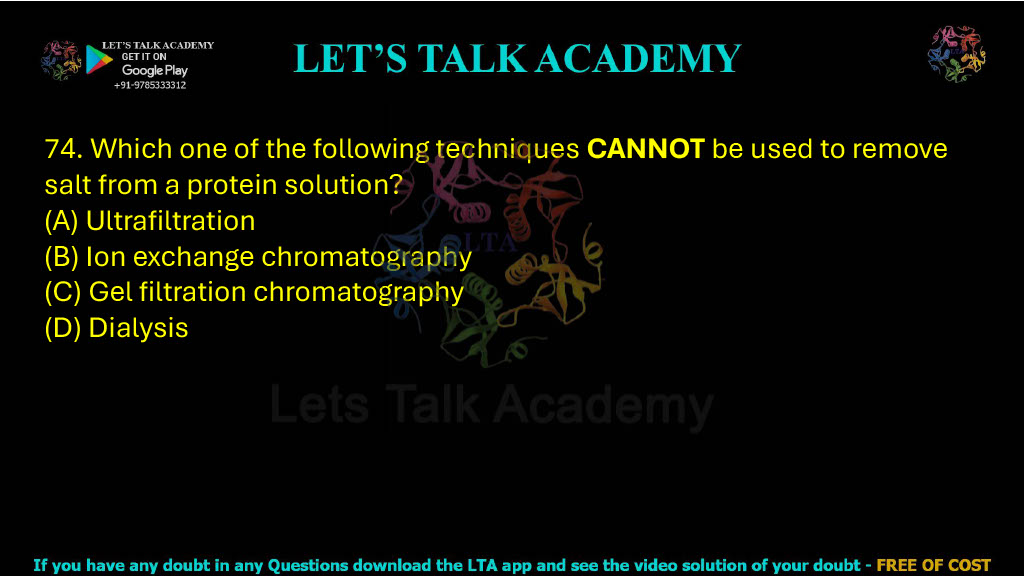
Ultrafiltration Cannot Remove Salt Protein Solution
74. Which one of the following techniques CANNOT be used to remove salt from a protein solution (A) Ultrafiltration (B) Ion exchange chromatography (C) Gel filtration chromatography (D) Dialysis The […]
CSIR NET Life Science Previous Year Questions on METHODS IN BIOLOGY – Video and Text Solutions
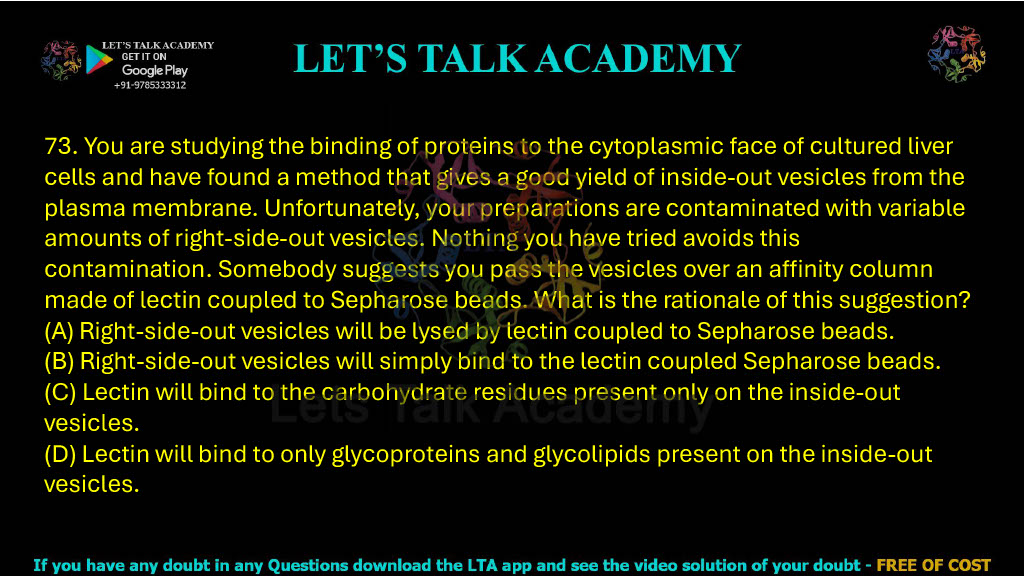
Lectin Sepharose Right-Side-Out Vesicles
73. You are studying the binding of proteins to the cytoplasmic face of cultured liver cells and have found a method that gives a good yield of inside-out vesicles from […]

CSIR NET Life Science Previous Year Questions on METHODS IN BIOLOGY – Video and Text Solutions
DEAE-Sephadex Chromatofocusing Phenyl Sepharose
72. Match the chromatographic technique from Group X with the appropriate elution conditions given in Group Y: Group X A. DEAE-Sephadex B. Chromatofocusing C. Phenyl Sepharose D. G-150 Sephadex Group […]
CSIR NET Life Science Previous Year Questions on METHODS IN BIOLOGY – Video and Text Solutions
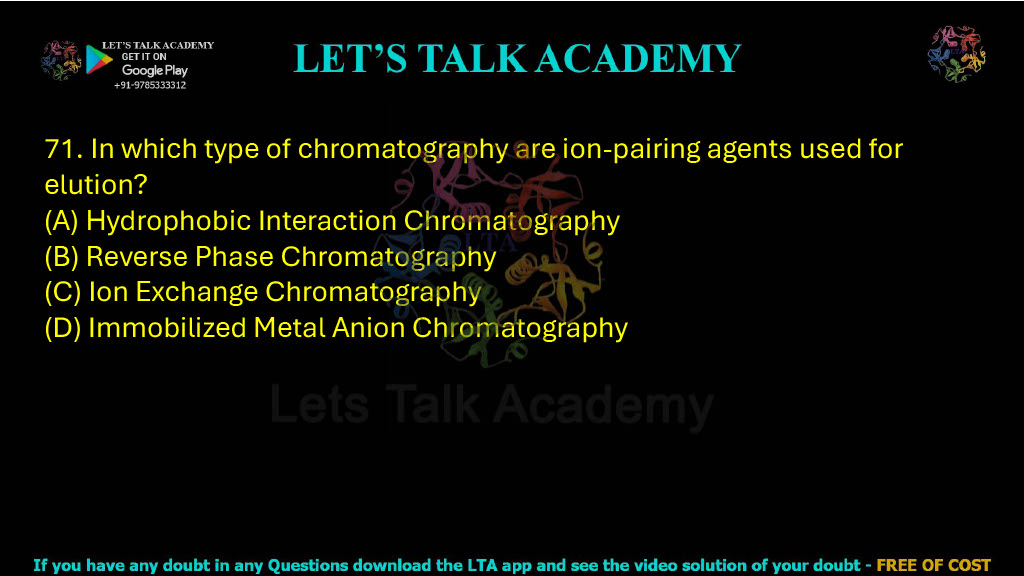
Ion-Pairing Agents Reverse Phase Chromatography
71. In which type of chromatography are ion-pairing agents used for elution? A. Hydrophobic interaction chromatography B. Reverse phase chromatography C. Ion exchange chromatography D. Immobilized metal anion chromatography Reverse […]
CSIR NET Life Science Previous Year Questions on METHODS IN BIOLOGY – Video and Text Solutions
Nickel Nitrilotriacetic Acid Columns
70. Nickel nitrilotriacetic acid columns are used in __________ chromatography. A. Ion exchange B. Affinity C. Size exclusion D. Reverse phase The correct answer is B. Affinity. Nickel nitrilotriacetic acid […]


