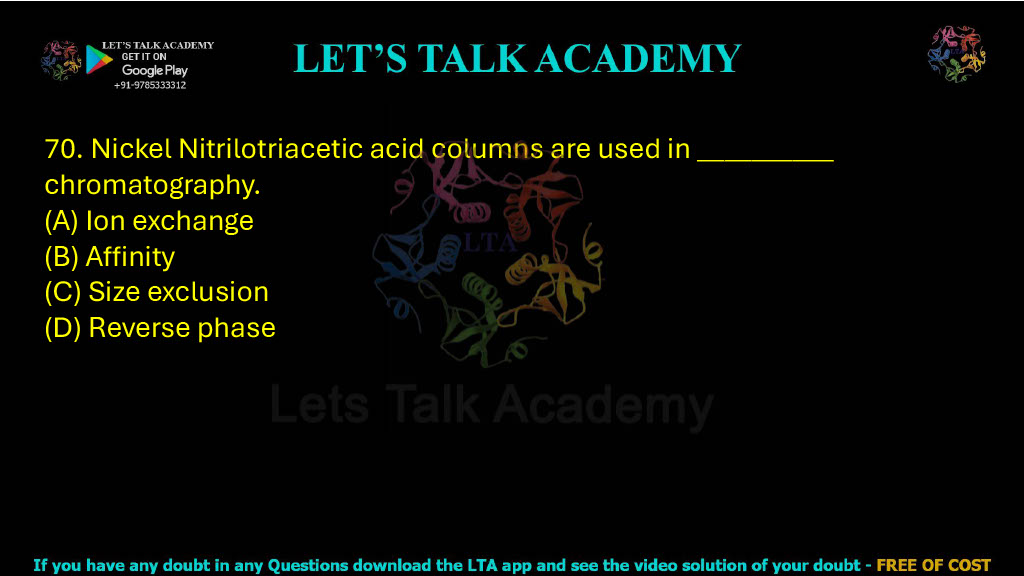
70. Nickel nitrilotriacetic acid columns are used in __________ chromatography.
A. Ion exchange
B. Affinity
C. Size exclusion
D. Reverse phase
The correct answer is B. Affinity.
Nickel nitrilotriacetic acid (Ni-NTA) columns enable immobilized metal affinity chromatography (IMAC) by chelating Ni²⁺ ions, which specifically bind histidine-tagged proteins for purification.
Option Explanations
A. Ion exchange separates by charge interactions with oppositely charged resins; Ni-NTA relies on metal coordination, not electrostatic forces.
B. Affinity uses biospecific interactions—Ni-NTA’s histidine-nickel binding (Kd ~10⁻¹³ M) captures His-tagged proteins selectively from mixtures.
C. Size exclusion (gel filtration) separates by molecular size via porous beads; Ni-NTA involves binding/elution, not size exclusion.
D. Reverse phase uses hydrophobic interactions with nonpolar stationary phases; Ni-NTA is hydrophilic metal chelation.
Ni-NTA in Protein Purification
Nickel nitrilotriacetic acid columns affinity chromatography revolutionized recombinant protein isolation since the 1980s. NTA chelates Ni²⁺ with four coordination sites, leaving two open for His-tag binding (6xHis), enabling one-step purification from cell lysates.
Ni-NTA Binding Mechanism
NTA (quadentate ligand) stabilizes Ni²⁺ on agarose beads. His imidazole nitrogens coordinate the remaining sites; binding occurs at pH 7-8. Elution uses imidazole gradient (50-500 mM) or low pH, yielding >95% pure protein.
Chromatography Type Comparison
| Type | Principle | Ni-NTA Match? | Key Feature |
|---|---|---|---|
| Ion Exchange | Charge | No | DEAE/CM resins |
| Affinity | Specific binding | Yes | His-Ni coordination |
| Size Exclusion | Molecular size | No | Sephadex pores |
| Reverse Phase | Hydrophobicity | No | C18 columns |
GATE Life Sciences Relevance
This PYQ distinguishes IMAC from other techniques. Ni-NTA capacity: 5-10 mg His-protein/ml resin; regeneration with EDTA. Essential for biotech/biochem sections.


1 Comment
Kanica Sunwalka
June 26, 2026AFFINITY chr.